

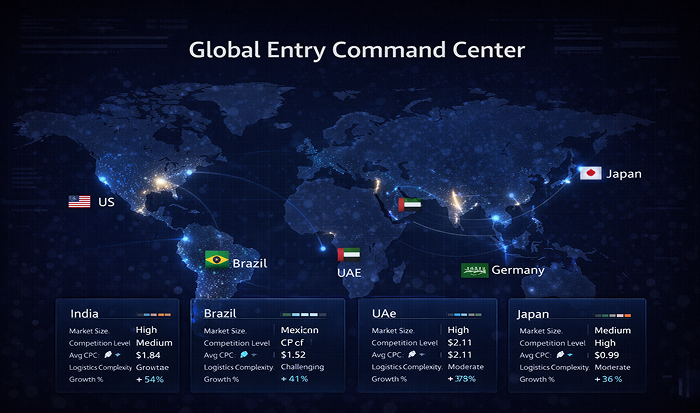
Introduction — International expansion is now a seller growth lever, not a “nice-to-have.”
In 2025–26, “going global” isn’t only for large brands—Amazon has made it increasingly structured for everyday sellers through regional accounts, cross-listing tools, and service-provider ecosystems that reduce friction.
If the domestic marketplace feels saturated, Amazon International Expansion can be the cleanest way to find new demand without reinventing your entire product line.
This research-style report breaks down an Amazon Global Selling Strategy for market entry, using a practical lens: where to start, what changes by country, and how to reduce risk in Amazon Cross Border Ecommerce.

Methodology — How this market entry analysis was built
This report blends Amazon’s official Global Selling guidance with operational realities sellers face when they try to sell internationally on Amazon.
Instead of treating global expansion as one big leap, the analysis breaks it into repeatable decisions: account structure, marketplace selection, localization, compliance, and fulfillment.
Inputs used
- Amazon Global Selling overview on how the program works (accounts, regions, requirements, fulfillment, and automation).
- Amazon guidance on regional coverage (Americas unified account, Europe account reach, and country-specific accounts in APAC and MENA).
- Cross-listing automation via Build International Listings (BIL), including offer creation and price synchronization rules.
- Fee structure notes for linked accounts (monthly fee logic and how it is capped when accounts are linked).
What “market entry” means here
Market entry is defined as the moment a seller can reliably:
- List compliant products in a target store.
- Fulfill orders with predictable delivery promises.
- Maintain profitable unit economics after fees, taxes, shipping, and returns.
Step 1 — Choose the right entry path (the account decision most sellers overlook)

Before product research and keywords, international expansion starts with understanding Amazon’s account structure—because it influences how fast you can launch, how you manage inventory, and how many dashboards you’ll juggle.
The three account “routes” Amazon emphasizes
- Americas route: Create a North America and Brazil unified selling account to reach the US, Canada, Mexico, and Brazil.
- Europe route: Create a Europe account to reach customers across Europe (Amazon positions Europe as a regional account approach).
- APAC & MENA route: Use country-specific accounts for markets like Australia, India, Japan, Singapore, UAE, Saudi Arabia, and Egypt.
What this means in practice
If your goal is speed, the simplest expansion is often into a region that’s operationally “closest” to your current setup (similar customer expectations, shipping lanes, and language).
If your goal is diversification, spreading across regions can reduce seasonality impact—Amazon explicitly positions global selling as a way to diversify sales cycles across countries.
Step 2 — Market selection framework (how to pick countries like a strategist)
Choosing where to sell internationally on Amazon should be a scoring exercise, not a gut call.
A strong Amazon Global Selling Strategy usually balances one “high volume” marketplace with one “fast growth” marketplace, so you’re not betting everything on a single demand curve.
The 6-factor market entry scorecard
Use these criteria to shortlist the best target marketplaces:
- Demand depth (traffic + category velocity).
- Competition intensity (review moats, brand dominance, CPC pressure).
- Compliance complexity (regulated categories, labeling, claims).
- Fulfillment feasibility (FBA availability, shipping lanes, storage constraints).
- Localization load (language, sizing, cultural preferences).
- Unit economics (fees + shipping + taxes + returns).
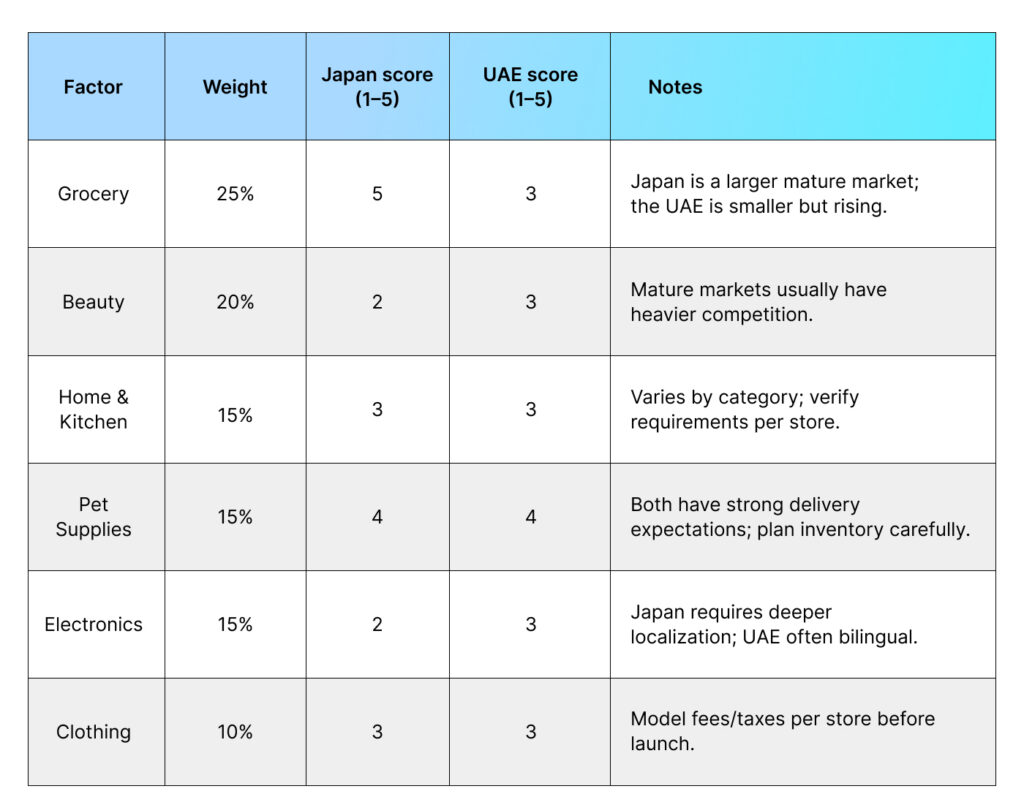
Market entry sample scoring template (illustrative only)
This is a seller-friendly structure for comparing countries before launch.
Step 3 — Listing expansion: cross-listing tools vs true localization
A common international mistake is “copy-paste expansion”—pushing the same listing into a new country and hoping the algorithm figures it out.
Amazon does offer automation to scale offers across stores, but sellers still need to manage what automation can’t fix: compliance, language nuance, and customer expectations.
Build International Listings (BIL): what it does well
Amazon’s Build International Listings tool is designed to help create and update offers from a single source marketplace to one or more target marketplaces, saving time by managing offers in one place.
It can automate tasks like creating offers in target marketplaces when matching ASINs exist, and it can synchronize eligible offers and prices based on settings and currency exchange rates.
BIL works within a region (like Europe or North America) and can work across regions when accounts are linked.
What BIL doesn’t solve (where sellers still win or lose)
- Localization of copy to match local intent, not just direct translation.
- Local compliance and category-specific documentation.
- Reviews and trust-building in a market where your brand is unknown.
Step 4 — Compliance and taxes: the “hidden workload” of Amazon Cross Border Selling
International expansion becomes expensive when sellers treat compliance as an afterthought.
Amazon explicitly advises sellers to complete requirements for taxes, regulations, compliance, safety, and listing before launching products in each country.
The practical takeaway is simple: compliance is a launch prerequisite, not a post-launch cleanup step.
Bullet checklist — pre-launch compliance basics
- Confirm category eligibility and restricted product rules in the target store.
- Verify labeling and claims requirements (especially for ingestibles, cosmetics, baby, and electronics).
- Plan tax registration and filing approach before inventory lands (using expert help if needed).
- Build a document folder per marketplace so you can respond fast if Amazon requests proof.
Step 5 — Fulfillment design: your delivery promise is part of your conversion rate
In Amazon Cross Border Ecommerce, fulfillment is not just “operations”—it’s a ranking and conversion input because it affects customer experience, delivery speed, and returns.
Amazon’s Global Selling flow includes a dedicated step to “ship inventory and fulfill customer orders,” and it frames global expansion as something you can streamline using supply chain solutions and vetted shipping providers.
That’s Amazon saying (politely) that logistics is the business model, not a back-office detail.
Three fulfillment models (and when each makes sense)
- FBA in-country: Highest conversion potential, more predictable delivery, but requires upfront inventory planning.
- FBM cross-border: Lower upfront inventory risk, but delivery times can hurt conversion and increase customer service load.
- Hybrid: FBA for hero SKUs, FBM for long-tail or seasonal SKUs until demand is proven.
Step 6 — Costs and fees: how to avoid “international revenue that isn’t profit”
A seller can win traffic and still lose money internationally if fees and subscriptions aren’t modeled correctly.
Amazon notes that selling plan fees can vary by store, and it explains that if you link global selling accounts, the monthly fee can be capped at the equivalent of USD 39.99 per month (or the sum of fees for active listings—whichever is lower).
Referral fees still vary by category, which means your best domestic category is not automatically your best international category.
Bullet checklist — the minimum numbers to model before launch
- Landed unit cost (COGS + packaging + inbound shipping).
- Amazon referral fee and fulfillment cost assumptions by store/category.
- Returns rate expectation (higher in some categories and sizing-driven segments).
- VAT/GST or other local taxes and whether you’ll include tax in pricing.
- Currency risk buffer (especially if you price in local currency but buy inventory in another).
Market entry playbooks — 3 realistic ways sellers expand internationally
Most sellers don’t fail internationally because of product quality—they fail because they choose an entry style that doesn’t match their cash flow and operational maturity.
Here are three playbooks that align well with Amazon’s “simplify global expansion” approach (cross-listing, supply chain tools, and account linking).
Playbook A — “Neighbor expansion” (lowest friction)
This approach expands first to the closest operational region (for example, expanding within the Americas via the unified account structure).
It’s usually the fastest path to incremental growth because logistics and customer expectations are more familiar.
Playbook B — “Scale + growth barbell” (balanced)
Pick one proven high-demand marketplace for stability and one faster-developing marketplace for upside, then use cross-listing tools where possible to reduce workload.
The point is to protect cash flow while still capturing early-mover advantages.
Playbook C — “Test, then commit” (risk-controlled)
Start with FBM or limited FBA quantities, validate conversion rate and returns behavior, then scale inventory once unit economics are proven.
This aligns with Amazon’s framing that you control your cost of selling by choosing the programs and services that fit your business.
Closing insight — International success is built, not launched
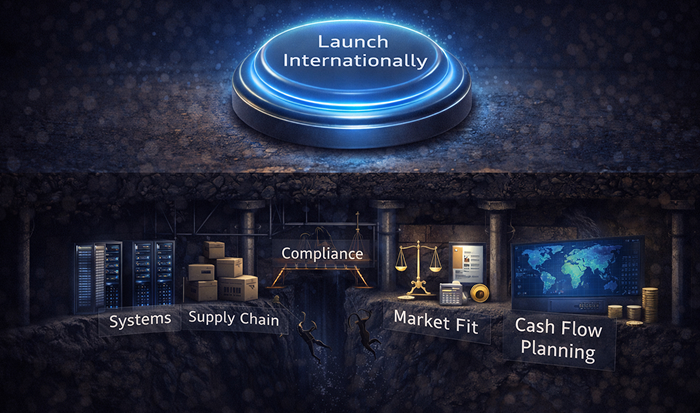
To sell internationally on Amazon successfully in 2025–26, the winning mindset is: treat expansion like a repeatable system, not a one-time project.
Amazon Cross Border Selling becomes far more manageable when you build a strategy around account structure, controlled listing replication (using tools like BIL), compliance readiness, and a fulfillment promise you can consistently keep.
If you share your home marketplace (India/US/UK) and product category, the market-entry scorecard above can be turned into a ranked shortlist of the best 2–3 countries to enter first.
