



Table of Contents
The Realities of a Winning Amazon Selling Strategy

Let’s be honest: the “gold rush” era of Amazon is over. You can’t just find a generic product, slap a logo on it, and wait for the checks to roll in. Today, a successful Amazon Selling Strategy is less about “gaming the system” and more about sophisticated brand psychology.
In a marketplace where shoppers have infinite choices, your brand needs to feel like the obvious answer, not just another search result.
Whether you’re just starting or you’re deep into scaling, your Amazon Selling Strategies have to move past the basics of SEO. You need to focus on how to actually stop the scroll.
Cutting Through the Noise
Most people think Selling on Amazon is a game of keywords. While those matter, they are just the entry fee. The real needle-mover is “Human-First Optimization.” This means writing bullet points that solve problems rather than just listing features.
Don’t just tell me the shovel is made of steel; tell me it won’t snap when the ground is frozen.
The Logistics of Trust
If you aren’t thinking about Amazon FBA Selling Strategies, you’re leaving money on the table. In the world of instant gratification, “Prime” is a psychological trigger. It represents a promise of speed and reliability that a self-fulfilled merchant rarely captures.
But FBA isn’t a “set it and forget it” solution, it requires aggressive inventory management to ensure you don’t get killed by storage fees while waiting for a payout.
Mastering the Ad Spend
Your Amazon Seller Marketing Strategy shouldn’t be a “spray and pray” approach with PPC. It’s about surgical strikes.
- Defensive Plays: Bidding on your own brand name so competitors don’t poach your loyal customers.
- Offensive Plays: Targeting the “Frequently Bought Together” sections of your biggest rivals.
- Video Content: A 15-second lifestyle clip of your product in use will do more for your conversion rate than ten paragraphs of perfect copy ever could.
Why Brand Visibility Matters in Selling on Amazon
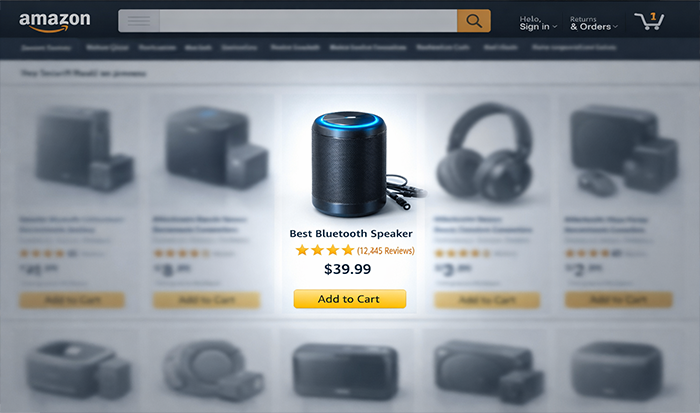
The reality of Selling on Amazon is that the “first page” isn’t just a goal, it’s the only place that matters. Think about your own habits: when was the last time you clicked “Next” at the bottom of a search result? Probably never. Amazon is essentially a high-stakes search engine where visibility equals survival.
If your product isn’t showing up, it doesn’t matter how high the quality is; it effectively doesn’t exist. This is why a cohesive Amazon Selling Strategy isn’t just a “nice-to-have” marketing plan, it is the engine that drives your entire business.
Why the Amazon Algorithm Rewards the "Winners"
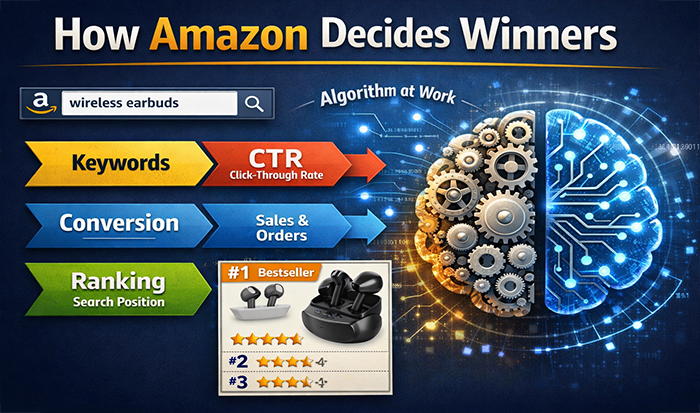
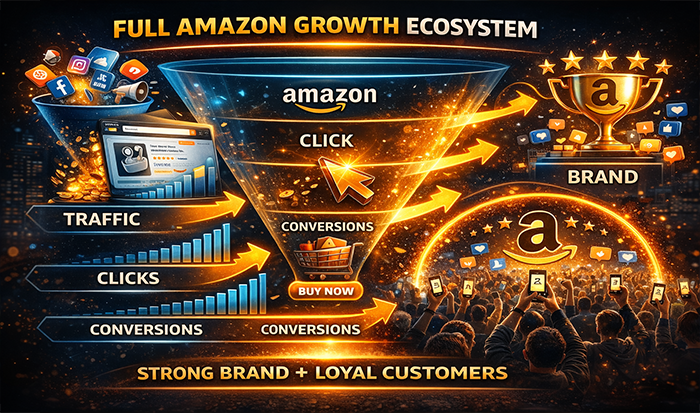
Amazon isn’t just looking for the best product; it’s looking for the most relevant one that is also likely to sell immediately. They want happy customers and quick transactions. When your Amazon Selling Strategies align with their algorithm (often called A10), you trigger a powerful “flywheel effect”:
- Search Relevance: You show up for the right terms.
- Increased Clicks: Customers see a compelling title and thumbnail.
- Higher Conversions: Your listing copy and images convince them to buy.
- Sales Velocity: Amazon sees people are actually buying your stuff.
- Better Organic Ranking: The algorithm pushes you even higher for free because you’re a “proven” winner.
The Human Element of an Amazon Seller Marketing Strategy
To get that visibility, you have to move beyond just “listing” a product. You need to treat your storefront like a brand. This involves:
- Solving Problems, Not Just Listing Specs: A human writer knows that a customer doesn’t just want a “stainless steel whisk.” They want a whisk that “won’t rust in the dishwasher and feels comfortable in a tired hand.”
- Building a “Review Moat”: Visibility gets them there, but social proof keeps you there. Part of your strategy should be about delivering such a good experience that the 5-star reviews become your secondary sales team.
- Aggressive Brand Protection: Once you’re visible, others will try to copy you. Registering your brand with Amazon gives you the tools to protect your intellectual property and keep your visibility high.
Leveraging the FBA Advantage
One of the most effective Amazon FBA Selling Strategies is simply letting Amazon handle the “last mile.” The “Prime” badge is a psychological shortcut for trust. It tells the customer, “You’ll have this tomorrow, and if you don’t like it, returns are easy.” That trust directly feeds your conversion rate, which, you guessed it, boosts your visibility even further.
Understanding Amazon’s Algorithm (A9 & A10)
To really make it in the Amazon marketplace, you have to stop thinking like a “vendor” and start thinking like a brand owner. The algorithm, whether we’re talking about the classic A9 or the more nuanced, behavior-driven A10, isn’t just a math problem to solve.
It’s a mirror of customer behavior. Amazon wants to show the product that is most likely to end the customer’s search.
If you want to move away from that “AI-generated” feel and write like an actual strategist, you have to talk about the friction, the psychology, and the long game. Here is a breakdown of an Amazon Selling Strategy that actually works in the real world.
The SEO Foundation: Don't Just Rank, Connect
Most people think Selling on Amazon is about stuffing as many keywords into a title as possible. That’s a mistake. Your title has two jobs: tell the algorithm what you are, and tell the human why they should click.
- The Intent Factor: Instead of just using “Water Bottle,” you use “Insulated Stainless Steel Water Bottle.” Why? Because you’re targeting the problem (lukewarm water) and the solution (insulation).
- Backend Secrets: Use your “search terms” field for the things you’d be embarrassed to put in the title, like common misspellings or Spanish translations. This is a quiet but deadly effective part of any Amazon Selling Strategies toolkit.
Converting the "Skimmers"
People don’t read listings; they skim them. If your bullet points look like a wall of text, you’ve already lost.
- The “So What?” Rule: Don’t just say “BPA Free.” Say “BPA Free – Safe for your family.”
- A+ Content: This isn’t just extra space for pictures. It’s where you handle objections. If people usually ask if your product fits in a car cup holder, put a photo of it in a cup holder right there.
The Power of the "Prime" Badge
Your Amazon FBA Selling Strategies should revolve around reliability. When a customer sees that Prime logo, their brain switches from “Should I buy this?” to “When will it get here?” By letting Amazon handle the heavy lifting, you aren’t just outsourcing shipping, you’re buying trust.
But watch your inventory like a hawk; nothing kills your organic ranking faster than going “Out of Stock” for a week.
Surgical Advertising (PPC)
An Amazon Seller Marketing Strategy without ads is just a hobby. New listings are invisible by default. You have to “buy” your initial data.
- The Flywheel: Start with an automatic campaign to see what people actually type to find you. Take those winners and move them into a manual campaign where you can bid more aggressively.
- Defense: Always bid on your own brand name. It’s cheaper to keep a customer than to lose one to a competitor who bid on your name.
The "Social Proof" Moat
Reviews are the currency of the platform. But gone are the days of “black hat” tactics. Today, it’s about the “Request a Review” button and, more importantly, a product that doesn’t disappoint.
If your packaging feels premium, people are 50% more likely to leave a positive note. It’s the small details that build a long-term Amazon Selling Strategy.
Common Mistakes to Avoid
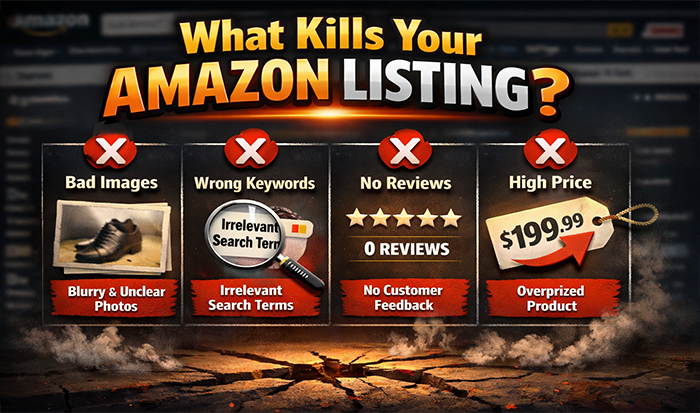
Even with the best product in the world, the Amazon marketplace is unforgiving. Most sellers don’t fail because their idea was bad; they fail because they tripped over the same five hurdles that everyone else does. If you’re serious about building a sustainable Amazon Selling Strategy, you have to treat these common pitfalls as your “red zone.”
Here’s a breakdown of what usually goes wrong and how a human operator (not an algorithm) actually fixes it.
The SEO Trap: "Setting and Forgetting"
The biggest mistake people make with Selling on Amazon is thinking SEO is a one-time chore. Keywords aren’t static; consumer language shifts with the seasons and trends.
- The Error: Using a list of keywords from 2024 and never touching them again.
- The Fix: You need to be a “keyword detective.” If customers start searching for “eco-friendly” instead of “reusable,” and your listing doesn’t adapt, you’ll vanish from the search results.
A real Amazon Seller Marketing Strategy involves monthly audits to see which terms are actually converting and which are just wasting space.
High-Resolution "Ghost" Images
We’ve all seen them, perfectly rendered 3D images that look… fake. In an age of AI, shoppers are craving “proof of life.”
- The Error: Using only sterile, white-background shots that don’t show scale or texture.
- The Fix: You need “Contextual Reality.” Show the product in a kitchen, in a gym, or in a hand. If your Amazon Selling Strategies don’t include lifestyle photography that feels like a real person took it, you’ll struggle to build trust.
People buy from people, even on a platform as massive as Amazon.
The PPC Money Pit
Advertising is a tool, not a crutch. If you’re spending 50% of your revenue on ads just to stay on page one, you don’t have a business, you have a hobby that Amazon is taxing.
- The Error: Relying on Sponsored Products to fix a listing that doesn’t convert organically.
- The Fix: Dial back the “spray and pray” approach. Your Amazon Seller Marketing Strategy should focus on high-intent long-tail keywords.
It’s better to have 10 clicks with 2 sales than 100 clicks with 1 sale. Optimize your organic “Retail Readiness” first, then use ads to pour gasoline on that fire.
Lazy Keyword Research
If you’re only targeting the most obvious keywords (like “Water Bottle”), you’re fighting a war you can’t afford to win.
- The Error: Ignoring the “Long Tail” and the “Negative” keywords.
- The Fix: Successful Selling on Amazon requires finding the niches. Instead of “Water Bottle,” maybe you’re the best “Leak-proof Toddler Bottle for Backpacks.” Also, tell Amazon what you aren’t.
If you sell a premium glass bottle, add “plastic” to your negative keywords so you aren’t paying for clicks from budget shoppers who will never buy your product anyway.
The "Aged Inventory" Nightmare
Inventory management is the silent killer. Amazon has become increasingly predatory with its storage fees in 2026, especially for items sitting longer than 180 days.
- The Error: Sending 1,000 units to FBA because “the shipping was cheaper,” only to have them sit for six months.
- The Fix: Your Amazon FBA Selling Strategies must be built on “Just-in-Time” logic. Use tools to forecast your 90-day velocity and only send what you can sell.
If you have “dead” stock, kill it, run a flash sale, use a coupon, or remove it. Paying $5.00+ per cubic foot in storage fees will bleed your margins dry before you even realize it.
Future of Amazon Selling Strategies

In 2026, the Amazon landscape has shifted from a “keyword-matching” game to a sophisticated “intent-matching” ecosystem. If your Amazon Selling Strategy is still stuck in 2023, you’re likely seeing your margins shrink while your visibility vanishes.
The current algorithm (often called A10 by the seller community) no longer just counts how many times you said “water bottle.” It’s looking for semantic context and real-world authority. Here is a look at the future of Selling on Amazon and how you need to adapt to stay relevant.
The Rise of "Answer Engine Optimization" (AI Search)
With the full integration of AI shopping assistants like Rufus and COSMO, search has changed. Shoppers aren’t just typing fragments; they’re asking questions like, “What’s the best durable yoga mat for someone with knee pain?”
- The Strategy: You must stop writing for “string matches” and start writing for “entities.” Your listing needs to explicitly answer the problems your product solves. If your Amazon Selling Strategies don’t include conversational, benefit-led copy that an AI can parse as a “solution,” you’ll miss out on the 60% higher conversion rate that AI-assisted shoppers are currently driving.
The End of Cheap Visibility (Ad Competition)
PPC costs are at an all-time high because the US and UK marketplaces are reaching “peak saturation.” You can no longer buy your way to the top without a surgical Amazon Seller Marketing Strategy.
- The Strategy: Shift from broad-match “vanity” terms to Micro-Dayparting and Agentic AI ad management. The goal in 2026 is “Margin Control.” If you aren’t using data to slash bids during low-conversion hours or targeting hyper-specific long-tail phrases, your ACoS (Advertising Cost of Sale) will eat your profit before you can restock.
Branding as a "Revenue Gate"
Amazon has made it clear: generic products are being pushed to the bottom. Brand Registry is no longer optional; it’s the barrier to entry for high-level visibility.
- The Strategy: Use A+ Content and Brand Stores to create a “Fandom.” When a shopper recognizes your brand, their decision friction drops. In 2026, the algorithm rewards “Brand Halo” effects, where the success of one product in your line automatically boosts the ranking of your new launches. This is the core of a sustainable Amazon FBA Selling Strategies plan.
External Traffic: The Ultimate Ranking Signal
Amazon’s A10 algorithm now prioritizes “off-platform validation.” A sale coming from an Instagram influencer or a Google Ad carries significantly more weight than a standard PPC sale.
- The Strategy: Treat Amazon as your “checkout counter,” but do your “marketing” elsewhere. By driving traffic from TikTok or email lists, you trigger a massive boost in organic ranking. Plus, with the Brand Referral Bonus, Amazon actually pays you back (usually around 10%) for the sales you bring in from outside. It’s a win-win for your Amazon Seller Marketing Strategy.
Conclusion
To wrap this up, let’s be real: Selling on Amazon in today’s landscape is a brutal game of inches. You aren’t just competing with millions of other sellers; you’re competing with the algorithm’s high expectations and the customer’s shrinking attention span.
Luck hasn’t been a factor on this platform for a long time. Success now requires a calculated, aggressive Amazon Selling Strategy that treats every listing like a high-stakes storefront.
Building a brand that actually lasts, and doesn’t just flicker for a month, comes down to a few non-negotiable pillars of a modern Amazon Seller Marketing Strategy:
- The Content Foundation: You have to stop writing for robots and start writing for the person holding the phone. Amazon Selling Strategies only work if your SEO draws them in and your brand story makes them stay.
If your listing doesn’t solve a problem within the first three seconds, they’re gone.
- The Operational Edge: High-level Amazon FBA Selling Strategies are about more than just shipping boxes; they are about maintaining a “Review Moat” and a flawless “Voice of the Customer” score.
The algorithm rewards stability, consistent stock, competitive pricing, and low return rates are what keep you on page one.
FAQs:
1. How do I improve my visibility for Selling on Amazon?
Visibility starts with Amazon SEO, optimize your title with your primary keyword and use high-intent backend terms. But the real driver is sales velocity: the faster you sell, the higher you rank organically.
2. Which Amazon Selling Strategies help with high conversion?
Traffic is useless without conversions. Use A+ Content and strong lifestyle images to build trust, and write bullets that solve customer pain points, not just list specs.
3. Are Amazon FBA Selling Strategies better than FBM?
For most, yes. Using FBA earns the Prime badge, a major trust signal while ensuring fast shipping and handling customer service, which boosts account health and rankings.
4. How should I approach an Amazon Seller Marketing Strategy for ads?
Don’t “spray and pray.” Start with auto campaigns to gather data, then move to manual targeting for top performers. Focus on long-tail keywords, lower competition, higher intent.
5. What is the biggest mistake to avoid in an Amazon Selling Strategy?
Running out of stock kills momentum. An “unavailable” listing gets heavily penalized. Tight inventory forecasting is just as critical as your SEO and ads.
Thought Leadership, Tips, and Tricks
Never miss insights into the Amazon selling space by signing up for our email list!
