

Introduction — The “next Amazon growth wave” is international
In 2025–26, the biggest Amazon expansion story isn’t just new features on Amazon.com—it’s how quickly Amazon International Marketplaces are scaling demand, logistics, and seller ecosystems across regions.
International segment sales reached $40.90B in 2025 Q3, up 14% year over year, and annual international sales climbed from $131.20B (2023) to $142.91B (2024), which signals durable momentum outside the U.S.
This report translates those signals into a practical view of Fastest-growing Amazon Marketplaces, focusing on where buyer demand and marketplace infrastructure are compounding fastest.
Methodology — How “fastest-growing” was identified
Amazon doesn’t publish one universal dashboard that ranks Amazon Market Growth by Country for every marketplace, so this analysis uses a blended “seller-realistic” method.
The goal is to identify which marketplaces are scaling quickest in useful ways (traffic, operations, ecosystem maturity), not just which ones are biggest today.
Inputs used in this report
- International sales acceleration as a macro growth signal for Amazon Global Marketplace Trends.
- Marketplace maturity proxies like visitor scale and expansion signals by country (especially in newer markets).
- Revenue scale for large established countries (useful for understanding where absolute demand is already proven).
The three lenses (how to read “growth”)
- High-scale growth: big marketplaces still expanding (often the safest global bet).
- Catch-up growth: newer marketplaces where Amazon is rapidly building selection, delivery speed, and habit.
- Infrastructure-led growth: markets where fulfillment centers and delivery coverage are actively expanding (often a conversion unlock).
The fastest-growing marketplaces (seller view) for 2025–26
The markets below are the most likely to show outsized growth (either by % growth off a smaller base, or by meaningful expansion on top of already-large demand).
They also reflect where Amazon is actively strengthening local experience—traffic, Prime adoption, and fulfillment density—which is what turns interest into repeat purchases.
India (Amazon.in) — high demand, fast evolution
Amazon.in is described as one of the most attractive Amazon marketplaces worldwide, with about 300 million visitors per month (Q1 2024), and it’s widely seen as a rapidly developing market.
The competitive context is real (Flipkart is a major rival), but the upside is equally real: huge buyer base, growing selection, and constant category expansion.
From a seller lens, India often behaves like multiple marketplaces in one—metros, tier-2/3 cities, and regional preferences can look like different demand clusters.
Japan (Amazon.co.jp) — “scale + growth” in one place
Japan ranked among the highest-grossing Amazon marketplaces (about $26B revenue in 2023 per the source) and is characterized as one of the fastest-growing marketplaces in Asia.
It also shows very large traffic (about 596.2 million visitors per month in Q1 2024 in the source), which matters because growth on a large base can still be enormous in absolute sales.
Popular categories cited include electronics, toys, and Otaku-related products—useful clues for assortment strategy.
UAE (Amazon.ae) and Saudi Arabia (Amazon.sa) — Middle East momentum
Amazon.ae averaged about 24.1 million visitors per month in Q1 2024, and the source notes three fulfillment centers in Dubai with additional site openings planned for 2024 and 2025—classic infrastructure-led growth signals.
Amazon.sa averaged about 16.2 million visitors per month in Q1 2024, positioning Saudi as a strong “next leg” market right after the UAE in the region.
For sellers, these marketplaces often reward strong operations (availability + fast delivery) because convenience is still being “trained” into buyer habits at scale.
Poland (Amazon.pl) and Sweden (Amazon.se) — EU catch-up growth
Poland has had its own marketplace since 2021 and averaged about 16 million visitors per month in Q1 2024, while Sweden averaged about 15.6 million in the same period—similar scale, similar “early growth” profile.
This is the sweet spot where growth can be fast because selection is still filling in and competition is often lighter than Germany/UK.
If an EU expansion is planned, these markets can be a practical testing ground before scaling deeper into the biggest Western European stores.
Egypt (Amazon.eg) — emerging market with visible traction
Amazon.eg (launched after Souq.com transitioned) drew around 17 million visitors per month in the source’s Q1 2024 snapshot.
That level of traffic suggests meaningful early adoption relative to many newer e-commerce
markets, which is often where % growth can look strongest as the platform matures.
For sellers, the biggest opportunity is usually “category whitespace”—everyday items with consistent demand but limited high-quality listings.
Marketplace growth indicators (2024–2025 signals)
This table summarizes the most actionable indicators for Amazon International Marketplaces—traffic proxies, infrastructure expansion notes, and what it means for sellers.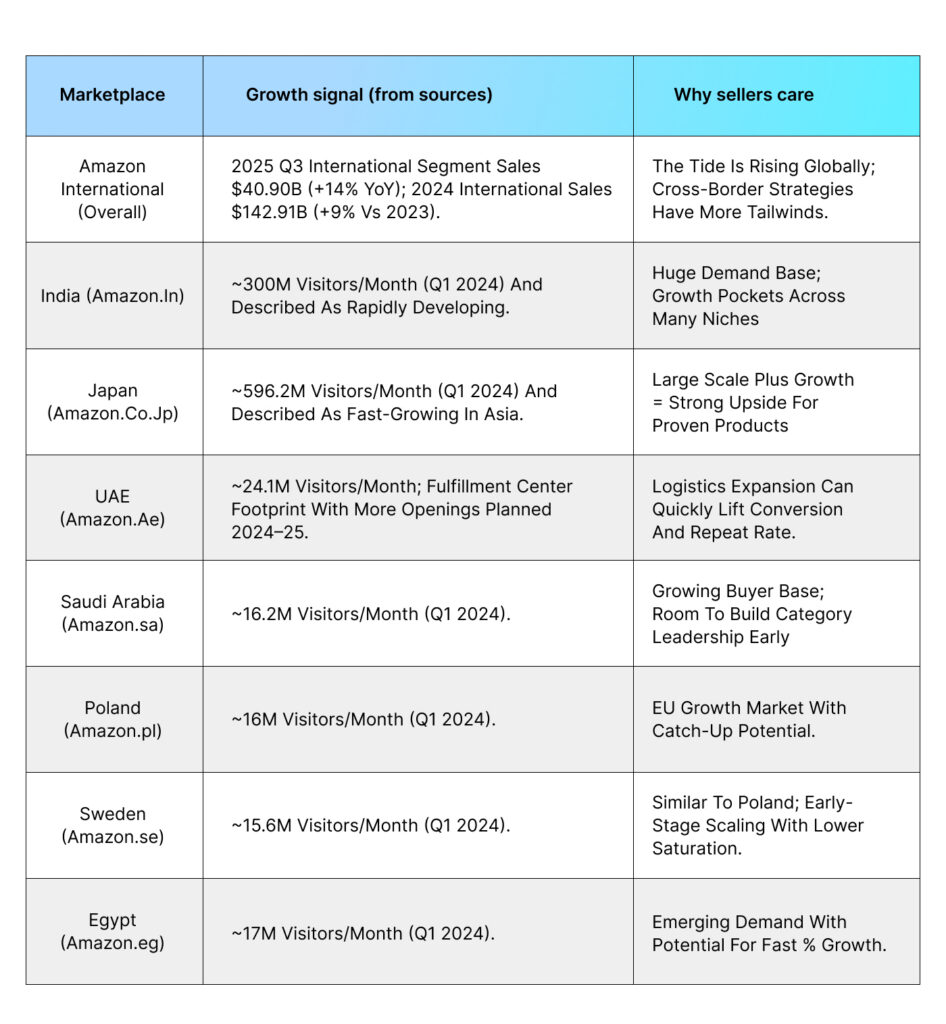
Bullet snapshot — What’s powering Amazon Global Marketplace Trends in 2025–26
These are the common growth engines seen across the fastest-scaling marketplaces.
- International sales momentum is up, creating more corporate focus, tooling, and operational investment outside the U.S.
- Newer marketplaces gain speed when fulfillment coverage expands, because delivery reliability directly increases conversion rates.
- As selection deepens, shoppers stop “checking Amazon” and start “starting on Amazon,” which is the real behavioral tipping point.
- Cross-border selling becomes easier when sellers reuse playbooks: listing structure, review strategy, ad testing, and inventory discipline.
Practical framework — How to pick the right “fast-growth” marketplace
The simplest way to choose is to match your product to the type of growth you want: scale growth vs catch-up growth.
If you want faster wins (early-stage growth)
- Prioritize UAE, Saudi Arabia, Poland, Sweden, and Egypt where the sources show meaningful traffic but still earlier maturity.
- Win by being “the best listing,” not just “the cheapest,” because assortment gaps still exist.
If you want stable volume (scale growth)
- Prioritize Japan (and then expand into other large EU stores once localized ops are stable).
- Expect higher standards: localization quality, customer expectations, and returns handling matter more at scale.
Closing insight — Growth is real, but timing is the advantage

The clearest macro takeaway is that international momentum is rising: $40.90B international segment sales in 2025 Q3 (+14% YoY) plus a 2024 jump to $142.91B (+9%) sets the stage for continued expansion.
The seller advantage comes from entering the right Amazon International Marketplaces before they look “obvious,” when traffic is climbing and fulfillment is scaling, but competition hasn’t fully caught up.
If you share your top product category and target region, the marketplace short-list can be narrowed into a launch sequence (which country first, which second, and why).
