




Table of Contents
Introduction

How AI and automation are transforming Amazon selling in 2026
By 2026, automation and artificial intelligence will have transformed Amazon sales with previously unheard-of efficiency and insight. These technologies streamline operations and minimize manual labor, from automated pricing adjustments to intelligent inventory management.
Data-driven decision-making is now possible for Amazon sellers thanks to AI tools, which make it easier for them to forecast demand, improve customer engagement, and optimize product listings. Sellers can scale operations more quickly and efficiently than ever before thanks to the integration of AI and automation.
Why sellers must adapt to stay competitive
Standing still is no longer an option as more sellers use automation and artificial intelligence. In terms of pricing, inventory turnover, and customer experience, rivals who use AI tools for Amazon sellers have a major edge.
Efficiency and responsiveness, exactly what AI and automation provide, are rewarded in Amazon’s marketplace. Adaptation is essential for long-term success because sellers who ignore these developments run the risk of falling behind and losing both visibility and revenue.
Quick overview of what the guide covers
This guide provides a comprehensive roadmap for using AI and automation to boost Amazon business growth. You’ll learn about the top AI tools for Amazon sellers, strategies to optimize listings, enhance PPC campaigns, and streamline operations.
Additionally, the guide covers advanced techniques to leverage analytics, improve conversions, and future-proof your Amazon business. By the end, sellers will have actionable insights to harness AI and automation for maximum growth in 2026 and beyond.
The Rise of AI and Automation in E-Commerce

Evolution of automation tools in the Amazon ecosystem
Over the years, AI and automation have evolved from simple inventory trackers to sophisticated platforms that manage pricing, stock, and customer interactions seamlessly.
E-commerce AI tools now empower Amazon sellers to automate repetitive tasks, reducing errors and saving valuable time. The integration of these tools has transformed the Amazon ecosystem, enabling sellers to focus on strategy, product development, and customer engagement while automation handles operational efficiency.
AI’s role in decision-making, optimization, and customer experience
AI and automation are no longer just operational aids—they are central to decision-making and optimization in Amazon selling. E-commerce AI tools analyze massive datasets to provide actionable insights on pricing strategies, product recommendations, and advertising performance.
They also enhance customer experience by personalizing interactions and predicting buying behavior. By leveraging AI in these areas, sellers can make smarter decisions, improve conversions, and deliver a more engaging shopping experience.
Benefits of AI and Automation for Amazon Sellers
Time-Saving & Efficiency Gains
Time spent on manual and repetitive tasks is significantly decreased by using AI tools for Amazon sellers and Amazon automation software. Now, routine tasks like order processing, inventory tracking, and repricing can be completed automatically, removing delays and human error.
In order to ensure that operations are not only quicker but also more intelligent, sellers can devote more time to strategic tasks like product expansion, brand building, and customer engagement.
Better Data-Driven Decisions
AI tools for Amazon sellers provide actionable insights that humans might overlook by analyzing massive volumes of traffic, sales, and competitor data in real-time. When combined with Amazon automation software, sellers are able to make well-informed choices regarding product positioning, pricing, and ad spend. This data-driven strategy gives sellers a competitive edge in a fast-paced market by lowering guesswork, increasing campaign efficacy, and assisting in the rapid identification of lucrative trends.
Improved Customer Experience & Personalization
The core of Amazon’s ecosystem is customer satisfaction, and AI tools for Amazon sellers are essential to boosting it. These tools make every customer interaction timely and relevant, from personalized product recommendations to automated follow-up emails.
Additionally, Amazon automation tools make it possible to handle reviews, returns, and inquiries quickly and effectively, guaranteeing seamless post-purchase experiences. Personalized interactions foster repeat business and boost loyalty.
Increased Sales and Conversions
Revenue growth is directly impacted when Amazon automation tools are integrated with AI tools for Amazon sellers. Sellers can increase the number of visitors who become customers by optimizing product listings, ad targeting, and dynamic pricing.
Automation guarantees that the right products reach the right audience at the right time, while AI forecasts demand trends and spots cross-selling opportunities. Higher conversion rates, higher average order values, and a discernible increase in overall sales are the outcomes.
Where AI Fits in the Amazon Seller Journey
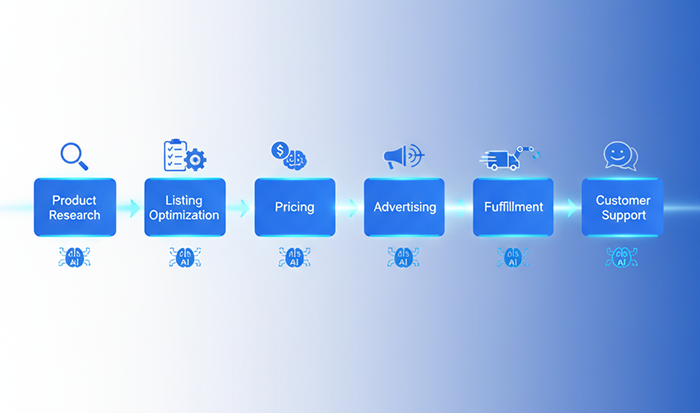
Product Research & Market Analysis:
E-commerce AI tools have revolutionized how Amazon sellers approach product research and market analysis. These tools can instantly process massive datasets from Amazon’s marketplace, including competitor listings, sales history, pricing trends, and customer demand patterns.
By leveraging AI, sellers can uncover hidden opportunities, identify trending products, and determine ideal price points for maximum profitability.
Advanced AI algorithms even predict emerging niches before they become saturated, allowing sellers to strategically enter markets with high growth potential. This level of precision drastically reduces the risk of launching unprofitable products and saves weeks of manual research.
Listing Optimization with AI Tools
Ranking and conversions depend on product listings being optimized, and Amazon AI optimization streamlines this difficult procedure. To produce useful suggestions for titles, bullet points, product descriptions, and backend keywords, AI-powered tools examine competitor listings, search volume, keyword performance, and user behavior.
Sellers can enhance the overall quality of their listings, optimize images and content for increased engagement, and automatically find high-performing keywords that are missing. This gives sellers a competitive edge in a crowded market by guaranteeing that products show up in pertinent search results and effectively convert browsers into buyers.
AI for Amazon PPC Campaigns
Manually running PPC campaigns takes a lot of time and is frequently ineffective. Machine learning is used by AI for Amazon PPC to identify high-converting keywords in real time, automate bid adjustments, and allocate funds to the most effective campaigns.
To continuously improve campaigns, these tools monitor metrics like click-through rate (CTR), conversion rate, and advertising cost of sale (ACOS). Sellers can optimize ROI, cut down on wasted ad spend, and scale their advertising strategies wisely by utilizing AI.
AI gradually discovers which campaigns result in steady sales, improving the predictiveness and data-drivenness of future ad management.
Review & Feedback Management
Customer reviews are a major factor influencing purchasing decisions. E-commerce AI tools monitor reviews and feedback across all listings, detect sentiment trends, and flag potential product or service issues.
Some AI solutions automatically send review requests to buyers or respond to negative feedback promptly, improving customer satisfaction and retention. Advanced AI even performs sentiment analysis to identify recurring complaints, enabling sellers to make product improvements proactively.
By using AI for review management, sellers can maintain a strong brand reputation and foster customer loyalty, which directly impacts repeat purchases and overall sales growth.
Inventory Forecasting & Supply Chain Automation
To prevent stockouts or overstocking, accurate inventory forecasting is essential. When paired with e-commerce AI tools, Amazon AI optimization makes use of market insights, seasonal trends, and historical sales data to accurately forecast demand. Sellers can minimize holding costs, automate reorders, and optimize stock levels with the help of these forecasts. AI can also optimize the entire supply chain, from order processing to shipment tracking, when combined with Amazon automation software. In order to increase profitability and customer satisfaction, sellers improve their control over logistics, reduce delays, and guarantee that products are always available to meet customer demand.
When Sellers Should Go Manual Instead of Automation

Situations where human oversight is critical
Even though automation and artificial intelligence (AI) offer enormous efficiency and predictive power, human judgment is indispensable in some circumstances.
A seller’s intuition and decision-making are frequently needed when dealing with complicated product issues, abrupt supply chain disruptions, or unforeseen market shifts.
Subtle context-specific elements like regional demand spikes or competitive actions might be difficult for Amazon automation software to take into account.
In these situations, depending only on AI may result in errors, so human supervision is necessary to successfully negotiate obstacles.
Product branding, storytelling, and customer service nuances
Automated efficiency is not enough to build a strong brand. Listings and advertising can be optimized by AI and automation, but human interaction is frequently required for creative branding, storytelling, and tailored customer interactions.
Amazon automation software cannot completely replicate the emotional connection and authenticity that customers respond to. Manual intervention guarantees that the brand voice and customer experience stay authentic and captivating when creating product narratives, interacting on social media, and answering complex customer questions.
Striking a balance between AI-driven automation and seller intuition
The most prosperous Amazon sellers blend their own skills with automation and artificial intelligence. Sellers can concentrate on strategic decision-making by using Amazon automation software to manage repetitive tasks like pricing, inventory control, and ad optimization. Finding the ideal balance guarantees effectiveness without compromising originality, instinct, or individualized attention. Sellers can make better decisions, react swiftly to changes in the market, and keep a competitive edge while utilizing technology to its maximum capacity by fusing AI insights with human judgment.
Top AI Tools for Amazon Sellers in 2026

AI Tools for Keyword Research & SEO
Customer reviews are a major factor influencing purchasing decisions. E-commerce AI tools monitor reviews and feedback across all listings, detect sentiment trends, and flag potential product or service issues.
Some AI solutions automatically send review requests to buyers or respond to negative feedback promptly, improving customer satisfaction and retention. Advanced AI even performs sentiment analysis to identify recurring complaints, enabling sellers to make product improvements proactively.
By using AI for review management, sellers can maintain a strong brand reputation and foster customer loyalty, which directly impacts repeat purchases and overall sales growth.
AI for PPC Bid Management & Optimization
Budgets can be depleted by pay-per-click campaigns if they are not properly managed. By examining past performance, competitor activity, and current demand, sophisticated AI tools for Amazon sellers automate PPC bid adjustments.
The top Amazon AI tools maximize return on investment, minimize wasted ad spend, and optimize keyword targeting. Sellers can optimize their ad campaigns more intelligently with Amazon AI by using predictive algorithms, which improves visibility and steadily increases sales.
AI-Powered Inventory & Demand Forecasting
Overstocking or running out of stock can crush profitability. AI tools for Amazon sellers now offer accurate demand forecasting by analyzing seasonality, competitor pricing, and sales velocity.
These best Amazon AI tools prevent stockouts, optimize warehouse space, and minimize holding costs. With AI-driven insights, sellers achieve seamless Amazon AI optimization in inventory management, ensuring products are always available when buyers are ready.
AI Chatbots for Customer Engagement
In 2026, AI tools for Amazon sellers extend beyond sales and ads into customer experience. Intelligent chatbots powered by AI handle queries 24/7, provide order updates, and recommend products based on buying history.
The best Amazon AI tools enhance post-purchase engagement, boost response speed, and drive customer satisfaction. By integrating chatbots, sellers achieve end-to-end Amazon AI optimization, turning one-time buyers into loyal customers.
Amazon Automation Software vs. AI Tools: What’s the Difference?
When discussing Amazon automation software versus AI and Automation, it’s important to understand how they differ.
Automation-only software is rule-based—tasks are executed according to predefined conditions, such as auto-repricing or scheduled email follow-ups. While reliable for repetitive processes, it lacks adaptability. In contrast, e-commerce AI tools learn from data, identify trends, and optimize strategies dynamically—whether in PPC bidding, keyword targeting, or demand forecasting.
Pros & cons: Automation software offers speed and consistency but can’t adapt to changing market conditions. AI and Automation, however, bring predictive insights and real-time optimization, though they may require higher investment and data training.
When to use both: Smart sellers combine automation with e-commerce AI tools—automation handles repetitive, rule-based tasks, while AI adapts to new trends for higher sales efficiency. Together, they provide the perfect balance of reliability and intelligence.
Sellerite’s AI and Automation Solutions vs. Alternatives

For modern sellers, adopting the right AI tools for Amazon sellers can make or break growth. Sellerite stands out by combining automation with adaptive AI, making it one of the best Amazon AI tools for 2026.
Sellerite’s Unique AI Features
Sellerite goes beyond basic automation. Its AI engine performs advanced Amazon AI optimization across keywords, ads, inventory, and pricing.
It learns buyer behavior patterns, predicts demand spikes, and fine-tunes PPC campaigns in real time. Unlike traditional automation, Sellerite continuously improves with data, giving sellers a competitive edge.
How Sellerite Compares to Other Best Amazon AI Tools
While other AI tools for Amazon sellers like Helium 10 or Jungle Scout focus heavily on research or analytics, Sellerite offers an all-in-one solution. It merges the strengths of Amazon automation software with adaptive AI. This makes it more efficient than tools that require multiple integrations for ads, inventory, and SEO. Sellerite provides seamless Amazon AI optimization under one platform, reducing complexity and boosting performance.
Case Example: Seller Growth Using Sellerite AI
One Amazon seller saw a 40% increase in sales within three months of switching to Sellerite. By leveraging its best Amazon AI tools, the seller optimized PPC bids, improved keyword rankings, and avoided costly stockouts.
Sellerite’s blend of AI tools for Amazon sellers and automation helped streamline operations, scale faster, and sustain long-term growth.
Common Mistakes Sellers Make with AI and Automation
While AI and Automation can transform Amazon businesses, many sellers misuse these tools, reducing their effectiveness.
- Over-relying on AI without human oversight: Sellers sometimes trust Amazon automation software blindly, expecting it to replace strategy. However, without human monitoring, AI can misinterpret market shifts or run inefficient ad campaigns, leading to wasted spend.
- Using too many tools without integration: Many sellers subscribe to multiple platforms but fail to connect them. Fragmented AI and Automation systems create data silos, making it harder to track true performance. Integrated Amazon automation software ensures all functions—ads, SEO, and inventory—work in sync.
- Ignoring compliance and Amazon’s policies: Automation may speed up tasks, but neglecting Amazon’s strict policies can backfire. Misuse of AI and Automation for reviews, messaging, or pricing can trigger account suspensions. Sellers must balance smart tech adoption with compliance to safeguard their business.
The Future of AI and Automation in E-Commerce Growth

The next phase of AI and Automation is shaping how sellers scale their businesses globally, with e-commerce AI tools unlocking unprecedented growth opportunities.
- Predicting trends: predictive analytics, voice commerce, generative AI in product descriptions. Advanced e-commerce AI tools will rely on predictive analytics, voice commerce integration, and generative AI to optimize product descriptions. This allows sellers to anticipate demand, reach customers through voice searches, and publish high-converting copy effortlessly.
- The expanding role of external traffic (Google, TikTok, social) managed by AI: Future AI and Automation systems will manage cross-platform traffic from Google, TikTok, and social media. By automating ad spend allocation and content delivery, e-commerce AI tools will drive external traffic directly to Amazon, strengthening rankings and boosting visibility.
- Opportunities for early adopters: Sellers who embrace AI and Automation early will gain a lasting competitive advantage. From smarter e-commerce AI tools that personalize offers to automated marketing funnels, early movers will enjoy lower costs, higher margins, and faster brand growth.
Conclusion

The rise of AI and Automation has completely reshaped how sellers succeed on Amazon. From smarter keyword research and PPC optimization to predictive inventory planning and customer engagement, AI tools for Amazon sellers now cover every aspect of growth.
The key takeaway: while automation saves time and AI unlocks insights, sellers must balance both with manual oversight to avoid common pitfalls and maintain control over strategy.
If you’re ready to scale smarter, try Sellerite’s AI-powered tools—a powerful blend of AI and Automation designed to help Amazon sellers grow faster, reduce errors, and stay ahead of the competition.
FAQs
1. What are the best AI tools for Amazon sellers in 2026?
Platforms that address end-to-end requirements, keyword research, PPC optimization, inventory forecasting, and customer engagement, are among the top AI tools for Amazon sellers in 2026. Particularly noteworthy are tools like Helium 10, Jungle Scout, Perpetua, and Sellerite, the latter of which combines automation and artificial intelligence for comprehensive Amazon AI optimization.
2. How do I choose the right AI and automation solution for my Amazon business?
Determine your pain points first, such as SEO, inventory, or ad spend. Amazon automation software is effective if you need to handle repetitive tasks. However, AI and automation solutions are superior for data-driven, adaptive strategies. Select an integrated tool that combines both, such as Sellerite.
3. How does Sellerite’s AI compare with the best Amazon AI tools available?
Sellerite offers an advanced suite of AI powered tools built specifically for Amazon sellers. It streamlines every stage of selling from keyword research and listing optimization to profit margin analysis and ad copy creation. The platform’s AI Listing Optimizer, Review Analyzer, and Compliance Checker help sellers save time, reduce errors, and make data-driven decisions. Developed by experienced Amazon sellers, Sellerite combines automation with expert insights, helping users launch products faster, better optimize campaigns, and expand their stores with confidence.
4. How does AI help with Amazon PPC optimization?
Predictive algorithms are used by AI tools for Amazon sellers to identify high-converting keywords, cut down on wasted ad spend, and modify bids in real time. By allocating funds appropriately and focusing on the right audience, this type of Amazon AI optimization guarantees the highest return on investment.
5. What’s the difference between AI tools and traditional automation tools?
Traditional Amazon automation software is rule-based—actions are triggered only if preset conditions are met. In contrast, AI and Automation tools learn, adapt, and optimize strategies dynamically. AI predicts demand, optimizes ads, and enhances decision-making, while automation handles repetitive tasks consistently.


 Back to top
Thought Leadership, Tips, and Tricks
Never miss insights into the Amazon selling space by signing up for our email list!
YOUR WINNING SOLUTIONS
Read more


Expert
strategies
delivered
to your
inbox
top industry minds to fuel
your brand’s growth.

Send request to Sellerite
Once you submit the consultation form, we’ll dive into the details and email you a tailored report within 24-48 hours.
"*" indicates required fields
*By submitting your Email Address, you are agreeing to all conditions of our Privacy Policy.
