


Introduction — Why Categories Matter More Than Products
If you sell on Amazon long enough, you realize something uncomfortable: success isn’t just about having a “good product.” It’s about choosing the right space to compete in. Amazon Product Categories shape everything—search visibility, ad costs, competition level, even how picky customers are.
Over 2024–25, some niches grew steadily while others turned into knife fights on page one. This report is meant to feel like a map, not a lecture. We’ll walk through where the real demand is, which segments inside the Amazon Product Categories List still have room, and how to use this to guide your next launch instead of guessing.

Methodology — How This Category View Was Built
To make this feel useful for actual sellers (not just analysts), the data view is organized around three questions: Where is money flowing, how crowded is it, and how friendly is it to new or mid‑size brands? The lens is practical: if you launched a well‑positioned product here, would you have a fair shot?
What this snapshot assumes:
- You’re looking at mature marketplaces like US, UK, and DE, where Top Selling Product Categories on Amazon are well established.
- Growth is more important than absolute size—an “upcoming” slice of the Amazon Product Category List can be better than a huge but saturated one.
- Within each category, sub‑niche dynamics matter more than the headline label (e.g., “Pet anxiety products” vs just “Pet Supplies”).
Think of the numbers and labels as directional, not gospel; the goal is to point your research where odds are better, not promise shortcuts.
Category Snapshot — Growth vs Competition
Category Opportunity Matrix
Here’s a high‑level view of how major Amazon Product Categories stack up when you balance size, growth, and competitiveness. It’s the table a consultant would sketch on a whiteboard before talking specific products.
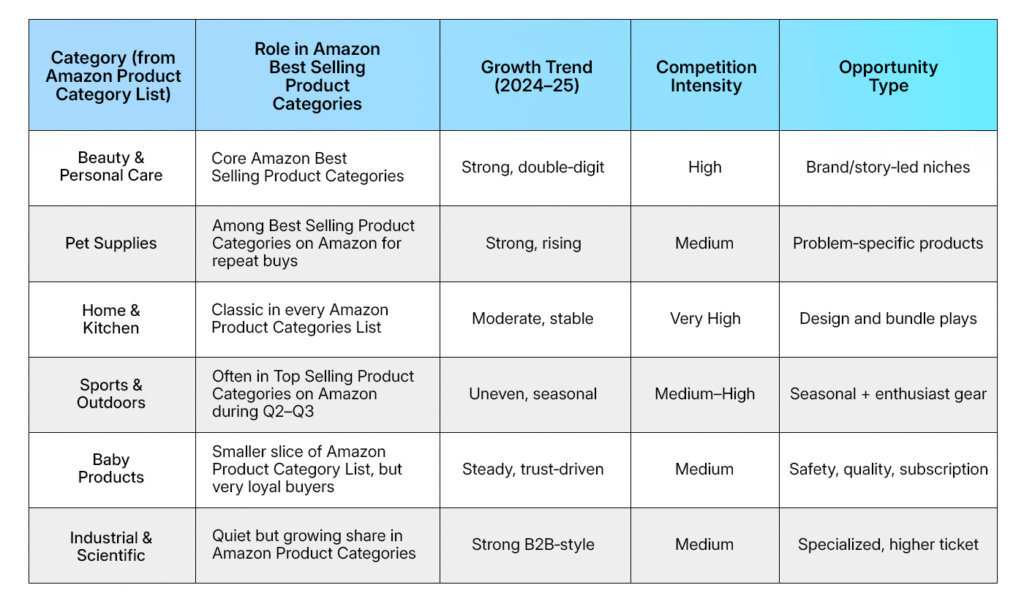
This matrix isn’t saying “go all‑in on Beauty” or “avoid Home & Kitchen.” It’s saying: if you’re not a big brand yet, you probably want to enter through specific problems and buyer segments, not broad, generic items everyone already sells.
Key Finding #1 — Beauty & Personal Care Is Big, But Micro‑Niches Win
Beauty sits comfortably in the Amazon Best Selling Product Categories cluster, but that doesn’t mean “any skincare product will do.” The broad category is crowded; the opportunity lives in sharp positioning. Think “fragrance‑free lotion for eczema‑prone kids” instead of just “body lotion.”
What stands out in this slice of the Amazon Product Categories List:
- Brands that lean into ingredients, skin type, and routine (morning vs night, pre‑makeup vs recovery) claim durable pockets of demand.
- Customers read, compare, and come back—repeat purchase potential is high if you solve a real, specific issue.
- Visuals, reviews, and story matter as much as price, which gives smaller brands a fighting chance if they communicate well.
If you’re entering Beauty, treat it less like a product category and more like a set of micro‑communities with specific problems and language.
Key Finding #2 — Pet Supplies Is Quietly Becoming a Powerhouse
Pet Supplies doesn’t always top every list of Top Selling Product Categories on Amazon, but its growth curve is hard to ignore. People treat pets like family, and buying patterns reflect that—recurring treats, supplements, calming aids, and enrichment toys.
Inside this corner of the Amazon Product Category List:
- Shoppers search by life stage and problem (“senior dog joint support,” “cat anxiety bed”) rather than just generic product types.
- Subscription behavior is common; if your product works, many buyers are happy to stick with the same brand.
- There’s still room for specialized formats (single‑ingredient treats, breed‑specific solutions, vet‑informed formulas) that big box brands ignore.
For a data‑driven seller, Pet is one of those Amazon Product Categories where you can realistically build a small portfolio and see compounding repeat revenue over time.
Key Finding #3 — Home & Kitchen Is Huge but Ruthless
Home & Kitchen has long been a staple among the Best Selling Product Categories on Amazon, simply because it covers so much: cookware, organizers, décor, tools. The flip side of that size is brutal competition, especially on obvious products like generic organizers or basic utensils.
Patterns in this mature section of the Amazon Product Categories List:
- Many search results are saturated with nearly identical products, all fighting on price and coupon stacking.
- Review walls (1,000+ reviews on top listings) are common for broad keywords, raising the bar for new entrants.
- Successful new products carve out angles—space‑saving designs, multi‑use items, aesthetics that match specific décor styles.
If you step into Home & Kitchen, you’re not just “adding a product.” You’re entering an arena where differentiation and branding matter more than a slightly cheaper unit cost.
Key Finding #4 — Sports & Outdoors and Baby Offer Timing‑Sensitive Wins
Sports & Outdoors and Baby don’t dominate every chart of Amazon Best Selling Product Categories, but they have unique traits that can work in your favor if you respect timing and trust.
Sports & Outdoors:
- Demand spikes around seasons and events (spring fitness, summer camping, back‑to‑school sports).
- Enthusiast sub‑niches—like climbing, trail running, or home gym accessories—can behave like loyal micro‑markets.
- Stock and cash flow planning matter; mistiming inventory around peak months can erase the advantage.
Baby Products:
- Parents search heavily by safety and reassurance rather than just price.
- Newborn and early‑life items turn over quickly, but winning brands often expand into the toddler years with the same customers.
- Even though the overall slice of Amazon Product Categories is smaller, trust once earned tends to stick.
These aren’t “launch anything and win” spaces, but they reward sellers who pay attention to life stages and seasonality, not just keywords.
Practical View — Where Opportunity Actually Lives
Opportunity by Category and Seller Type
To make this less abstract, here’s a simplified way to line up Amazon Product Categories against seller profiles. It’s not a rulebook, but it helps you think about “fit” instead of chasing whatever’s trending this week.

This is where the “opportunity” part of Top Selling Product Categories on Amazon becomes real: matching your strengths to buyer expectations instead of forcing a product into the wrong room.
How to Use Category Data in Your Launch Decisions
Knowing which are the Amazon Best Selling Product Categories is only step one. The real leverage comes from how you apply that information before you commit to inventory. A simple, seller‑friendly workflow might look like this:
- Shortlist 2–3 promising areas from the Amazon Product Categories List that align with your experience or supplier access.
- For each, dive into sub‑niches and search terms, ignoring broad “top” keywords at first.
- Check review patterns, price ceilings, and product styles on page one instead of only search volume.
From there, you’re deciding not just “where is demand?” but “where can I show up as clearly different and still make margin?” That shift in thinking alone saves many sellers from painful, crowded launches.
Closing Insight — Don’t Chase Hot Categories, Chase the Right Corner

The big message from looking across Amazon Product Categories is simple: opportunity rarely sits at the broad category label level. It hides one or two layers down, in specific problems, life stages, and styles that aren’t fully served yet.
Instead of asking “What are the Best Selling Product Categories on Amazon right now?”, a better question is: “Inside this category, which buyer group is annoyed, underserved, or paying a premium to solve a very specific issue?”
If you can answer that, and your offer genuinely meets that need, the category starts working for you instead of against you—no matter how crowded the leaderboard looks on the surface.
