

Why This 2026 Buyer Data Matters
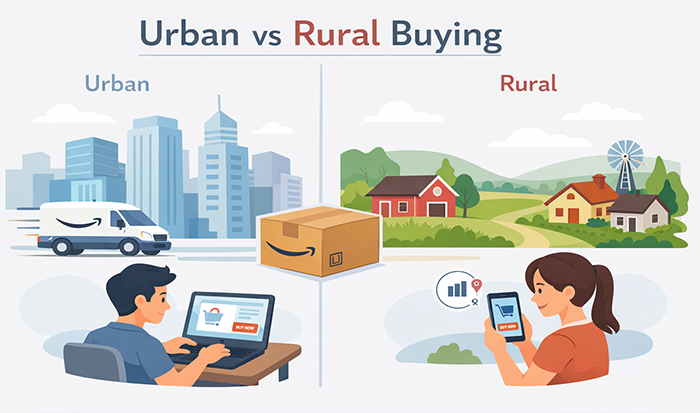
If you sell on Amazon long enough, you start noticing that not all customers shop with the same priorities. Some buyers move fast, care deeply about delivery speed, and compare multiple listings before buying.
Others spend more time building trust, checking payment options, and looking for reassurance before they place an order. That is exactly why the difference between Urban Ecommerce and Rural Ecommerce behavior matters in 2026.
This Sellerite-style report looks at how e-commerce buying patterns differ between urban and rural shoppers on Amazon. We are not treating this as a simple geography split. We are looking at how location shapes trust, convenience, product discovery, decision-making, and platform expectations.
The reason this matters now is simple. Rural digital participation is growing fast, while urban buyers remain more mature and convenience-driven in their online behavior.
One recent study notes that rural India accounted for roughly 45% of all new internet users in the past year, highlighting just how important non-urban digital adoption has become.
That does not mean rural and urban shoppers behave the same. It means the gap is narrowing in access while still staying very different in motivation.

How We Define Urban And Rural Ecommerce Buying Patterns
What “buying patterns” actually means here
For this report, e-commerce buying patterns include more than just who shops online more often. We are looking at the practical behaviors that shape purchase decisions on Amazon:
- Product research habits.
- Trust and communication needs.
- Delivery expectations.
- Payment comfort and flexibility.
- Promotion and content sensitivity.
This matters because two shoppers may both buy on Amazon, but for very different reasons. One may treat Amazon as the fastest option. Another may treat it as the only practical option, given the available choices.
Why these benchmarks matter in 2026
The 2026 environment makes this comparison more useful than before. Urban markets are increasingly saturated, while rural e-commerce continues to expand as smartphone use, digital payments, and delivery reach improve.
At the same time, buyer expectations still differ sharply. Urban shoppers often prioritize speed, variety, and convenience. Rural shoppers often place more weight on trust, access, communication, and practical value. For Amazon sellers, that means a single listing strategy will not always resonate equally with both groups.
What The 2026 Data Suggests About Urban Vs Rural E-commerce
Urban buyers still shop more frequently and more efficiently
The available data suggests that urban consumers remain more active and more comfortable with online shopping overall. One comparative market study notes that urban consumers show higher online activity frequency, supported by better digital literacy, stronger internet access, and broader exposure to online marketing.
The same pattern shows up in attitude studies. Urban buyers tend to be younger, more educated, and financially better off, which makes them more likely to value fast delivery, product variety, ease of use, and smooth digital experiences.
In practice, that means Urban Ecommerce often behaves more like convenience commerce: quick decisions, faster repeat behavior, and higher expectations from the platform.
Rural buyers are growing fast, but trust still shapes the journey
The rural story is not one of low demand. It is more a story of different conditions. Rural consumers are increasingly shopping online, especially as smartphone access and affordable data expand.
But their journey tends to be more trust-sensitive and infrastructure-dependent.
One study found that rural users placed higher importance on easy communication with sellers, easy product comparison, and quick seller response than urban users did.
Specifically, “easy to communicate with sellers” had the highest importance overall at 0.708, and it was even higher among rural users at 0.742.
That tells us something important: Rural Ecommerce is not just about getting more shoppers online. It is about reducing uncertainty once they arrive.
Urban Vs Rural E-commerce at a Glance
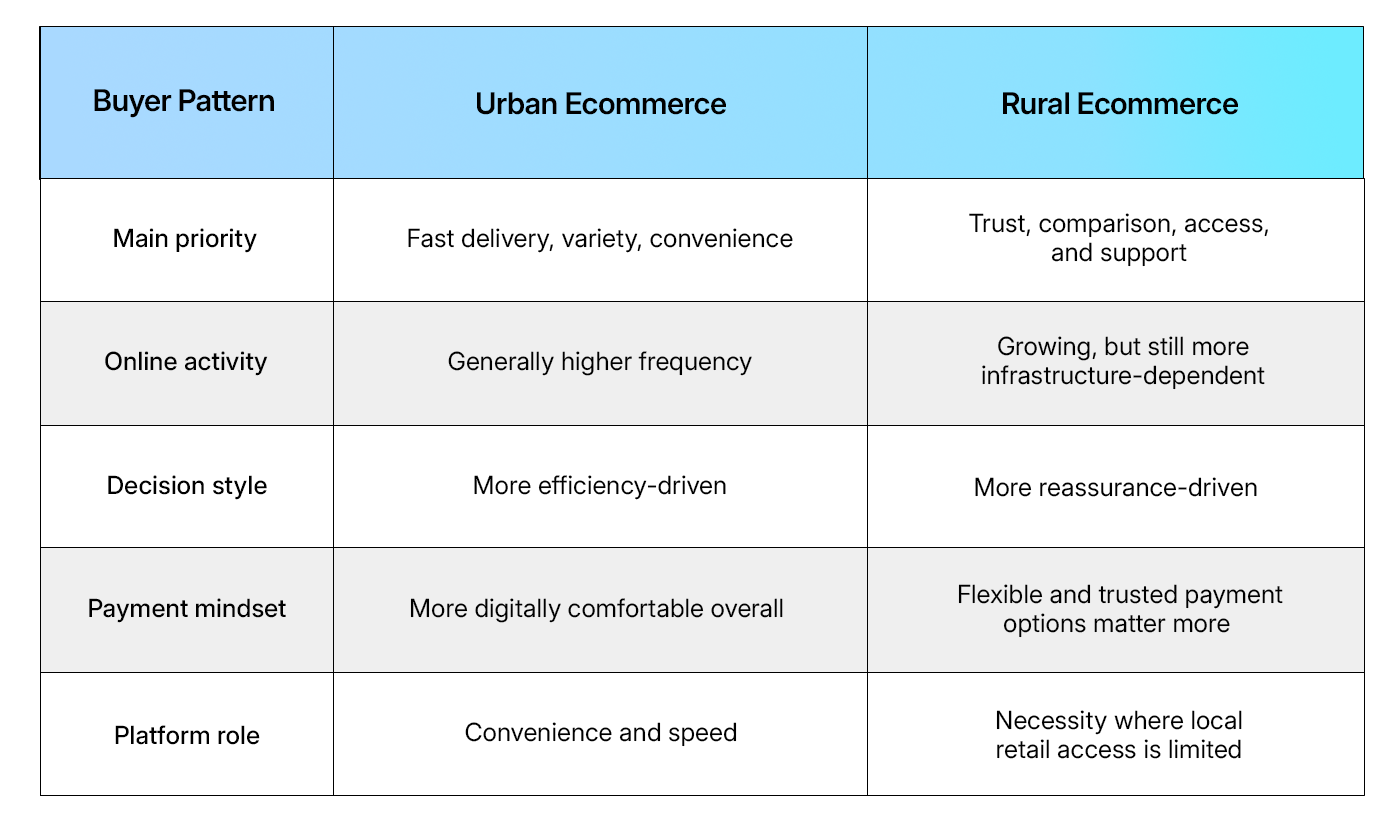
This comparison shows why e-commerce buying cannot be treated as one flat behavior pattern. The platform may be the same, but the shopper’s mindset can be very different.
What Usually Drives Urban Ecommerce Behavior
Speed and choice dominate the urban experience
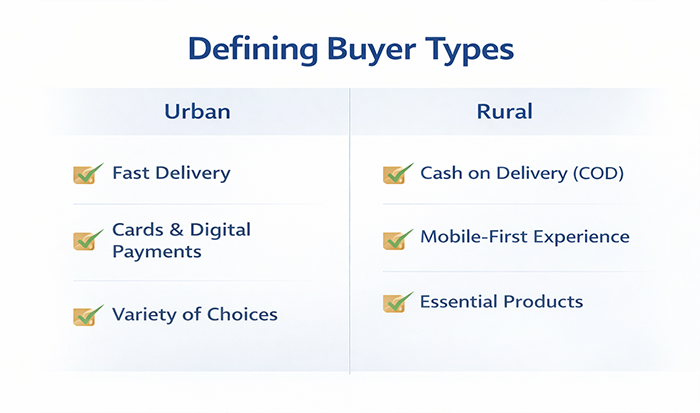
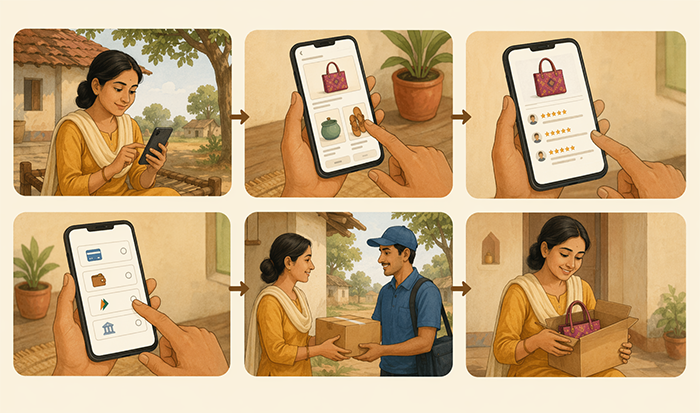
Urban buyers often use Amazon because it saves time. They usually have more alternatives offline, but still choose ecommerce because it offers speed, variety, and convenience in one place.
A factor analysis in one study found that the first major component explaining online shopping differences was “fast delivery and product variety,” accounting for 49.8% of the variance and showing a stronger association with urban consumers. That is a strong signal that Urban Ecommerce often behaves in a practical, utility-first way.
Convenience matters more than persuasion
Urban shoppers are often more familiar with e-commerce systems, which means they need less convincing about the platform itself. They are less focused on learning how online buying works and more focused on whether a product is the right fit, at the right speed, and at the right price.
For Amazon sellers, this means listings targeting urban-heavy demand often benefit from:
- Strong main images.
- Fast delivery signals.
- Clear price-value positioning.
- Wide product assortment and easy browsing.
What Usually Drives Rural Ecommerce Behavior
Limited offline access changes the role of ecommerce
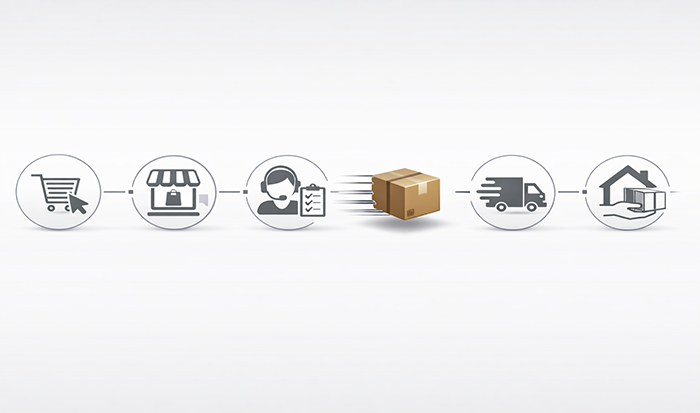
For many rural consumers, online shopping is not just a convenience layer. It can be a way to access products that are harder to find locally. One study found that distance to physical stores was the strongest differentiating factor, with a loading of 0.804.
That matters because it shifts the role Amazon plays. In many rural cases, the marketplace is not replacing a nearby store. It is filling a gap left by limited local retail access.
Trust-building plays a bigger role
Rural shoppers often place more value on clarity, support, and platform trustworthiness. Comparative research also notes that rural consumers tend to value affordability, cultural relevance, and trustworthy platforms more strongly, while remaining more hesitant around defects, returns, and online risk.
That is why Rural Ecommerce often responds better when the listing and experience reduce doubt through:
- Clear product information.
- Strong comparison value.
- Reliable communication and support.
- Flexible or trusted payment options such as cash-on-delivery.
Where Sellers Misread Ecommerce Buying Patterns
A common seller mistake is assuming that rising rural adoption means rural buyers now behave just like urban ones. The data does not support that. Rural adoption is growing, but trust, infrastructure, and value sensitivity still shape the experience differently.
Common misreads include:
- Assuming speed matters equally everywhere.
- Treating promotions the same way across urban and rural demand.
- Underestimating the role of communication in rural buying.
- Ignoring how local store access changes platform dependence.
The better approach is to think of urban and rural behavior as overlapping but not identical. Growth in access does not automatically mean identical motivation.
A Sellerite-Style Workflow For Better Market Fit
If you want to improve performance across both Urban Ecommerce and Rural Ecommerce segments, the smartest approach is not to create two completely different businesses. It is to make the Amazon experience work for both types of buyers.
A practical workflow looks like this:
- Keep product information clear and easy to compare.
- Highlight convenience and delivery speed where they are strong.
- Reduce trust friction through better images, clear copy, and consistent support.
- Use payment and offer strategies that do not assume identical buyer comfort levels.
- Watch where your strongest demand is actually coming from before changing positioning.
What This Means For Your 2026 Strategy
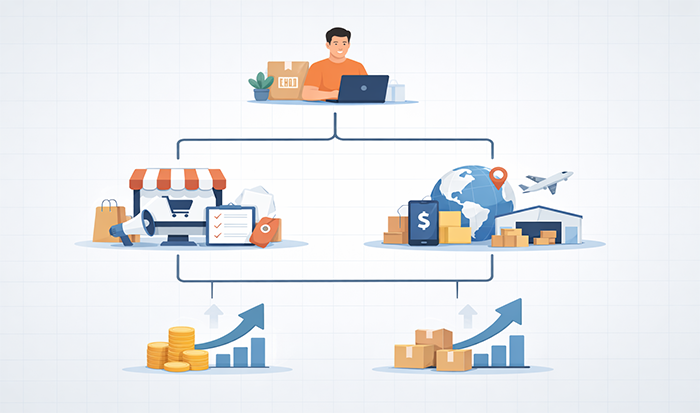
The core takeaway from this report is simple: Ecommerce Buying patterns on Amazon are expanding across both urban and rural markets, but they are not converging completely. Urban shoppers still tend to be faster, more convenience-driven, and more delivery-sensitive. Rural shoppers are growing fast, but often remain more trust-driven, comparison-oriented, and access-sensitive.
For Sellerite users, the practical lesson is clear. Do not treat all Amazon demand as identical. If your listing, offer, and buying experience are built only for the most digitally mature customer, you may miss part of the opportunity. The strongest 2026 strategies will be the ones that serve both Urban Ecommerce speed and Rural Ecommerce trust at the same time.
