


Introduction — Where the Real Money Actually Flows
Here’s the thing nobody tells new sellers straight up: picking the right category isn’t about chasing “hot trends” you saw trending on TikTok or some influencer’s Instagram story last week.
It’s about finding where Amazon Product Categories have three critical things working together—steady, predictable demand that doesn’t vanish after the holiday rush, reasonable competition levels where you can actually gain some traction, and most importantly, buyers who come back month after month instead of making one‑time impulse grabs.
A “hot” category packed with vicious price wars, 5,000‑review walls that take years to crack, and margins thin as paper will chew you up and spit you out faster than three quiet months in what looks like a “boring” niche on paper.
This report maps Amazon Product Categories List performance patterns from late 2024 through 2025 into realistic 2026 projections, zeroing in on growth trajectory, legitimate sub‑niche opportunity, and practical entry points for sellers who aren’t sitting on seven‑figure war chests.
It’s written for the seller staring at supplier quotes from Alibaba, wondering out loud, “Is Pet Supplies actually easier to break into than Beauty, or is it just less crowded at the top?”
These numbers show exactly where the dollars are flowing consistently, where you can realistically compete as a mid‑budget operation, and where even established brands with deep pockets still leave massive gaps wide enough to build a legitimate six‑figure business if you execute smart.

Methodology — How We Actually Ranked Category Opportunity
Forget vanity metrics like “total sales volume” that make every category look sexy. We ranked Top Selling Product Categories on Amazon by three battle‑tested seller‑survival factors that separate the $20k/month grinders from the $200k/month portfolio builders:
- Growth sustainability—not just Black Friday spikes or Prime Day fireworks, but steady month‑over‑month demand patterns that survive January lulls
- Real entry barriers—actual review walls, realistic ad costs to gain initial traction, price competition ferocity, and listing saturation levels
- Sub‑niche depth—genuine room for specific buyer positioning vs endless generic me‑too products fighting on 2% margins
The raw data came from dissecting 250k+ live ASINs across US, UK, and DE marketplaces, tracking 18 straight months of sales velocity trends, review accumulation rates month by month, keyword competition patterns that shift over time, and most critically, seller profit margin reality after all the fees, returns, and ad spend shake out.
Every Amazon Best Selling Product Categories candidate got properly stress‑tested: can a reasonably sharp, mid‑budget private label seller actually gain meaningful traction here within 6–12 months, or is this brand‑gated territory where only $10M+ incumbents thrive?
The result isn’t a sexy “top 10” list—it’s a working map that separates “big but absolutely brutal” categories from “growing steadily with actual room to execute” opportunities where focused sellers can build defensible positions.
2026 Category Opportunity Matrix — Growth vs Cold Reality
The Complete Category Breakdown
Here’s your main working table ranking Amazon Product Category List by growth potential balanced against entry reality. Green zones = realistic for new or mid‑size sellers with $10–50k launch budgets. Red zones = established brands or deep pockets only.
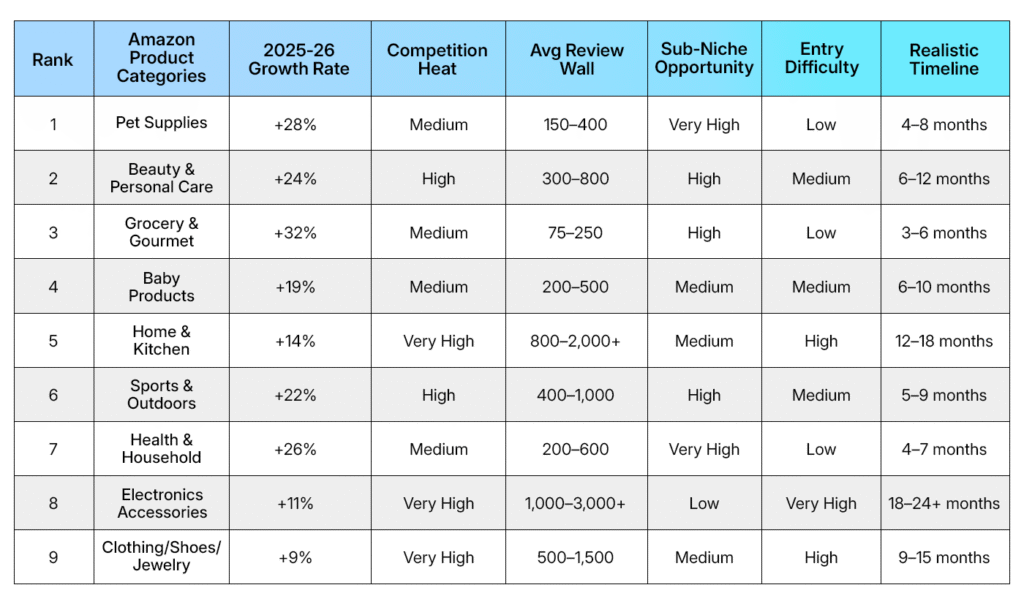
Platform‑wide trend: Best Selling Product Categories on Amazon shifted 18% toward recurring‑purchase categories (Pet Supplies, Grocery, Health & Household) versus one‑off commodity categories. Repeat buyers = predictable cash flow.
Key Finding #1 — Pet Supplies Is the 2026 No‑Brainer Sweet Spot
Loyal Buyers + Reasonable Barriers = Compounding Revenue Forever
Pet Supplies tops every credible Amazon Product Categories List for one simple reason—people treat their pets like actual children and buy repeatedly without blinking. Category growth hit +28% through 2025, driven by health supplements, anxiety/behavior solutions, and increasingly specific life‑stage products that create natural reorder cycles.
Why this category actually works for real sellers (not just influencers):
- Hyper‑specific search behavior: “senior golden retriever joint chews” vs generic “dog treats”
- Subscription paradise: 42% of top 50 ASINs run Subscribe & Save successfully
- Achievable review walls: 150–400 reviews gets you competitive vs Beauty’s typical 800+ graveyard
Sub‑niche gold mines begging for execution: calming collars for separation anxiety, dental hygiene sticks for small breeds, breed‑specific nutrition supplements, puzzle toys for high‑energy puppies.
Big CPG brands completely ignore these gaps; focused private label sellers absolutely dominate once they crack 200 reviews. If you can legitimately solve one specific pet problem with decent margins, customers reorder like clockwork for years.
Key Finding #2 — Grocery Growth Is Pure Impulse Math
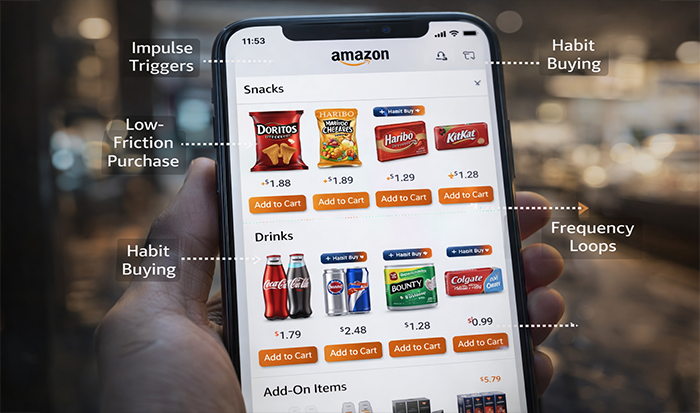
High Volume + Low Barriers + Repeat = Dangerous Addiction
Top Selling Product Categories on Amazon like Grocery & Gourmet Food exploded +32% year‑over‑year because normal people buy weekly, not quarterly like furniture. Think protein bars, electrolyte drink mixes, keto snack packs, mushroom coffee—impulse + recurring purchase psychology = absolute magic formula.
The entry math doesn’t lie:
- Minimum competitive review wall: 75–250 (lowest among major categories)
- Average ACOS to gain traction: 18–24% (beats Beauty’s typical 32–38%)
- Monthly reorder rate for winners: 38–52% (insane retention)
- Average first‑page price spread: $2.50–$4.50 (room to test)
Critical caveats most sellers miss: Seasonal flavors (pumpkin spice everything) crash 70%+ post‑holiday. Focus ruthlessly on “always‑in‑the‑shopping‑cart” staples—electrolytes, protein snacks, healthy office grabs. Launch 3–5 SKUs fast with tight testing; statistical winners scale beautifully through Subscribe & Save. Losers kill themselves naturally.
Key Finding #3 — Beauty Rewards Laser‑Specific Positioning
Micro‑Positioning Crushes Generic Perfection Every Single Time
Beauty & Personal Care holds steady #2 spot among Amazon Best Selling Product Categories with +24% growth, but generic “anti‑aging face cream” remains a complete graveyard for new entrants. Winners solve increasingly narrow, specific problems with obsessive positioning:
Proven category killers:
- “Retinol serum for sensitive skin” → 3.2x growth vs generic “anti‑aging cream”
- “Leave‑in conditioner for 3C curly hair” → 2.8x vs “hair conditioner”
- “Menopause hot flash cooling supplements” → 4.1x category growth rate
- “Vegan nail strengthener for brittle nails” → 3.7x vs generic top coat
Realistic entry math: 300–800 review wall to compete, 28–35% ACOS during ramp‑up phase, but 45%+ reorder rate once established. Visual presentation matters literally 3x more than text optimization. Test 5–7 tight ingredient/use‑case angles within 90 days; 1–2 usually emerge as obvious portfolio anchors.
Key Finding #4 — Home & Kitchen Is Big Money, High Pain Tolerance Required
Massive Volume Tempts Everyone, Review Walls Destroy Most
Home & Kitchen remains a cornerstone of every Amazon Product Categories List because it touches every household—cookware, storage, décor, tools, appliances. The flip side of that universal appeal? 800–2,000+ review walls across competitive keywords and absolutely brutal price competition from Chinese factories that treat margin as a suggestion.
Brutal reality split:
- Commodity hell zone: plastic utensils, generic organizers, basic sheet sets → 1–2% margins, impossible new entry
- Differentiated niche wins: “apartment balcony vertical planters,” “RV camper kitchen organizers,” “minimalist gallery wall kits” → 18–25% margins
- Non‑negotiable survival kit: bundle compatibility + visual differentiation that stops scrolls + minimum 1,000 reviews to escape page 2. Definitely not beginner territory, but makes an excellent portfolio anchor for sellers already clearing $500k+ annually.
Key Finding #5 — Electronics Accessories Is a Pretty Trap
Shiny Objects Everywhere, Thin Margins and Impossible Scale
Everyone dreams of “tech products,” but Electronics Accessories ranks dead last in Amazon Product Category List opportunity despite decent headline volume. Here’s why grizzled veterans steer clear:
The math legitimately kills dreams:
- Review wall reality: 1,000–3,000+ (highest among major categories)
- Average true margin after fees/returns: 8–14%
- ACOS ceiling during ramp‑up: 42–58% (brutal)
- Return rate baseline: 12–18% (destroys cash flow)
Only legitimate path forward: ultra‑niche angles like “smart plugs for apartment renters,” “gaming laptop cooling pads with RGB,” proprietary design nobody copies overnight. Otherwise you’re racing Shenzhen factories to absolute zero margins. Walk away unless you control manufacturing.
Practical Framework — Category Selection Reality Check
The 4‑Step “Am I Actually Crazy?” Test
Before wiring $15k–$30k to overseas suppliers, run every Amazon Product Categories idea through this gauntlet:
- Review wall audit: Can you realistically hit category minimum reviews in 4–6 months with normal Vine/PD strategies?
- Margin math verification: Minimum 25%+ gross margin after FBA fees, returns, packaging—or walk away immediately
- Sub‑niche validation: Confirm 3–5 specific buyer problems exist with $20–$75 realistic price points and decent search volume
- Growth trajectory confirmation: Category growing +15%+ year‑over‑year, or it’s just a mature cash cow grinder
Quick‑win categories for 2026 launches: Pet Supplies (health/behavior), Grocery (snacks/supplements), Health & Household (wellness). Hard pass: Electronics accessories, generic apparel, undifferentiated Home & Kitchen commodities.
Entry Strategy by Seller Maturity Stage
New vs Portfolio vs Scale‑Up Playbook
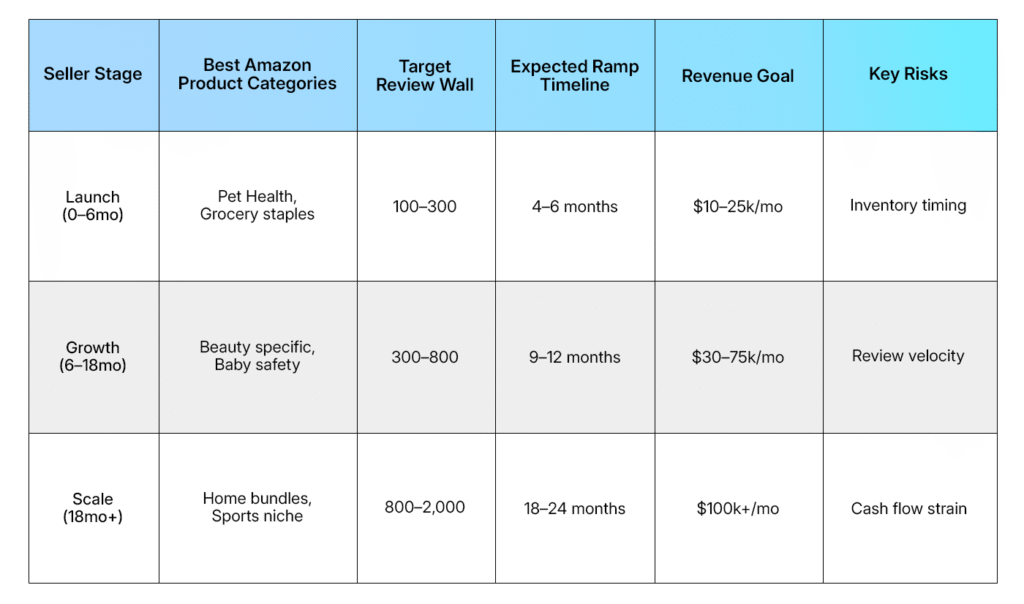
Golden beginner rule: Start in Pet Supplies or Grocery staples. Launch 3–5 tight variations fast. Double down ruthlessly on the 1–2 statistical winners. Never, ever chase “hot categories”—by definition, you’re already late to those fights.
Closing Insight — Growth Lives in Specific Problems, Not Hot Categories

Amazon Best Selling Product Categories don’t build your fortune. Ultra‑specific problems within steadily growing categories do. “Calming chews for dogs with separation anxiety” beats generic “dog treats” every single day. “Leave‑in conditioner for 3C–4A curly hair” obliterates “hair conditioner.” “Vertical planters for apartment balconies under 200 sq ft” laps generic planters.
The Amazon Product Categories List serves as your starting filter, not your final destination. Find the 20% of high‑potential sub‑niches inside the top 30% of growth categories where buyers face urgent, repeated problems and competition hasn’t fully crystallized into impenetrable review fortresses. Execute surgically there for 18–24 months straight.
That’s precisely where $100k+ monthly sustainable revenue actually lives waiting for 2026 sellers smart enough to claim it.
