




Table of Contents
Introduction
Amazon is not just a place where simply listing a product helps in generating sales. With rising competition and shrinking organic visibility, Amazon PPC advertising is one of the backbones of profitable Amazon selling. But running ads is very easy; running ads that help in converting, which most sellers fail to do.
Through this guide, you will understand the Amazon PPC Campaign setup, strategy, optimisation, and scaling. With your ads, don’t just get clicks, but actual sales.
Understanding Amazon PPC: The Foundation
At its core, Amazon PPC advertising is a straightforward auction: sellers bid on keywords to land their products in front of the right shoppers. You only pay when a customer actually clicks on your ad.
However, the secret to long-term success isn’t just about having the biggest budget—it’s about efficiency and intent. You aren’t just buying clicks; you’re buying data and market share.
The Pillars of a Smart PPC System
A well-structured campaign does more than just “run ads”—it acts as a growth engine for your entire business:
- Amplifies Visibility: It puts your brand in the spotlight, ensuring you aren’t buried on page five of the search results, where shoppers rarely venture.
- Captures High-Intent Traffic: Instead of casting a wide, expensive net, you target shoppers who are already standing at the “checkout counter” with their wallets out.
- Boosts Conversion Rates: By aligning the right keyword with the right product image and price, you turn casual browsers into confident buyers.
- Defends Your Turf: It protects your organic rankings by keeping competitors from poaching your brand name and your best-selling spots.
Scales with Heart & Logic: Rather than just throwing money at the screen, a smart system grows with you. It learns which products customers love most and reinvests profits into the winners, creating a sustainable cycle of growth that doesn’t drain your margins.
Why "Spending Smart" Matters
In the early days, you might spend more to “teach” the Amazon algorithm who your customer is. But as your system matures, the goal is to lower your ACOS (Advertising Cost of Sales) while increasing your total sales volume. It’s the difference between a “money pit” and a “wealth builder.”
Step 1: The "Retail Ready" Check – Fix Your Listing First
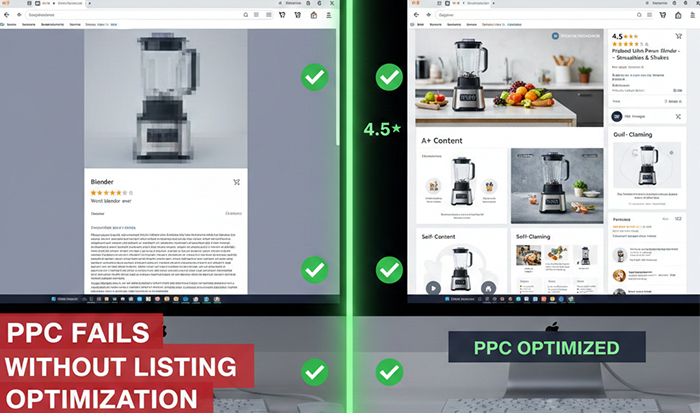
Think of your PPC campaign like a high-end valet service: it can bring the most prestigious guests to your front door, but if the house is a mess inside, they aren’t going to stay.
No amount of aggressive bidding can save a listing that isn’t built to sell. Before you even touch the Amazon PPC Campaign Setup, you need to ensure your “storefront” is inviting, informative, and persuasive.
The Conversion Essentials
Before launching your ads, check these five boxes to ensure you aren’t just “donating” money to Amazon:
- SEO-Optimized Titles: Your title shouldn’t just be a string of keywords for the bot; it should tell a human exactly what they’re buying in the first 50 characters, weaving in your primary keyword naturally.
- Benefits-First Bullet Points: Shoppers don’t buy features; they buy solutions. Don’t just list “stainless steel”—tell them it’s “rust-proof and dishwasher-safe for a stress-free cleanup.”
- Premium Visual Storytelling: High-res images are the bare minimum. You need lifestyle shots that help customers visualize the product in their lives and infographics that answer their questions before they even ask.
- The “Price-to-Value” Sweet Spot: You don’t have to be the cheapest, but you must be competitive. If you’re priced higher than the market leader, your listing needs to clearly show why.
- Social Proof (The 15-Review Rule): Launching ads with zero reviews is an uphill battle. Aim for at least 10–15 reviews with a 4-star+ rating to give shoppers the confidence to click “Add to Cart.”
The Golden Rule: PPC is the fuel, but your listing is the engine. PPC brings the traffic; your listing does the heavy lifting of converting that traffic into a sale.
Step 2: Researching Amazon PPC Keywords (The True Game-Changer)
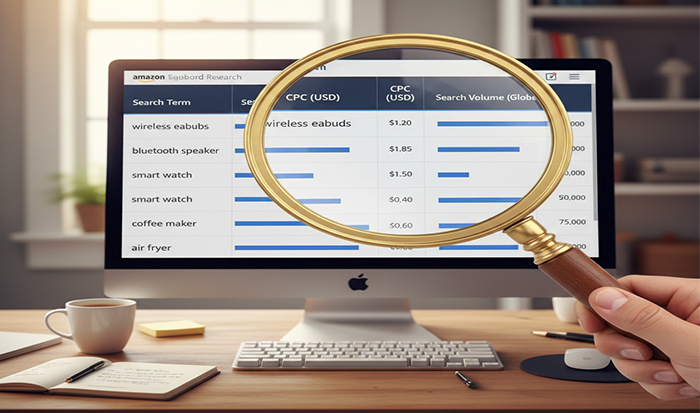
Because they guess the keywords, the majority of sellers fail. Research on Amazon PPC keywords needs to be supported by data.
- How to Identify Lucrative Keywords
- Utilise search term reports from Amazon
- Examine rival listings
- Make use of keyword tools (Helium 10, Jungle Scout, SellerApp).
- Examine data from auto-campaigns
Types of Keywords to Aim for:
- High-intent keywords (focused on purchases)
- Long-tail keywords (higher conversion, lower CPC)
- Branded keywords of competitors
- Converting terms that exactly match
Your Amazon PPC Conversion Rate is directly increased by conducting thorough keyword research.
Step 3: Choosing the Right Campaign Types – Building Your Engine
Think of Amazon’s ad formats like tools in a toolbox. You wouldn’t use a hammer to turn a screw, and you shouldn’t use every ad type for the same goal. A winning strategy uses a mix of all three, each with a specific purpose in your sales journey.
When you work with Professional Amazon PPC Advertising Services, the focus shifts from “just running ads” to a full-funnel approach. This means capturing people who are just browsing, those who are ready to buy right now, and even those who looked at your product but walked away.
Sponsored Products (Your Core Engine)
This is where the magic happens for most sellers. These ads look like organic search results and are your best bet for driving immediate sales.
- The Starting Line: Every product should start here.
- The Strategy: Use Automatic campaigns to let Amazon’s AI find keywords for you, then move those winners into Manual campaigns to dial in your bids.
- The Payoff: When optimized, this usually delivers your highest Return on Ad Spend (ROAS).
Sponsored Brands (Your Storefront)
Once you have Brand Registry, Sponsored Brands allow you to claim the “headline” spot at Brand Awareness: These ads showcase your logo, a custom headline, and multiple products at once.
- Top-of-Funnel: It’s great for introducing your brand to shoppers who are searching for a broad category rather than a specific product.
- Storytelling: It allows you to drive traffic to your Amazon Storefront, creating a branded shopping experience away from competitors.
the very top of the search results.
Sponsored Display (Your Secret Weapon)
This is often the most underutilized tool. Sponsored Display allows you to follow shoppers both on and off Amazon.
- Retargeting: Did someone view your product but didn’t buy? These ads remind them to come back and finish the job.
- Competitor Conquesting: You can place your ad directly on a competitor’s product page, right under their “Add to Cart” button, to offer a better alternative.
- Scaling Up: This is essential for mature products that have already tapped out search volume and need to find new audiences.
Step 4: Perfect Amazon PPC Campaign Setup (Structure Matters)

A messy campaign structure burns money. A clean structure scales profits.
Recommended Campaign Structure
Auto Campaign (Discovery)
- Low bids
- One campaign per ASIN
- Harvest converting search terms
Manual Campaigns (Control)
- Exact match (top converters)
- Phrase match (mid-funnel)
- Broad match (discovery)
This structured Amazon PPC Campaign Setup ensures data clarity and cost control.
Step 5: Bidding Strategy That Actually Converts
In the world of PPC, the biggest spender rarely wins; the smartest bidder does. You aren’t just throwing money at keywords—you’re buying data, learning from it, and placing bets where you’re most likely to win.
The "Smart Bidding" Playbook
Think of your bidding strategy as a living conversation with the market. Here is how to keep it profitable:
- Test the Waters First: Don’t go all-in on day one. Start with conservative bids to see how the market reacts, then scale up only when you see a “green light” in your metrics.
- Double Down on Winners: When a keyword starts bringing in sales at a healthy profit, give it more fuel. Increasing bids on high-conversion terms ensures you stay ahead of the competition where it counts.
- Trim the Dead Weight: If a search term is costing you a fortune (high ACOS) but barely moving the needle on sales, pull back. Don’t let underperforming keywords drain your budget.
- Location Matters: Pay attention to where your ads show up. If you’re crushing it on the “Top of Search” but losing money on “Product Pages,” shift your budget to the placements that actually drive the “Add to Cart” clicks.
- Play it Safe Early On: Use “Dynamic Bids – Down Only.” Think of this as an “anti-waste” setting. It tells the algorithm: “If a click doesn’t look like it’s going to lead to a sale, don’t spend my full bid.” It’s the best way to protect your margins while you’re still gathering data.
Step 6: Amazon PPC Optimization (Where Profits Are Made)
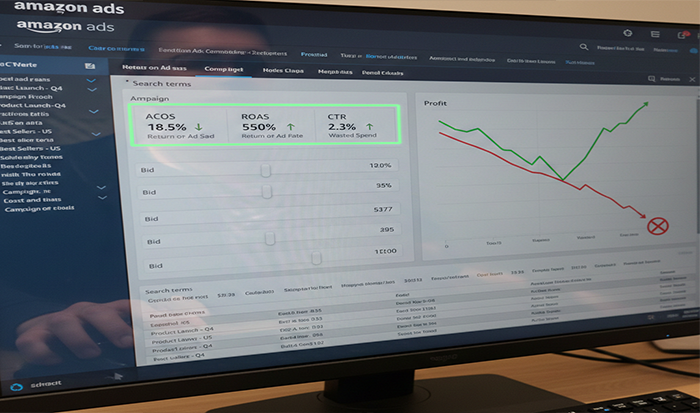
This is the point where Amazon PPC shifts from a necessary expense into a genuine profit engine. Optimization isn’t just about managing ads; it’s about making your money work harder by trimming the fat and doubling down on what actually converts.
By pausing keywords that drain your budget without results and lowering bids on those high-ACoS terms that eat into your margins, you create the breathing room needed to reinvest in your real winners.
When you take the profitable search terms discovered during your initial research and give them the budget they deserve, you stop guessing and start scaling. It’s the fine-tuning after the initial setup that transforms a basic campaign into a high-efficiency machine, ensuring every dollar spent is an intentional step toward better margins and long-term profitability.
An Amazon PPC Campaign Setup That Converts (Real Example)
This example demonstrates a conversion-first Amazon PPC setup, built in the correct order and optimized for long-term profitability.
The product is a silicone kitchen spatula priced at $14.99. After Amazon fees and cost of goods, the net profit per unit is $6.20, setting a break-even ACOS of 41%.
Step 1: Start With an Automated Campaign (14 Days)
The campaign begins with a single Automated campaign, running for 14 days.
- Daily budget: $30
- Bid range: $1.05–$1.15
During this period, the campaign spends $420, generates 39 orders, and produces $584 in revenue, resulting in an ACOS of 49%. At this stage, profitability is not the goal – data collection is.
After 14 days, the search term report is analyzed:
- 8 keywords generated 29 of the 39 sales
- 41 search terms received clicks with zero conversions
All non-converting terms are added as negative keywords.
Step 2: Launch Manual Campaigns Based on Real Data
Using the converting keywords, Manual campaigns are created, each with a daily budget typically ranging between $35–$60, depending on product margin, competition, and desired scale.
For each well-converting keyword, bids are structured with a clear $0.20 gap between match types:
- Broad – $0.65–$0.75
- Phrase – $0.85–$0.95
- Exact – $1.05–$1.15
This structure ensures Exact match captures the highest-intent traffic, while Phrase and Broad allow controlled discovery without inflating CPCs or competing internally.
Important: These bid ranges are a starting point, not a fixed rule. Bids should always be adjusted based on real campaign performance. Keywords with strong conversion rates, low ACOS, or consistent top-of-search results may require higher bids to scale profitably, while underperforming terms should be reduced or paused.
The Manual Exact campaign spends $348 over 14 days, generates 61 orders, and produces $914 in revenue, achieving an ACOS of 38%, below break-even.
The Manual Phrase campaign spends $124, generates 14 orders, and produces $210 in revenue, with an ACOS of 59%. One converting phrase is promoted to Exact, while poor performers are negated.
It’s important not to judge a keyword too quickly. Each new keyword or bid change should be given 72–96 hours to collect enough impressions, clicks, and conversion data before making optimization decisions. Premature changes often lead to false conclusions and unstable performance.
Step 3: Lower - But Never Turn Off - the Automated Campaign
After Manual campaigns are live, the Automated campaign is never turned off. Instead:
- Daily budget is reduced to $10–$15
- Bids are lowered to $0.90–$1.00
At this stage, the Automated campaign functions as a continuous keyword discovery and learning engine, allowing Amazon’s algorithm to identify new long-tail and emerging search terms over time.
Any new converting terms are reviewed regularly and migrated into Manual campaigns using the same structured bid logic. Non-converting terms are added as negatives to keep spend efficient.
Campaign Outcome After 30 Days
- Traffic quality improves – spend shifts from exploratory Automated traffic to high-intent Manual Exact keywords
- ACOS trends downward – moving from data-collection levels toward profitability as wasted spend is eliminated
- Keyword control increases – top-performing search terms are isolated, scaled, and protected from internal competition
- PPC becomes predictable – budgets, bids, and results stabilize, allowing confident scaling instead of guesswork
Example: Why Amazon PPC Requires Daily Professional Management
It’s important to understand that reaching these results requires daily monitoring and ongoing optimization. Amazon PPC is not a set-and-forget system. Campaigns must be reviewed consistently to adjust bids, budgets, search terms, and placements based on real performance data.
This level of execution requires either strong hands-on experience in Amazon PPC or working with a professional Amazon PPC manager or PPC management company Without systematic daily oversight, even well-structured campaigns can quickly lose efficiency and profitability.
Amazon PPC can also become the biggest profit drainer if it’s not managed correctly. When campaigns are left unchecked, PPC can silently consume margins on a daily basis – every dollar spent must have a clear purpose, justification, and expected return.
Step 7: Improving Amazon PPC Conversion Rate
A strong Amazon PPC Conversion rate is dependent on what happens after you click. Even the best Amazon PPC advertising is invalid if listings do not convert. Optimising titles, images, A+ content, and reviews helps in ensuring that the traffic converts into sales.
Pairing strong listings with intent-driven keywords helps in uncovering through Amazon PPC Keyword research, and in this case, your ads will help in attracting buyers who are ready to buy things, not only browsing it.
Step 8: Best Amazon PPC Strategies Used by Top Sellers

Top sellers are dependent on data, which is backed; in that case Best Amazon PPC strategies work, not guesswork. They separate brand, generic, and competitor campaigns, which aggressively mine search term reports, and are constantly refining bids with the help of ongoing Amazon PPC Optimisation.
Their Amazon PPC advertising success eventually comes from disciplined testing, which is a structured Amazon PPC Campaign setup and doubling down on keywords that help in delivering strong ROAS.
Step 9: When to Use Amazon PPC Advertising Services
As your business scales, managing Amazon PPC often stops being a side task and starts feeling like a full-time job. This is usually the moment when bringing in professional advertising services makes the most sense.
Instead of you spending hours staring at spreadsheets, experts take over the heavy lifting—handling complex bid automation, expanding your keyword reach, and constantly fine-tuning your performance tracking.
They have the experience to spot costly pitfalls before they drain your budget, focusing instead on dialling in your conversion rates. For sellers looking to grow quickly and predictably, leaning on professional support often proves much more effective than the “trial and error” approach, allowing you to focus on your brand while they focus on the returns.
Step 10: Scaling Amazon PPC Without Losing Control

Scaling Amazon PPC advertising requires balance—higher budgets without losing efficiency. The key lies in structured Amazon PPC Campaign Setup, consistent Amazon PPC Optimization, and continuous Amazon PPC Keyword Research to expand into profitable opportunities.
Sellers who scale successfully monitor performance daily, protect winning campaigns, and apply Best Amazon PPC Strategies systematically, ensuring growth doesn’t dilute profitability.
FAQs:
1. How much should beginners spend on Amazon PPC advertising?
Start with 10–15% of your product price as a daily budget and scale once you identify profitable keywords.
2. How long does Amazon PPC take to show results?
Initial data appears in 7–14 days, but real optimization requires at least 30 days.
3. What is a good Amazon PPC Conversion Rate?
A healthy Amazon PPC Conversion Rate ranges between 10–20%, depending on the category.
4. Is Amazon PPC optimization a one-time task?
No. Amazon PPC Optimization is continuous and should be done weekly for the best results.
5. Should I hire Amazon PPC advertising services?
If managing multiple ASINs or scaling aggressively, professional Amazon PPC Advertising Services can save time and reduce wasted spend.

 Back to top
Thought Leadership, Tips, and Tricks
Never miss insights into the Amazon selling space by signing up for our email list!
