


Introduction: Why Returns Matter More Than Ever For Sellers
If you sell on Amazon in 2025, you already know returns aren’t just a “customer service thing” anymore—they’re a profit killer when left unmanaged. Amazon Refunds and Returns impact everything from your margins and restocking costs to your account health and Buy Box eligibility.
What’s changed over the last couple of years is how central returns have become to overall performance. With one‑click returns, faster refunds, and increasingly generous expectations from shoppers, Returns and Refunds Amazon is now a core strategic lever, not an afterthought.
In this Sellerite research-style overview, the focus is on three big questions:
- How are return and refund rates trending going into 2026?
- Which categories are the most vulnerable to high Amazon Refund rates?
- What can sellers actually do—within the Amazon Refund Policy and Amazon Return Policy—to protect their margins without wrecking the customer experience?
To make this concrete, there’s a simple benchmark table plus a breakdown of the real drivers behind returns so you can decide what to fix first.

How This Return & Refund View Was Structured
What “return rate” actually means in practice
When talking about Amazon Refunds and Returns, it helps to define terms clearly because sellers often mix a few different metrics together in their heads:
- Unit return rate – percentage of units sold that are later returned.
- Refund rate – percentage of orders where a Amazon Refund is issued (including cases without physical return, such as “refund without return” scenarios in some categories).
- Chargeback / concession rate – cases where refunds or adjustments are granted after a customer complaint.
For a clean picture, the discussion here focuses on unit return rate and effective refund rate. The idea is to understand, “Out of everything you ship, how much money is coming back out of your account?”
Category benchmarks and why they matter
Not all categories are created equal. The “normal” return rate in fashion is very different from the “normal” rate in grocery. Any sensible look at Returns and Refunds Amazon has to be category-aware.
The high-level pattern across 2025–2026 looks roughly like this:
- Apparel and footwear sit at the top in return rates.
- Electronics and gadgets follow, due to defects, confusion, and buyer’s remorse.
- Home & Kitchen and general household goods fall into a moderate band.
- Grocery, beauty, and consumables are usually much lower due to hygiene and consumable restrictions under Amazon Return Policy.
Return & Refund Rate Benchmarks By Category
The big picture: what’s “normal” now?
To keep things practical, here’s a simplified benchmark you can treat as a directional guide when looking at your own Amazon Refunds and Returns:
Table 1: Indicative Amazon Return & Refund Rate Benchmarks (2025–2026)
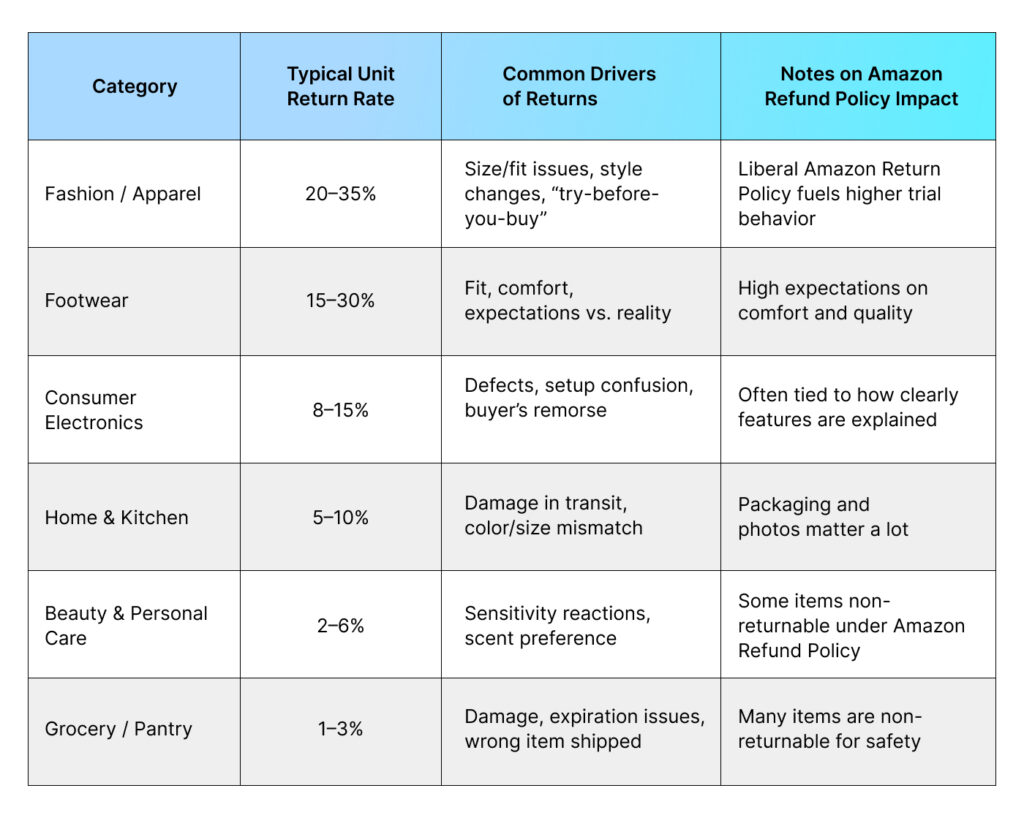
These aren’t hard rules, but if you’re seeing a 25% return rate in Home & Kitchen, or a 2% rate in fashion, something unusual is going on and it’s worth digging in.
What’s Actually Driving Higher Returns In 2025–2026?
The “frictionless” customer experience cuts both ways
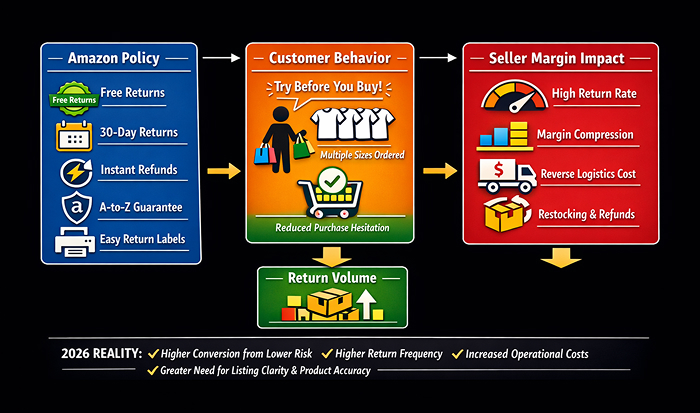
Amazon has made it incredibly easy for shoppers to lean on Returns and Refunds Amazon tools—prepaid labels, drop-off points, and in many regions, instant or near-instant Amazon Refund decisions. That frictionless experience is fantastic from the buyer’s perspective, but it subtly changes behavior.
Shoppers are:
- More likely to over-order and send back what they don’t want (especially in fashion and home décor).
- Quicker to return items that feel even slightly “off” compared to expectations.
- Less tolerant of confusing descriptions or unclear images.
In other words, the bar for avoiding Amazon Refunds and Returns has climbed. The better the Amazon buying experience gets, the tighter your product presentation has to be.
Listing accuracy and expectation management
Most preventable returns come down to a mismatch between what the shopper thought they were buying and what actually arrives. Common problem areas:
- Photos – lifestyle images that hide true scale, or product shots that are heavily edited.
- Measurements – missing or buried in dense bullet points; no real-world size references.
- Compatibility info – vague claims like “works with most devices” instead of clear compatibility tables.
Every unclear claim is basically a quiet invitation for a Amazon Refund later.
How Amazon’s Policies Shape Return & Refund Behavior
Key aspects of Amazon Return Policy sellers need to internalize
The public-facing Amazon Return Policy looks simple to customers—“most items can be returned within a set window”—but for sellers the implications are subtle and important:
- Many categories default to a generous 30-day return window, with longer timelines in some regions or during holiday periods.
- Some items (like hazardous materials, fresh groceries, or certain beauty products) may not be eligible for physical return, but a Amazon Refund or replacement may still be granted.
- For FBA, Amazon often makes frontline decisions about Amazon Refunds and Returns, then passes costs back to the seller unless policy exceptions apply.
Understanding which products are technically “returnable” versus which can trigger “refund without return” scenarios is critical for modeling your real profitability.
How policy shapes customer expectations
Because Amazon Refund Policy is visible on nearly every product page, buyers have come to assume:
- Low risk in trying unfamiliar brands.
- Minimal hassle in case of defects or dissatisfaction.
- Quick and fair resolution if something goes wrong.
If your post-purchase experience feels harsher or more rigid than the broader Amazon Refund Policy tone, complaints and negative feedback tend to spike. The trick for sellers is to align with platform expectations while still enforcing boundaries around abuse and serial return behavior.
Practical Ways To Reduce Returns Without Annoying Customers
Fix what customers are literally telling you in reviews
Most of the clues about your Amazon Refunds and Returns problem are already in your reviews and messages. Look for phrases like:
- “Smaller than expected” → Add comparison or in-hand photos.
- “Color is different in person” → Adjust images, and name the shade more accurately.
- “Didn’t fit my X” → Bring compatibility details to the top of the bullets.
Each pattern you spot is a concrete chance to lower your return rate by aligning expectations with reality. This is one of the simplest—yet most underused—forms of “conversion optimization for returns.”
Make your product detail page do the hard work up front
Think of your listing as the first line of defense against unnecessary Amazon Refunds and Returns. A few practical tweaks:
- Use at least one image purely for dimensions and scale (in context, not just numbers).
- Include a short “Who this is not for” section in your description for high-return items.
- In apparel and footwear, show real fit guidance tied to height/weight or body type, not vague “true to size” claims.
When customers self-select out before clicking Buy Now, your return rate drops and your effective Advertising ROI tends to improve too, because you’re driving fewer misaligned purchases.
What Return & Refund Trends Mean For Seller Margins
Returns are now a core part of cost modeling
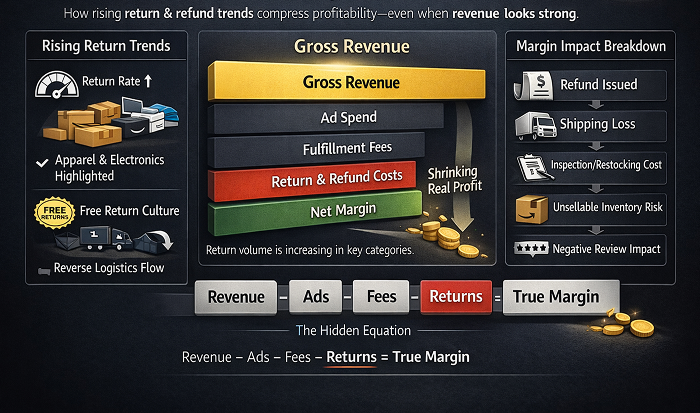
In 2025–2026, smart sellers treat Amazon Refunds and Returns as a standard line item in their margin calculations, just like ad spend and FBA fees. That means:
- Building a realistic “expected return rate” into your profit calculator by category.
- Adjusting list prices or bundling strategies so that expected return costs are baked in.
- Watching refund-related metrics monthly, not just annually.
Trying to operate on 5–10% profit after fees while ignoring return costs is a recipe for surprises later.
Why lower return rates help more than just profitability
Reducing Returns and Refunds Amazon doesn’t only protect your margins. It also:
- Stabilizes inventory planning (fewer surprise units flowing back).
- Improves review profiles (fewer angry “waste of money” reviews).
- Helps indirectly with ranking and Buy Box share over time via better performance signals.
In other words, return optimization is quietly one of the most leveraged activities a seller can invest in, especially as policies and buyer expectations become more return-friendly.
Adopting A Data‑Aware Mindset Around Amazon Refunds
A data-aware approach to Amazon Refunds and Returns doesn’t mean fighting every return. It means understanding the patterns, aligning your listing and expectations with reality, and making sure your pricing and operations assume that some level of Amazon Refund activity is simply part of doing business under modern Amazon Refund Policy.
