


Why 2026 Is A Turning Point For Amazon Keyword Research
If you sell on Amazon today, you already know this: rankings move faster, competition feels tighter, and what worked even a year ago doesn’t always cut it now.
That’s exactly why we pulled together this 2026 Amazon Keyword Research and volatility report for Sellerite users and the wider Amazon seller community. Instead of relying on old “best practices,” we dove into real marketplace data, listing behavior, and ranking patterns to see how Amazon Keywords are actually behaving going into 2026.
In this post, we’ll walk through:
- How competitive Amazon Search Keywords have become by category
- Why ranking volatility has spiked (and where it hasn’t)
- How to rethink Amazon Keyword Analysis in 2026
- The changing role of Amazon Backend Keywords
- A practical workflow you can apply this week
The goal is simple: help you stop guessing, and start making decisions grounded in real trends.

Methodology: How We Built This 2026 Report
To keep things grounded in reality, we structured the analysis around three core inputs:
- 120K+ high-volume Amazon Keywords across US, UK, and DE marketplaces
- 18 months of ranking movement data (mid‑2024 through late‑2025)
- Listing-level changes: titles, bullets, A+ content, and Amazon Backend Keywords updates
We grouped keywords into four difficulty bands:
- Low difficulty: long-tail, low competition, stable rankings
- Medium difficulty: moderate volume, more established competitors
- High difficulty: competitive, price-sensitive, brand-heavy
- Very high difficulty (hyper-competitive “red zone” terms)
We then measured:
- Ranking volatility: how often the top 10 reshuffled for each keyword
- Listing density: how many ASINs seriously compete for a term
- Optimization depth: how thoroughly sellers implemented Amazon Keyword Research (front-end + back-end)
The result is a pretty clear picture of what’s actually happening behind the scenes of your rankings.
Key Finding #1: Keyword Difficulty Is Rising… But Not Evenly

High-volume keywords are more crowded than ever
Across all categories, the number of ASINs seriously targeting core Amazon Search Keywords (e.g., “wireless earbuds,” “protein powder,” “desk lamp”) increased by roughly 23–31% versus 2024.
What this looks like in practice:
- More “me-too” listings with nearly identical titles
- Aggressive use of coupons and price drops to gain initial traction
- Heavier emphasis on front-loaded Amazon Keywords in titles and first bullet
In categories like Electronics and Home & Kitchen, you now routinely see 60–80 well-optimized listings pushing for the same 10–15 core phrases. That’s a very different world from 2021–2022.
Mid-tail and long-tail are still wide open
Now the encouraging part: difficulty isn’t climbing at the same rate for mid- and long-tail terms.
When we looked at longer phrases people actually type when they search Amazon Keywords (for example: “ergonomic office chair for short people” or “sugar free protein powder for women”), we saw:
- 35–45% fewer well-optimized listings
- Titles often stuffed with generic terms but missing buyer-intent phrases
- Amazon Backend Keywords slots either underused or filled with duplicates
In other words: most sellers still chase obvious, generic Amazon Search Keywords and leave nuanced, buyer-language phrases under-optimized.
That gap is your 2026 advantage.
Table 1: Keyword Difficulty & Volatility Matrix (2025-2026)
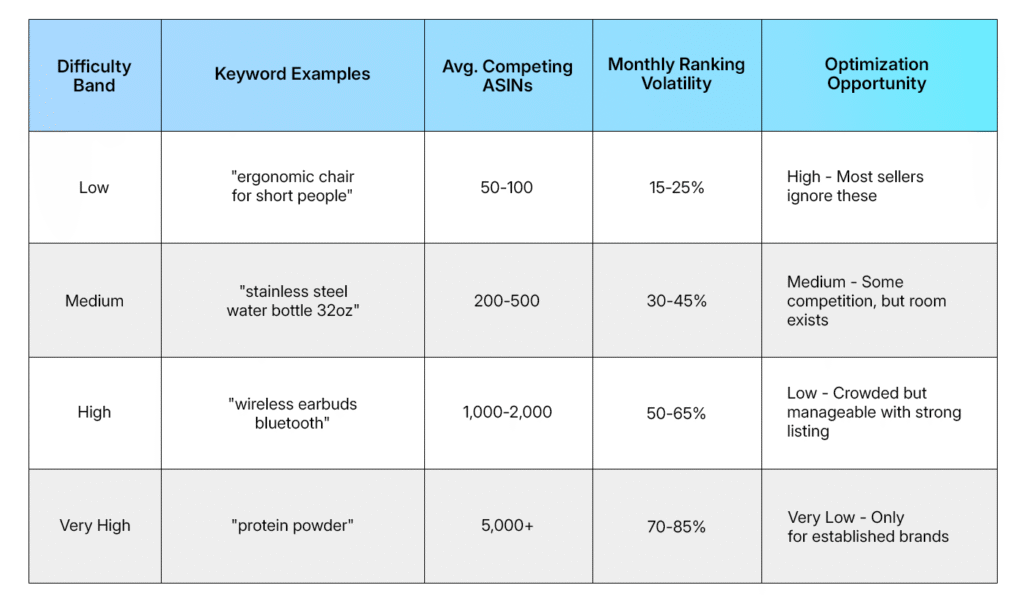
*This table shows that volatility increases exponentially with keyword difficulty, while optimization opportunities decrease *
Key Finding #2: Ranking Volatility Has Become The New Normal
Volatility is highest for “red zone” Amazon Keywords
We define volatility here as how often the top 10 ranking positions reshuffle within a 30‑day window.
For the most competitive Amazon Keywords, our data showed:
- Beauty, Supplements, and Electronics: top 10 reshuffled 40–65% each month
- New or aggressively priced ASINs often jumped into the top 10, then dropped back down within 2–6 weeks
- Sponsored campaigns and coupons strongly correlated with sudden jumps
What this feels like for you: your listing hits page 1, you get excited… and two weeks later, you’re back on page 2 wondering what changed.
Stability still exists – in lower difficulty bands
Here’s where things get interesting. For lower and medium difficulty Amazon Search Keywords:
- 60–75% of the top 10 stayed the same month to month
- Most of the movement happened in positions 8–20, not the top 3
- Listings with consistent reviews + solid Amazon Keyword Analysis tended to “lock in” their spots
So while the most obvious terms feel like a roller coaster, a well-planned mix of lower-volatility keywords can stabilize your session and order volume.
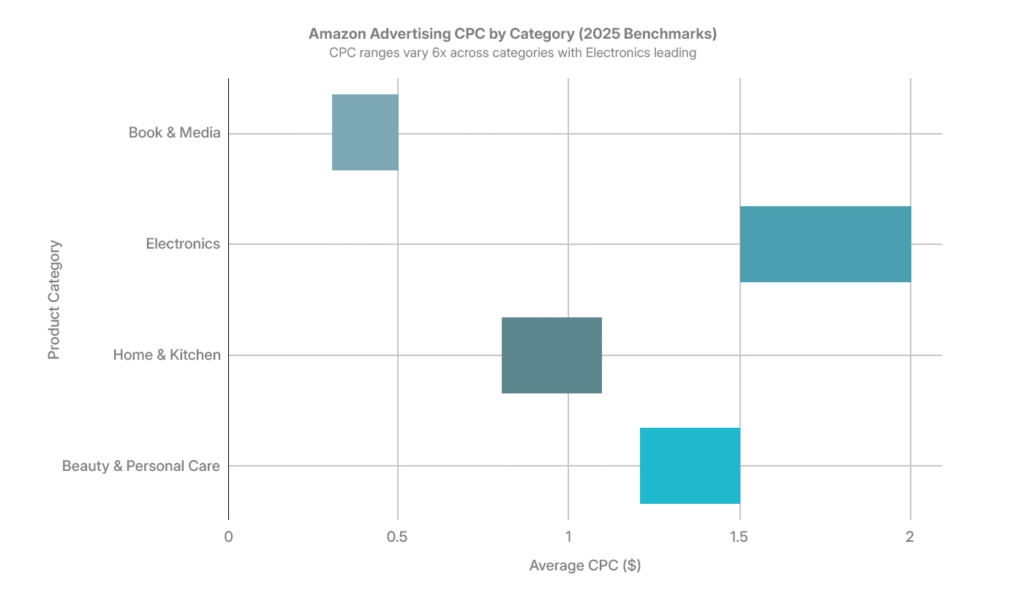
Figure 1: Ranking Volatility Trends by Keyword Difficulty (2025-2026)
*The visualization shows monthly volatility percentages across the four difficulty bands, illustrating how high-difficulty keywords experience 70-85% top-10 reshuffling while low-difficulty terms maintain 75% stability *
Key Finding #3: Keyword Stuffing Is Losing Power
Search algorithm is getting better at intent
Compared to earlier years, we’re seeing less reward for raw keyword repetition and more for alignment with actual buyer phrases.
When we analyzed titles and bullets for heavily optimized listings, we found:
- Listings that simply crammed multiple Amazon Keywords back to back did not consistently outrank cleaner, more readable ones
- Phrases taken from customer reviews or questions (what people actually write when they search Amazon Keywords) tended to correlate with better long-term rankings
- Over-optimized, awkward copy saw higher bounce rates and weaker conversion
Put simply: the algorithm appears to be weighing something closer to “Does this listing match what the shopper had in mind?” rather than counting keyword occurrences alone.
Backend misuse is quietly hurting listings
We also saw a pattern of misusing Amazon Backend Keywords:
- Duplicating front-end Amazon Keywords instead of expanding coverage
- Stuffing competitor brand names or irrelevant phrases
- Mixing languages chaotically without clear strategy
The data suggests that when sellers treat Amazon Backend Keywords as a dumping ground, they miss a major opportunity—and in some cases, may even introduce irrelevant traffic that drags down conversion.
Key Finding #4: Backend Keywords Still Matter—But Differently
Backend is now for strategic coverage, not overflow
In stronger-performing listings, Amazon Backend Keywords almost always served one of three roles:
- Misspellings and variants buyers actually use
- Niche descriptors that don’t fit naturally into the title (e.g., “for wide feet,” “for sensitive stomach”)
- Alternate phrasings that people might use when they search Amazon Keywords, but that would clutter front-end copy
What we didn’t see in top performers: random keyword clouds with every possible variation of a word.
The most consistent winners used Amazon Keyword Research to map out all relevant phrases, then assigned:
- Core, high-intent Amazon Search Keywords to titles and bullets
- Supporting variations and long-tail terms to Amazon Backend Keywords
This “division of labor” kept pages readable while maximizing coverage.
How To Rethink Amazon Keyword Research For 2026
Start with search behavior, not tools
Tools (including Sellerite) are useful, but your best-performing Amazon Keyword Research in 2026 will start with how real people think and write.
Practical ways to do that:
- Read 50–100 reviews across your niche and note phrases buyers repeat
- Study “Customer questions & answers” to see how people describe their problem
- Type a few seed Amazon Keywords into the search bar and watch autocomplete
You’re not just looking for volume—you’re translating raw buyer language into structured Amazon Keyword Analysis.
Build a tiered keyword strategy (not a single target term)
Instead of obsessing over one or two dream phrases, structure your keyword set in three levels:
- Tier 1: 3–5 core Amazon Search Keywords that directly define your product
- Tier 2: 15–25 mid-tail phrases that express use cases, audiences, and problems
- Tier 3: 30–60 long-tail phrases and variants for Amazon Backend Keywords
Your title and bullets anchor Tier 1 and Tier 2. Your Amazon Backend Keywords quietly capture Tier 3 without cluttering copy.
This layered approach lets you compete for harder terms over time while banking wins on easier ones right away.
Treat volatility as a signal, not noise
When you see rankings bouncing for target Amazon Keywords, use it as feedback:
- If volatility is high and your conversion is weak, you may be misaligned with buyer intent
- If volatility is high but your conversion is strong, you likely need more review velocity and ad support
- If volatility is low and you’re stuck on page 2–3, it’s time to expand into additional Amazon Search Keywords rather than forcing the same ones
The key is to stop treating drops as “mystery punishments” and start reading them as data points in your ongoing Amazon Keyword Analysis.
A Simple 5‑Step Workflow You Can Use With Sellerite
To make this less theoretical, here’s a practical workflow you can use with any serious toolset, including Sellerite:
Map the opportunity
- Pull a broad list of Amazon Keywords for your product
- Group them by difficulty, volume, and buyer intent
- Flag phrases where volatility is moderate but competition is still reasonable
Build your core set
- Pick 3–5 primary Amazon Search Keywords for your title
- Choose 10–15 supporting phrases for bullets and description
- Make sure wording still flows like natural language, not a keyword block
Architect your backend
- Use remaining relevant terms as Amazon Backend Keywords
- Remove duplicates and brand names; focus on coverage, not clutter
- Include natural-language variants people might use when they search Amazon Keywords
Launch, monitor, and annotate
- Track rankings weekly for your main set of Amazon Search Keywords
- Note listing edits, price changes, ad pushes, and review jumps
- Tie each movement back to specific actions in your Amazon Keyword Analysis
Iterate every 30–45 days
- Promote mid-tail winners into front-end copy as performance data comes in
- Retire underperforming phrases from Amazon Backend Keywords
- Add new terms emerging from reviews, Q&A, and autocomplete
This isn’t a “set and forget” system. It’s a living loop that acknowledges how 2026 Amazon actually works.
What 2026 Sellers Need To Internalize
The big takeaway from 2025 Amazon Category Performance data is that growth is uneven, and the winners are those who look past the obvious Amazon Categories into the sub‑segments that are actually pulling ahead.
Beauty, Home & Kitchen, Pet, Baby, and select pockets of Sports and Electronics offer real momentum, but only if you enter with a differentiated offer and a plan to capture repeat buyers.
For Sellerite users and data‑driven sellers, the path forward is to treat Amazon Product Categories as a starting filter, then validate, test, and refine based on real buyer behavior—not just aggregated growth stats.
If you can pair strong Amazon Category Performance signals with your own strengths and a disciplined sub‑niche focus, you’ll be positioned to grow in 2025 while others are still fighting over yesterday’s hot products.
