

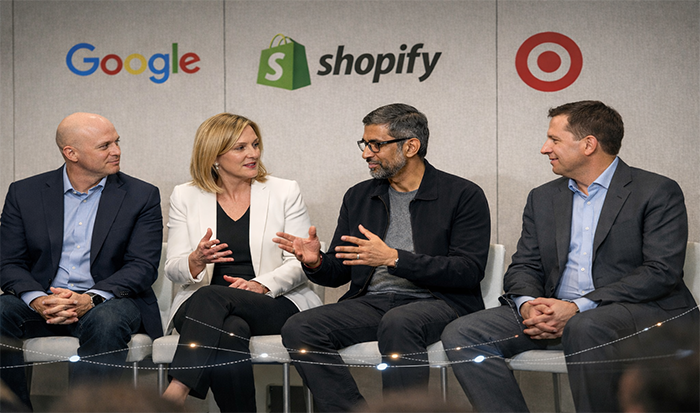
Major retailers including Google, Shopify and their partners have developed an industry-wide standard that allows Artificial Intelligence (AI) to make purchases on behalf of customers across various e-commerce channels without needing human involvement. This new standard reflects both the increasing influence of AI on how consumers buy products as well as the desire to streamline the purchase experience by removing obstacles during checkout.
The initiative was announced Sunday at the National Retail Federation’s annual conference in New York and centers on the Universal Commerce Protocol (UCP). Co-developed by Google alongside companies such as Shopify, Etsy, Wayfair, Walmart, and Target, the protocol is designed to create a common framework that allows AI tools to move shoppers seamlessly from product discovery to purchase.
More than 20 retailers, platforms, and payment providers have already endorsed UCP, including Home Depot, Best Buy, Macy’s, Mastercard, and Visa. The goal is to eliminate the need for shoppers to jump between different apps, websites, and checkout systems — a major source of cart abandonment in online retail.
According to Google, UCP will soon support in-conversation shopping experiences within AI Mode in Search and the Gemini app, allowing users to complete purchases without leaving the chat. Similar integrations are planned with other AI assistants, including Microsoft Copilot.
Part of this transition is to implement so-called “agentic” commerce in which Artificial Intelligence (AI) performs not only recommendations on what products to buy but also facilitates fulfilling orders such as: Checkout; Payment; Completing Order. Checkout has consistently been cited as the most vulnerable portion of the shopping experience by retailers because of a lack of consistency in rules regarding payment processing, returns and exchange policies, loyalty programs, and delivery.
However, consumer trust remains a hurdle. While AI already drives significant retail influence — accounting for roughly 20% of sales during the recent holiday season, according to Salesforce — a separate study shows only 17% of shoppers are comfortable letting AI complete purchases on their behalf. The future of AI-driven commerce will depend on building trust through clearer standards and smoother experiences.
