




Table of Contents
What Is Amazon’s Marketing Strategy?

In practice, that flywheel blends:
- Relevance: Your listing and ads match the exact words shoppers type.
- Velocity: You generate consistent sales (paid and organic) for your target keywords.
- Experience: You fulfill fast, price competitively, earn reviews, and keep customers happy.
When those three lock in, Amazon’s ranking and ad systems push you higher, lowering your cost per sale while boosting market share. That’s why sellers who get it right often see compounding returns that feel different from other channels.
You’ll hear this question a lot: What is Amazon’s marketing strategy? On the platform level, Amazon focuses on selection, price, and convenience, anchored by customer obsession. For sellers, an effective Marketing Strategy for Amazon mirrors that mindset—optimize for the customer first, then align your SEO, PPC, pricing, and operations to feed the conversion loop.
Why Amazon Strategy Works So Well (Real Reasons Sellers Feel It)
- Shoppers arrive with wallets open and comparisons at their fingertips.
- Prime trust, 1–2 day shipping, and familiar UX crush friction.
- Reviews serve as social proof at the exact moment of truth.
Here’s the human part: sellers feel the difference. A founder launches a new SKU, invests in a smart Amazon Strategy (clean listing, tight PPC, a few coupons), and within a week they’re seeing impressions turn into orders. The math starts to work. More sales bring better rankings, better rankings reduce cost-per-click, lower CPCs let you widen your keyword net—and suddenly, growth doesn’t feel like a guessing game.
But it’s not effortless. The same engine punishes stockouts, sloppy pricing, weak images, and slow responses. Sellers who respect the system—relevance, velocity, experience—win. Those who try to “game” it burn cash.
The Core Pillars of an Effective Amazon Marketing Strategy
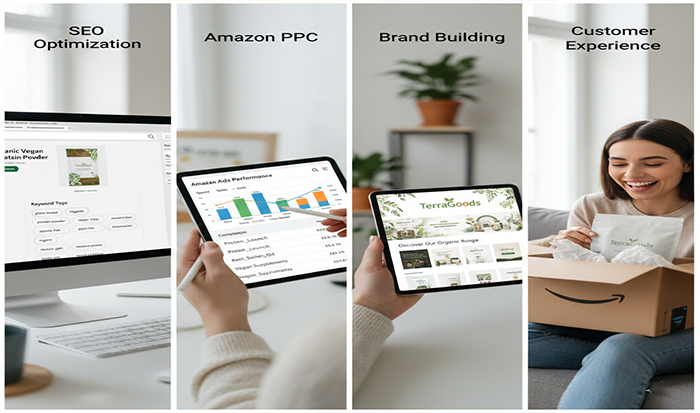
Amazon SEO & Listing Optimization
Keyword research:
- Build a master keyword map: primary, secondary, long-tail, competitor terms.
- Use Brand Analytics and Search Query Performance (if enrolled) to validate demand.
Listing structure:
- Title: Frontload your primary keyword and key differentiator. Keep it readable.
- Bullets: Benefits first, features second. Think outcomes, not specs.
- Description/A+ Content: Tell the story, remove objections, add comparison charts, FAQs, and lifestyle imagery. If eligible, use Premium A+ modules for enhanced layouts.
- Backend keywords: Include synonyms and misspellings. No repetition, no punctuation needed.
Visuals:
- Main image: Crisp, true-to-product, white background, fills frame.
- Gallery: Show scale, use infographics for key features, include a 15–45 second product video.
- Mobile-first: Your first 2–3 images do most of the conversion work on phones.
Conversion levers:
- “Manage Your Experiments” to A/B test titles, main images, and A+.
- Use comparison tables to keep shoppers in your brand ecosystem.
- Add a Brand Story module to weave credibility and range.
Variation strategy:
- Parent-child variations consolidate reviews and reduce choice paralysis.
- Only group legitimate variations (size/color/pack). Avoid abuse; Amazon does audit.
Amazon PPC Advertising
Ad types:
- Sponsored Products: High-intent, keyword, and ASIN targeting. Your workhorse.
- Sponsored Brands (including video): Top-of-search visibility and brand discovery. New-to-brand metrics in many locales.
- Sponsored Display: Retargeting and category/competitor awareness. Great for defense and cross-sell.
Campaign structure:
- Harvesting: Auto campaigns to discover, Broad for exploration, Phrase/Exact for control.
- Negatives: Trim waste. Add poor performers as negatives weekly.
- Single keyword ad groups (for hero terms) to control bids and placements.
Bidding & budgets:
- Start with “dynamic bids – down only” for control; test “up & down” on high converters.
- Placement modifiers for top-of-search when conversion is strong.
- Dayparting can reduce late-night waste if data supports it.
Metrics to watch:
- ACOS (ad spend ÷ ad revenue): Efficiency of ads.
- TACoS (ad spend ÷ total revenue): Impact on overall business. Aim to reduce over time as organic lifts.
- CVR, CPC, CTR by placement: Optimize creatives and bids.
Lifecycle approach:
- Launch: Higher bids on core terms, lean on coupons to lift CVR.
- Scale: Expand long-tail, add Sponsored Brands video, and refine search terms.
- Defend: Bid on your brand, protect your detail pages with Sponsored Display.
- Mature: Shift budget to high-ROAS clusters; test DSP if available to you.
Organic Ranking Strategy
- Map 8–15 “hero” keywords; design your listing and PPC to win those first.
- Use ads, coupons, and deals to drive early momentum and improve CVR.
- Keep prices stable; frequent swings can hurt Buy Box and trust.
- Avoid stockouts at all costs—ranking drops are painful to rebuild.
- Leverage external traffic with Amazon Attribution and Brand Referral Bonus where available; cheaper clicks plus ranking fuel is a powerful combo.
Review & Ratings Strategy
Pre-conditions:
- Nail product quality, packaging, and instructions. Less confusion = fewer returns and negatives.
Review generation (within policy):
- Enroll eligible ASINs in Amazon Vine to seed credible reviews.
- Use Amazon’s “Request a Review” button (automated, compliant).
- Set up a compliant, value-adding follow-up message (no incentives, no gating).
Ongoing hygiene:
- Reply to negative reviews with empathy and solutions.
- Use “Customer Reviews” and “Voice of the Customer” to spot recurring issues.
- Variation strategy can ethically pool reviews across color/size if truly the same product.
Pricing Strategy for Amazon
- Understand your landed cost and contribution margin after referral + FBA + storage fees.
- Use repricing rules or tools to stay competitive without racing to the bottom.
Buy Box dynamics:
- Landed price (item + shipping), stock status, seller metrics, and Prime eligibility drive share.
Tactics:
- Coupons (green badge) can lift CTR and CVR while preserving list price.
- Prime Exclusive Discounts during events can boost rank velocity.
- Test bundles and multi-packs to shift price tiers and improve per-order margin.
Guardrails:
- Respect MAP where applicable; protect brand equity.
- Never discount so deep that your ad + fee structure goes negative long term.
Customer Experience Strategy
Fulfillment:
- FBA for Prime eligibility, better conversion, and operational simplicity.
- Watch IPI, restock limits, and storage fees; plan inventory forward.
Service:
- Respond to buyer messages within SLA; keep ODR and late shipment rates low (for FBM).
- Clear, friendly instructions reduce post-purchase confusion and returns.
Quality loop:
- Mine returns and Q&A to improve the product and listing content.
- Use packaging to set expectations and highlight differentiators.
Brand Building on Amazon
- Enroll in Brand Registry to unlock A+ Content, Brand Analytics, Store, and more.
- Create a cohesive Amazon Store with clear navigation, bestsellers above the fold, and seasonal modules.
- Use Brand Story and comparison charts to keep shoppers within your catalog.
- Drive off-Amazon demand with Amazon Attribution links and (where available) Brand Referral Bonus.
- Consider Amazon Live or influencer content where relevant to your category and region.
- Encourage follow-ups on your Store (where available) to nurture repeat demand.
Amazon Seller Marketing Strategy vs Traditional E-Commerce Marketing

- Traffic intent: On Amazon, people search with high purchase intent; on DTC sites, traffic is often interruption or discovery-driven.
- Data ownership: Amazon gives limited customer data; DTC lets you own CRM, email, and SMS lists.
- Conversion drivers: Amazon relies on reviews, Prime, Buy Box, and price; DTC relies on UX, brand story, offers, and trust signals.
- Creative freedom: Amazon listings are constrained; DTC sites give full design/control over the experience.
- Speed to learn: Amazon gives fast feedback via PPC and rankings; DTC learning is slower and needs multi-touch attribution.
- Competition: On Amazon you sit next to competitors on the same shelf; on DTC you own the shelf and flow.
- Fees: Amazon charges referral, FBA, and storage fees; DTC has payment processing plus ops and ad costs.
- Algorithm influence: Amazon visibility depends on search, sales velocity, and CX; DTC depends on your SEO/ads and your site logic.
- Retention: Amazon limits direct remarketing; DTC enables rich lifecycle marketing (email/SMS, loyalty).
- Logistics impact: On Amazon, inventory/fulfillment directly affect visibility; on DTC they affect customer experience more than rankings.
Proven Amazon Marketing Strategies Used by Top Sellers
- Hero SKU focus before catalog sprawl: Build rank and reviews on 1–3 core products first; let them pull the rest of the line.
- Keyword cluster domination: Own your top cluster with exact match, optimize listing semantics, and run defense on variations.
- Structured PPC funnels: Auto/Broad to discover, Phrase/Exact to scale, Sponsored Brands video for mid-funnel, Sponsored Display for defense/retargeting.
- Conversion-led creatives: Mobile-optimized main image, crisp infographics, short explainer video, A/B tests via “Manage Your Experiments.”
- Price signaling with margin control: Strategic use of coupons and Prime Exclusive Discounts to lift CVR while protecting contribution margin.
- Review velocity without risk: Vine, compliant review requests, frictionless packaging, fast resolutions to negatives.
- Inventory as a marketing lever: Stay in stock, avoid aged inventory penalties, maintain restock coverage for peak keywords.
- Parent-child architecture: Consolidate reviews and simplify the shelf with legitimate variations and bundles.
- Brand defense and smart conquesting: Bid on your brand; selectively conquest competitor terms with differentiated creatives and landing pages.
- External traffic with attribution: Warm audiences from social/search to Amazon with Amazon Attribution; leverage Brand Referral Bonus where available to offset fees and signal ranking.
Story: How a Small Seller Scaled Using Smart Amazon Marketing Strategies
Here’s what changed:
- Positioning shift: Instead of “silicone mat,” we reframed as “precision baking surface for flawless macarons and pastries.” That guided keywords, images, and copy.
- Listing overhaul: We shot a clean main image showing thickness and texture, added a 30-second video (batter piping, oven footage, easy cleanup), and built A+ with a temperature resistance chart and a comparison to cheaper competitors.
- Keyword plan: We mapped 12 core keywords (macaron baking mat, pastry mat, silicone baking sheet) and 40+ long-tail variations.
- PPC structure: Auto (harvest), Broad (explore), and Exact for the 12 core terms; Sponsored Brands video for “macaron baking mat.”
- Conversion helpers: A 10% coupon at launch and a simple size guide in the second image reduced returns.
- Reviews: Enrolled in Vine for the first 30 units; turned on “Request a Review” automation.
Results over 90 days:
- CTR doubled after the image change and coupon.
- CVR rose from ~9% to ~18% as reviews crossed 75 with a 4.6 average.
- ACOS started at 43%, settled near 28%; TACoS dropped from 19% to 10% as organic rank rose.
- Sales climbed to 40–50 units/day, with seasonal peaks around baking holidays.
- No hacks. Just a disciplined Amazon Seller Marketing Strategy aligned to how shoppers decide.
Mistakes Sellers Make While Building Their Amazon Strategy

- Launching too many SKUs too fast: Focus resources on a hero product. Earn rank and reviews before expanding.
- Copy-pasting DTC messaging: Amazon is benefits-first, scannable, and comparison-rich. Strip fluff; emphasize outcomes and proof.
- Ignoring the main image: It’s your billboard. Test it relentlessly; small changes yield big CTR lifts.
- Treating PPC as a faucet, not a strategy: Without harvesting, negatives, and placement optimization, you’ll overspend and learn nothing.
- Underestimating operations: Stockouts crush ranking; poor packaging inflates returns. Inventory and CX are marketing.
- Racing to the bottom on price: Use bundles, variations, and value framing instead of blanket discounts.
- Neglecting backend keywords and attributes: Missing attributes harm indexing and filters. Complete every field relevant to your category.
- Not measuring TACoS: ACOS can look great while overall sales stagnate. TACoS tells you if ads lift total revenue.
- Failing to defend your brand: If you don’t bid on your brand name or protect your detail page, competitors will.
- Chasing hacks over habits: Sustainable growth comes from iterative testing, not short-lived loopholes.
- Actionable fix: Run a monthly optimization cadence—keywords, images, A/B tests, PPC search term pruning, inventory forecasting, and CX review.
How to Create a Powerful Marketing Strategy for Amazon (Step-by-Step Guide)
- Define your success metrics: Choose targets for revenue, profit, TACoS, review count/average, and in-stock rate. Make them time-bound.
- Map your market and positioning: Identify top competitors, price bands, and feature gaps. Write a one-line value promise that appears in your title and first image.
- Build your keyword universe: Combine research tools with Brand Analytics and Search Query Performance (if available). Cluster by intent (primary use case, materials, problems solved).
- Architect your listing: Write benefit-first bullets, frontload keywords in the title, and complete every attribute. Create A+ with a comparison chart and Brand Story.
- Produce conversion-grade creatives: Main image for CTR, 2–3 infographic images, 1–2 lifestyle shots, and a short product video. Think mobile-first.
- Set up your PPC foundation: Create Auto (harvest) + Broad (explore) + Phrase/Exact (control). Add Sponsored Brands (incl. video) for your primary cluster; Sponsored Display for defense.
- Establish budgets, bids, and negatives: Start with competitive bids on core terms, review search terms twice weekly, and add negatives to control waste.
- Plan your pricing and promos: Model contribution margin with fees. Use a launch coupon (5–15%) to lift CVR; test Prime Exclusive Discounts during high-traffic periods.
- Seed and manage reviews: Use Vine (eligible ASINs), automate “Request a Review,” and resolve negatives quickly with genuine support.
- Protect the Buy Box and stock levels: Forecast inventory, maintain healthy restock coverage, and avoid price volatility that risks Buy Box loss.
- Expand through variations and bundles: Add legitimate variants to concentrate reviews. Use Virtual Bundles (brand-registered) to raise AOV and defend shelf space.
- Integrate external traffic: Drive warm audiences via search/social with Amazon Attribution. Where available, leverage Brand Referral Bonus to offset fees and support ranking.
Final Thoughts: Why Amazon’s Marketing Strategy Still Dominates the E-Commerce

Will competition intensify? Always. But brands that commit to clarity of positioning, conversion-grade creatives, disciplined PPC, ethical review building, smart pricing, and world-class operations keep winning—year after year. If you build the flywheel and keep it turning, Amazon keeps meeting you with more momentum.
So ask yourself: which 1–2 moves will lift your relevancy and conversion this month? Start there. Then show up next month, do it again, and watch the marketplace start working for you.
FAQs
1. What is Amazon’s marketing strategy in simple words?
2. What’s the fastest way to boost conversions on my listing?
3. How much budget should I start with for Amazon PPC?
4. How long does it take to rank for target keywords?
5. Should I use coupons or drop the list price?

 Back to top
Thought Leadership, Tips, and Tricks
Never miss insights into the Amazon selling space by signing up for our email list!
Read more


Expert
strategies
delivered
to your
inbox
top industry minds to fuel
your brand’s growth.

Send request to Sellerite
Once you submit the consultation form, we’ll dive into the details and email you a tailored report within 24-48 hours.
"*" indicates required fields
*By submitting your Email Address, you are agreeing to all conditions of our Privacy Policy.
