



Table of Contents
Introduction: Why Amazon FBA is Essential for Sellers

Explain what Fulfillment by Amazon (FBA) is
Picture this: you’ve got a product people love, but your spare bedroom looks like a warehouse, and every evening disappears into packing tape and shipping labels.
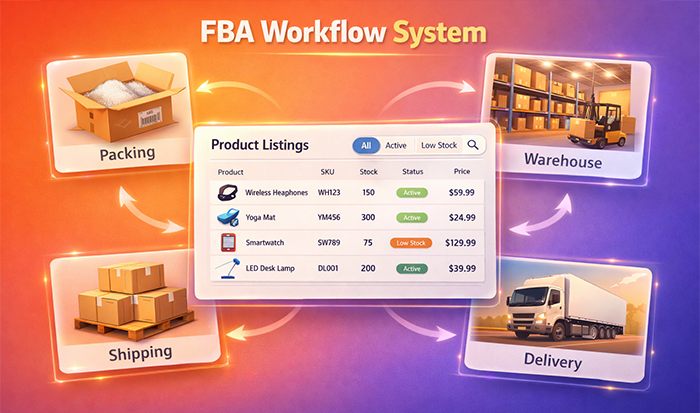
Fulfillment by Amazon (FBA) flips that script. You ship inventory to Amazon’s fulfillment centers, and Amazon handles storage, picking, packing, shipping, returns, and customer service.
Your offer earns Prime eligibility, your customers get fast delivery, and you get time back to focus on growth.
- Faster delivery with Prime eligibility that boosts trust and conversion
- Amazon manages customer service and returns at scale
- Scalable logistics without renting a warehouse or hiring staff
- Access to multiple marketplaces and programs with one operational backbone
- Better Buy Box odds due to reliable shipping performance
Understanding Amazon FBA Costs
Fulfillment Fees Breakdown
At first glance, FBA’s fee structure can feel like alphabet soup. Once you break it down, it’s surprisingly logical. You’ll typically pay two core fees: a per-unit fulfillment fee and a monthly storage fee.
The fulfillment fee depends on your item’s size and weight; standard-size products cost less than oversize or heavy/bulky items. Storage is charged by cubic foot and fluctuates by season, with higher rates during peak months.
For most sellers, the per-unit fulfillment fee is the biggest lever. It covers picking and packing, shipping to customers, and basic customer service.
If your product sits in a more expensive size tier because of a few millimeters or grams, re-engineering packaging can shift you into a lower bracket—often yielding more profit than simply raising price.
Storage, meanwhile, rewards healthy sell-through. The longer inventory sits, the more penalties creep in, especially in Q4.
Key components:
- Pick and pack fee (per shipped unit)
- Outbound weight handling (size/weight tier)
- Monthly storage (by cubic foot, seasonally adjusted)
- Aged inventory surcharges (long-stay stock)
- Returns processing fees (category-dependent)
Hidden Fees to Watch Out For
- Aged inventory surcharges for items lingering beyond set thresholds
- Returns processing fees (notably in apparel, shoes, and high-return categories)
- Removal and disposal order fees for clearing slow stock
- Inbound shipping to fulfillment centers (Partnered Carrier, SPD/LTL/FTL)
- Labeling and prep fees if Amazon performs these services
- Storage overage fees during peak if you exceed capacity limits
- Inventory placement service fees (if you choose fewer destination FCs)
- Dimension/weight re-measure adjustments impacting fees
How to Calculate Your ROI With FBA
- Basic ROI formula: ROI =
- (NetProfit÷LandedCostofGoods)×100
- (NetProfit÷LandedCostofGoods)×100
- Net Profit = Selling Price − Referral Fee − FBA Fulfillment Fee − Storage (allocated) − Inbound Freight − Packaging/Prep − Returns Allowance − Advertising Cost − COGS
Example: You sell at $29.99. COGS is $8. FBA and referral fees total $10. Ads average $4 per unit. Returns allowance is $1. Net Profit = 29.99 − (8 + 10 + 4 + 1) = $6.99. ROI =
- 6.99÷8×100
- 6.99÷8×100 ≈ 87%. With this, you can answer “is Amazon FBA worth it?” using data. If ROI dips below your threshold after stress tests (Q4 storage, fee changes, return spikes), you know to reprice, repackage, or rethink.
Amazon FBA for Beginners: Step-by-Step Setup
Creating Your FBA Account
Getting setup right the first time saves headaches later. Move step-by-step and document everything.
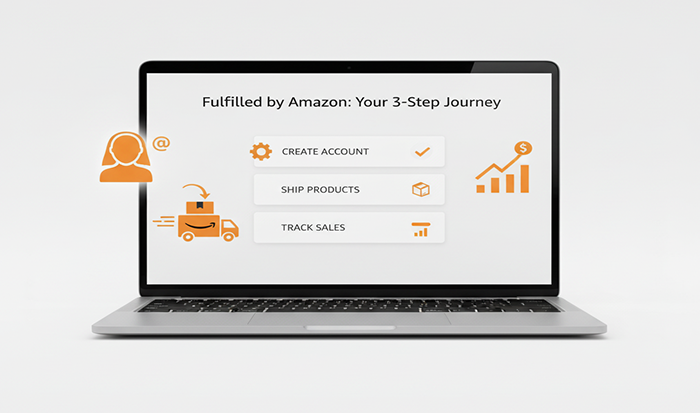
- Create a Professional Seller account.
- Complete identity verification, business info, and tax interviews.
- Configure marketplace settings and enable FBA.
- Add products (create new listings or match existing ASINs).
- Convert SKUs to Fulfilled by Amazon in Manage Inventory.
- Set labeling and prep preferences (merchant-applied vs. Amazon).
- Configure payments, returns, and notification settings.
- Create your first inbound shipment plan.
Sending Inventory to Amazon Warehouses
Two essentials: packaging/labeling and shipping methods. Packaging must prevent damage across multiple handling stages. Each unit needs a scannable barcode (FNSKU or manufacturer barcode if eligible), any required safety labels, and protective materials. Cartons must meet weight and dimension limits. For shipping, Small Parcel Delivery (SPD) with Amazon Partnered Carriers is cost-effective for modest volumes, while LTL/FTL is better for pallets and larger loads.
Tips:
- Use carton-level content info to speed receiving
- Double-check box contents accuracy to avoid delays and discrepancies
- Photograph cartons and labels before pickup for documentation
- Stagger shipments to maintain in-stock rates without choking cash flow
Managing Inventory and Orders
- Restock management: Forecast weekly, factor lead-time variability, and watch Restock Limits or Capacity Monitor. Plan promotions early and allocate buffer inventory.
- Inventory health: Track sell-through, aging tiers, and stranded inventory. Use removal orders strategically to prevent surcharges. Fix listing suppressions promptly.
- Order flow: Review customer service reports, return reasons, and defect trends. Improve product pages and packaging to reduce preventable returns.
Opportunities with Amazon FBA
Scaling Your Business Efficiently
- Add new SKUs without expanding fixed overhead
- Standardized shipping and CS free you to prioritize marketing and product
- Predictable fulfillment improves forecasting and cash planning
- Easier to run promotions when fulfillment is turnkey
Leveraging Amazon Prime and Fast Shipping
Prime is more than speed—it’s a trust signal. Many shoppers filter by Prime and expect reliable delivery windows. The badge lifts click-through and conversion, often enough to justify competitive pricing.
- Higher Buy Box win rate at similar prices
- Reduced cart abandonment due to delivery confidence
- Stronger ad performance because conversion rates improve
Accessing Global Marketplaces with FBA
- Expand to Canada, UK, EU, Australia, Japan, and the Middle East
- Use EFN/Pan-EU or NARF-style programs to test without heavy upfront investment
- Centralize support while you validate pricing, compliance, and localization needs
- Gradually move from cross-border fulfillment to in-country stock as volume grows
Challenges Sellers Face with Amazon FBA
High Competition and Saturated Niches
Data-driven positioning helps. Study competitor reviews to identify gaps you can fill. Benchmark price-to-value across the top results. If the space is purely a race to the bottom, reconsider. There are always sub-niches or feature combinations that reward thoughtfulness. Your aim is not just to be present; it’s to be chosen.
Inventory and Cash Flow Management
Use rolling forecasts that incorporate recent velocity, seasonality, and marketing plans. Build supplier relationships that support flexible MOQs and faster turns.
If lead times are long, place staggered POs to smooth arrivals and reduce the risk of outages or overhangs. When cash is tight, prioritize high-contribution SKUs and delay marginal additions until your turns improve.
Cash discipline pairs with tactical moves: negotiate better freight rates, optimize cartonization to reduce damages, and keep a contingency plan for expedited replenishments without relying on costly air freight.
Over the long run, brands that manage inventory flow with precision outlast those who swing between feast and famine.
Policy Compliance and Account Health
Violations risk suppressions or worse, even if fulfillment is flawless. Keep a compliance checklist to guard against accidental errors, and audit your listings regularly, especially after packaging or formulation changes.
Respond promptly to warnings with clear Plans of Action. Healthy account metrics protect your catalog and ensure the logistics advantages of FBA aren’t undermined by preventable issues.
Advanced Tips for Maximizing FBA Success

Optimizing Product Listings for Better Sales
Your listing is your storefront, salesperson, and brand all in one. Treat it like a dynamic asset that you improve every month.
Do this:
- Lead with benefits in titles and bullets, weaving in natural phrases from this Amazon FBA guide
- Use high-res images, lifestyle scenes, comparison charts, and infographics addressing objections
- Build A+ Content and a concise brand story to boost dwell time and trust
- Answer customer questions promptly; encourage authentic reviews
- Test main image, price, and first bullet—small lifts compound
Insight: A 1–2% conversion increase can meaningfully drop your ad spend per sale and raise your organic rank—creating a virtuous cycle.
Minimizing Costs Without Sacrificing Quality
Do this:
- Engineer packaging to fit lower FBA size tiers without risking damage
- Negotiate price breaks tied to on-time forecasts and quality metrics
- Use removal orders before aged surcharges; liquidate via value channels
- Track return reasons weekly; fix root causes in design, QC, or listing clarity
- Consolidate inbound shipments smartly; compare SPD vs. LTL by season
Insight: Reducing landed cost by 5–8% often outperforms raising price by the same amount while keeping you competitive.
Using AI and Tools to Streamline FBA Operations
Smart tooling compresses routine work and sharpens decisions. You’re still the strategist—tools just give you X-ray vision.
Do this:
- Forecast demand with seasonality and promo overlays; flag stockout risk windows
- Mine reviews with AI to find recurring issues and new feature opportunities
- Automate ad bids around ACOS/ROAS targets; pause ads when inventory is tight
- Monitor fee changes, re-measures, and storage risk with alerts
- Use dashboards to track contribution margin, not just revenue
Insight: Automation handles the 80%; review exceptions weekly to prevent drift and catch costly outliers early.
Case Study: How a Seller Succeeded with Amazon FBA
That change alone dropped the fulfillment fee by more than a dollar a unit. Suddenly, ads were viable and price tests had room to breathe.
They built a listing that felt “lived-in”: lifestyle photos under a desk, a quick video demo, and bullets tackling common objections—noise, slippage, durability. Reviews surfaced a pattern: people wanted a carry pouch. They added it within two weeks and updated images immediately.
Lessons learned:
- Engineer to fee tiers first; design for delight second
- Write copy for outcomes (looser hips, quieter rolling), then features
- Treat reviews like a roadmap; iterate fast on product and listing
- Split POs to protect cash; stagger inbound shipments to avoid stockouts
Six months in, the brand launched two complementary SKUs, expanded to Canada via FBA, and kept ACOS healthy by protecting conversion—constant testing of images and A+ content yielded incremental gains that compounded.
Is Amazon FBA Worth It in 2026?

A balanced lens helps. Run is Amazon FBA worth it assessments by SKU using conservative assumptions. If your model breaks with modest headwinds, iterate—repackage, reposition, bundle, or walk away. There’s opportunity, but it’s earned, not given.
When it’s worth it:
- Strong margins after ads, returns, and peak storage
- Differentiated value (design, IP, brand, community, bundle)
- Predictable supply chain with quality control baked in
- Prime eligibility plus optimized listings that convert
When it’s not:
- Competing only on price in saturated niches
- Unreliable lead times and thin capital
- Ignoring aged inventory, fee changes, and return causes
- Weak compliance posture and inconsistent product quality
Bottom line: treat this Amazon FBA guide like a decision framework. If your data says “go,” FBA can scale you faster than almost any other channel—without buying forklifts.
Conclusion

FBA takes care of the heavy lifting so you can focus on levers that actually build a brand: product quality, story, reviews, and smart marketing.
Success comes from disciplined operations, understanding fees, forecasting inventory, and minding policy compliance, paired with creative differentiation.
Use the insights from this Amazon fulfillment guide to engineer your margins, optimize listings, reduce returns, and automate the routine.
At Sellerite, we help Amazon sellers improve ROI and scale efficiently with data-backed strategies. If you’re serious about profitable growth, we’ll help you turn the moving parts into a repeatable system.
FAQs
1. What is Amazon FBA and how does it work?
2. What are typical Amazon FBA costs?
3. How do I know if my product is profitable with FBA?
4. What are common mistakes beginners make?
5. Can I sell internationally with FBA?

 Back to top
Thought Leadership, Tips, and Tricks
Never miss insights into the Amazon selling space by signing up for our email list!
Read more

Expert
strategies
delivered
to your
inbox
top industry minds to fuel
your brand’s growth.

Send request to Sellerite
Once you submit the consultation form, we’ll dive into the details and email you a tailored report within 24-48 hours.
"*" indicates required fields
*By submitting your Email Address, you are agreeing to all conditions of our Privacy Policy.
