



Table of Contents
Introduction to Amazon Advertising

Why Amazon PPC matters in 2026
By 2026, Amazon has evolved to not only be a retailing behemoth, but an ad behemoth. Each month, thousands of new sellers come online, so visibility—and profitability from advertising—become essential.
Without a meticulously crafted Amazon PPC strategy, even great products get buried. Amazon PPC matters now more than ever because:
- Organic reach alone is seldom enough; paid ads often dictate visibility.
- Amazon’s algorithm increasingly favors sponsored placements.
- Rising ad costs and competition make ad ROAS (Return on Ad Spend) a boardroom metric, not just a marketing one.
Difference Between Amazon PPC and Amazon DSP Campaigns
To create an end-to-end Amazon advertising strategy, you must grasp the difference:
- Amazon PPC (Pay-Per-Click): You pay for each keyword bid, your ads appear on Amazon, you pay only if someone clicks. PCC is intent-based search and excels at the bases of the sales funnel.
- Amazon DSP Campaigns (Demand-Side Platform): You buy broader audience segments—targeting based on shopping behaviors, interests, and demographics—across Amazon and beyond. DSP ads appear as banners, videos, and displays not just on Amazon, but across its entire partner network. You pay per 1,000 impressions (CPM), not per click.
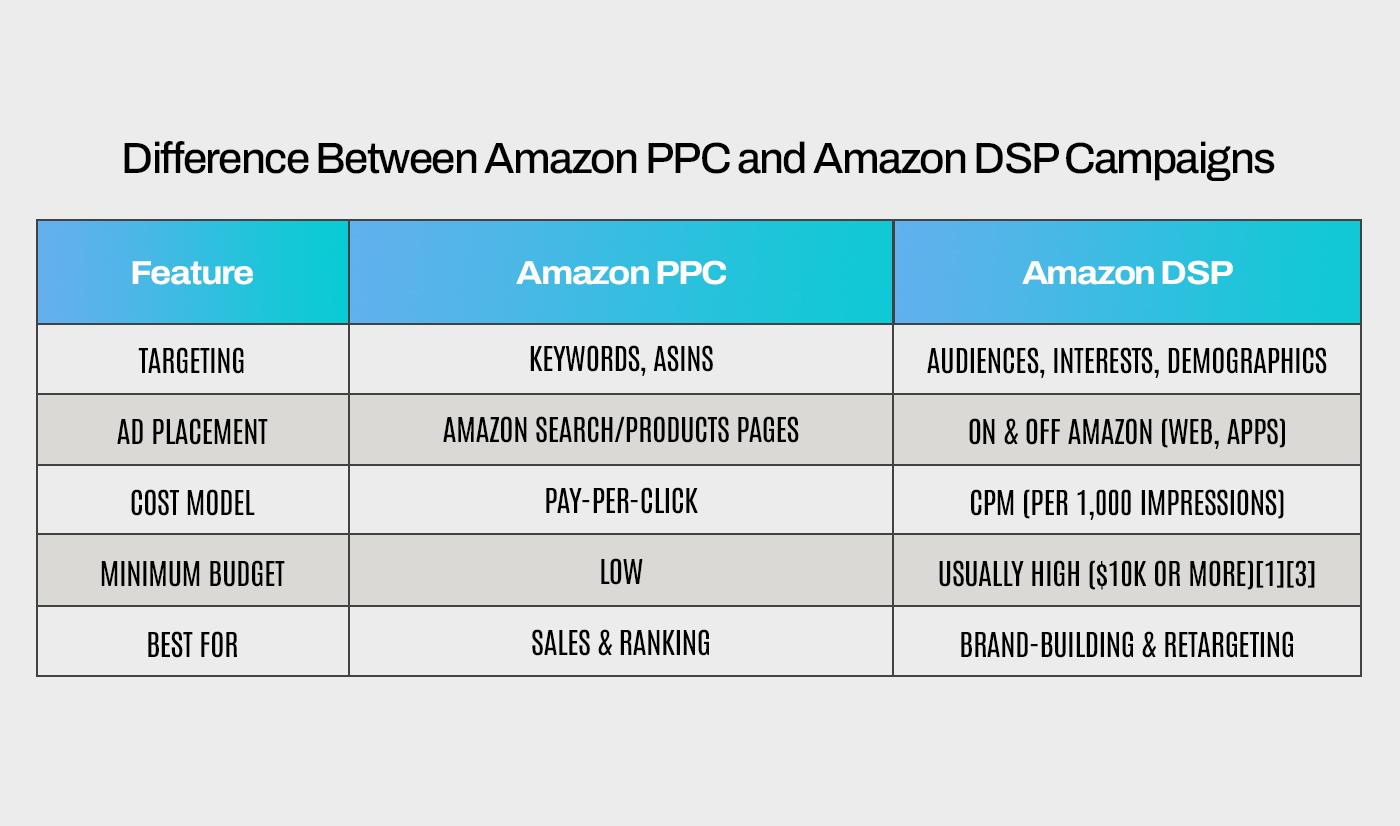
PPC provides immediate, sales-oriented results on Amazon. DSP is ideal for sustainable brand growth and sophisticated retargeting. The greatest brands artfully combine both.
The importance of a solid Amazon advertising strategy
A well-designed Amazon advertising plan is the difference between literally throwing money at ads and having a predictably profitable, scalable business. It allows you to:
- Divide budgets effectively.
- Optimize for reach while maximizing profit.
- Use both data-driven automation and manual optimization.
Understanding Amazon PPC Strategy

What is Amazon PPC?
In its essence, Amazon PPC (Pay per click) is a performance ad model: you show ads on Amazon, and only pay when someone actually clicks on your ad.
This is the power behind Amazon’s dominant Sponsored Products, Sponsored Brands, and Sponsored Display ads.
- Sponsored Products: Individual product ads are shown in search results and product detail pages.
- Sponsored Brands: Your logo, headline, and several products are featured—excellent for visibility and cross-selling.
- Sponsored Display: Ads displayed both onsite and on Amazon’s expanded network; excellent for retargeting and competitor ASIN targeting.
Sponsored ads optimization involves constantly optimizing these ad types for visibility and conversions.
The Fundamentals of Amazon Pay-Per-Click Advertising
- Structure: Campaigns > Ad Groups > Keywords/ASINs > Ads
- Targeting: Manual (you choose keywords/ASINs), or Automatic (Amazon chooses based on listing relevance)
- Bidding: Set a maximum bid. Amazon holds instant auctions for each qualifying impression.
The key to a successful Amazon PPC strategy lies in reaching high-converting relevant searches and avoiding wasted spend.
Key Metrics to Track in Amazon PPC
PPC success is measurement-driven. Ignore metrics, and you’re flying blind. Focus on:
ACOS (Advertising Cost of Sale): ACOS=(Ad Spend/Ad Sales)×100
Lower is best, but the context plays a role.
TACOS (Total ACOS): Considers total sales (ad + organic), showing overall ad profitability. Critical to long-term planning.
CTR (Click-Through Rate): Advertising views that turn into clicks—indicates the relevance of your ad creative and targetting.
CPC (Cost per Click): What you pay per click—less CPC equals more traffic on the same budget.
To constantly respond to how to improve ROAS Amazon, track these, trim losers, double winners.
Amazon PPC Campaign Types Explained

Sponsored Products Campaigns
The workhorse of the majority of Amazon ad portfolios, these campaigns appeal to keywords or ASINs. Here are sophisticated Amazon PPC tips to optimize performance:
- Segment campaigns by match type (Broad, Phrase, Exact) so that you can view performance at a detailed level.
- Use negative keywords generously to eliminate irrelevant search terms and enhance conversion rate.
- Begin with auto campaigns to gather data, and then mine the search term report to create high-performing manual campaigns.
Campaign Setup Quick-Start:
- Establish campaign objectives (launch, scale, defend).
- Research buyer intent keywords.
- Splitting ad groups by match type.
- Use negative keywords every week.
- Track ACOS and reallocate the budget to winners.
Sponsored Brands Campaigns
This ad format places your brand in the foreground. Exceptional Amazon advertising strategy mandates leveraging Sponsored Brands to:
- Establish market-wide visibility.
- Cross-promote different products.
- Protect your brand from competitor conquesting.
Optimize with:
- Strong, benefit-focused headlines.
- Landing page testing (Storefront vs. individual listing).
- Seasonal creatives mirroring buyer intent cycles.
Sponsored Display Ads
While highly similar to DSP, Sponsored Display ads fall within the PPC model. They’re your best option for:
- Retargeting: Encourage browsers who didn’t buy to return.
- Competitor ASIN targeting: Show up on your competitors’ listings and significantly “steal” traffic.
Combining Sponsored Display with Amazon DSP campaigns guarantees you’re addressing every remarketing facet.
Bidding Models and Budget Management

Dynamic vs. Fixed Bids
Your bidding strategy can make or break your Amazon PPC campaign. Amazon presents you with two fundamental options:
- Dynamic Bids (Down Only): Amazon reduces your bid in real-time if a click is less likely to convert. Keeps you from spending too much.
- Dynamic Bids (Up and Down): Amazon increases or decreases your bid in real-time for each auction, up to twice your base bid. Good for optimizing high-converting traffic.
- Fixed Bids: Amazon will always bid your designated amount, no matter the context. Use for tight budget management or product launches.
The correct bid type varies by your objectives. For sustained ROAS optimization, the vast majority of sellers employ dynamic bids ‘down only’ by default, but test ‘up and down’ for aggressive conquest campaigns.
Portfolio Budgets and Daily Spend
Got multiple campaigns running? Portfolio budgets let you put a macro-level limit across campaigns, keeping spend in line with your overall Amazon advertising strategy.
- Give more budget to top performers.
- Minimize waste for under-performers.
Tune daily and monthly spend in real-time against:
- Product seasonality
- Inventory levels
- Market trends
Advanced Amazon PPC Tips for Better ROAS
Negative Keywords and Search Term Reports
The strongest method of cutting wasted spend? Ruthless application of negative keywords. Review your search term reports every week:
- Add irrelevant or low-converting search terms as negatives.
- Remove “bleeder” terms soaking up your budget.
- Utilize separate lists for every campaign configuration.
These Amazon PPC tips always provide lower ACOS and greater conversion rates at scale.
Dayparting and Seasonal Adjustments
Not all hours or seasons convert the same. Dayparting refers to a strategy of changing bids up or down for time-of-day and day-of-week performance.
- Example: Increase bids 7-11 PM if conversion rates peak then.
- Decrease bids during traditionally slow hours.
Align budget spends for large shopping holidays—Prime Day, Q4 holidays—or shift to lower spend during less busy months.
This makes your Amazon advertising strategy nimble and less expensive.
Sponsored Ads Optimization Tactics
Small incremental gains here bring huge returns. For ongoing sponsored ads optimization and how to improve ROAS Amazon outcomes, concentrate on:
- A/B test ad copy and primary images for greater CTR.
- Periodically refresh bullet points and titles with popular keywords.
- Enhance listings with Amazon A+ Content & Video.
- Test various landing pages (Storefronts, custom URLs).
The objective: convert more clicks into buys, not merely get more eyeballs.
Amazon DSP Campaigns: The Next Growth Channel

What is Amazon DSP?
Consider Amazon DSP campaigns your branding, awareness, and full-funnel ace up your sleeve. With DSP:
- Target audiences by interests, past behavior, and demographics—within AND beyond Amazon.
- Run image, video, and audio ads on Amazon-owned and third-party sites.
- Bid and optimize in scale with sophisticated data and algorithms.
The main difference? Whereas Amazon PPC is search-driven (users looking for something), Amazon DSP is audience-driven (targeting segments based on behavior and interest).
Amazon DSP Campaign Strategies
Unleashing the full potential of DSP means more than just basic retargeting:
- Prospecting: Engage completely new shoppers who fit your desired customer profile, even prior to them showing purchase intent.
- Retargeting: Re-engage near-converting buyers with tailored creatives, promo deals, or cart reminders.
- Brand Loyalty Building: Run upper-funnel campaigns to promote repeat purchases and drive LTV up.
Consider your Amazon DSP campaigns a means of establishing a “brand moat”—insulating from competition and engaging buyers at each point.
Budgeting for DSP vs. PPC
DSP has a much greater barrier to entry—minimum spend thresholds tend to be $10,000+ per campaign, whereas PPC can be done with a few hundred bucks.
- PPC: Quick, testable, actionable, accessible to all sellers.
- DSP: Greater reach, better for branding, best for established brands and larger budgets.
A hybrid Amazon advertising strategy employs PPC for quick ROI and DSP for long-term brand equity and retargeting scale.
Common Mistakes in Amazon Advertising Strategy
Over-Reliance on Auto Campaigns
Auto campaigns work well for early keyword research and data harvesting, but overdependence on them can cripple growth. Manual campaigns:
- Provide more granular keyword control.
- Enable accurate negative targeting.
- Support more detailed budget management.
For established brands, manual targeting almost always provides better, more profitable outcomes.
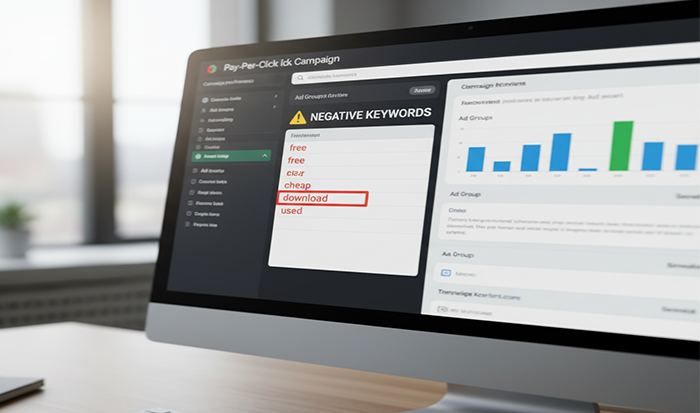
Ignoring Negative Keywords
This single error can silently siphon thousands from your advertising budget. Without negative keywords:
- You pay for unnecessary, low-intent clicks.
- ACOS increases, ROAS decreases.
- Winning searches can be outbid by your competitors.
Negatives are added on a weekly basis based on search term reports.
Poor Sponsored Ads Optimization
Not continually optimizing—ad copy, images, targeting—indicates you’re accepting mediocrity, not aiming for excellence. Actual sponsored ads optimization occurs through:
- Weekly performance checks.
- Regular split-testing.
- Rapidly switching from losers to winners.
Step-by-Step Amazon PPC and DSP Strategy for 2026
- Begin with PPC: Create wide auto campaigns to gather data and then quickly create segmented manual campaigns by match type.
- Apply negative keywords on a weekly basis.
- Test bidding models: Begin dynamic ‘on the down only’ for efficiency, pilot ‘on and down’ for conquesting.
- Spend budget by performance: Transfer spend from high-ACOS to low-ACOS campaigns on a monthly basis.
- Add in Sponsored Brands and Display: Protect your brand, increase reach, and retarget previous visitors.
- Scale up to DSP: With consistent PPC ACOS and profitable cash flow, spend 15-20% of the ad budget in Amazon DSP campaigns for prospecting and sophisticated retargeting.
- Optimize on an ongoing basis: Use A/B tests, creative rotation, and constant metric reviews to refine.
- Seasonality prep: Budget and bid changes prior to Prime Day, Q4, and new product rollout.
Each step must ladder up into a unified Amazon advertising strategy—one that is proactive, not reactive.
Future of Amazon Advertising in 2026

AI-driven Amazon PPC tips
Artificial Intelligence is continually reshaping the way brands optimize Amazon PPC:
- Machine learning-driven automated bidding responds to real-time trends and shopper activities.
- Forecasting analytics for inventory, seasonal, and competitor activity.
- Machine learning-based suggested creatives and dynamic split-testing.
Sophisticated AI tools imply less guesswork, greater ROI-maximizing accuracy.
Growth of DSP and External Traffic
With Amazon’s expanding advertising empire, Amazon DSP campaigns and third-party traffic (social ads, influencer campaigns) will be key pillars of advanced ad strategies. Look for:
- Deeper integration of Amazon attribution for off-platform ads.
- Wider adoption of DSP retargeting funnels.
- More collaboration between brand and agency teams.
An omnichannel by default Amazon advertising strategy that is future-proof.
Conclusion

To be an expert in Amazon PPC and DSP for greatest ROI, combine hands-on strategy with vision:
- Own your Amazon PPC strategy by optimizing targeting, bids, and creativity.
- Scale with Amazon DSP campaigns when your brand and margin are set up for full-funnel ad spend.
- Combine data and creativity—data informs what, optimization on how you scale profitably.
- Make incremental improvement and ongoing learning your daily routine.
The 2026 winning formula is obvious: Integrated strategy, economic discipline, and an unrelenting focus on both ROI and brand growth.
FAQs
1. What is the best Amazon PPC strategy for beginners?
Begin with auto campaigns for data, rapidly switch to segmented manual campaigns, and apply negative keywords on a weekly basis. Target Sponsored Products for quicker sales.
2. How can I improve ROAS on Amazon PPC campaigns?
Maximize product pages (images, titles), prioritize high-converting keywords, use negative keywords and search term reports, and adjust bids to top-performing terms.
3. Are Amazon DSP campaigns worth it for small sellers?
Generally, not for low-budgeters—DSP has a steep minimum spend and is ideal for big brands. Grow with PPC first, then expand into DSP based on cash flow.
4. What is the difference between Amazon PPC strategy and DSP?
PPC is click-based, concentrated within Amazon, and optimal for one-time conversions. DSP targets audience segments on and off Amazon at the awareness and retargeting levels.
5. How much budget should I allocate to Amazon advertising strategy?
Begin with 10–15% of gross revenue for PPC, adjusting and increasing by results. Spend 15–30% of your overall ad budget on DSP only after prior PPC returns settle and margins permit prospecting expenditure.
Mastering these techniques means more than surviving on Amazon—you’ll thrive. If you’re ready to level up, keep optimizing and combining both PPC and DSP, and let Sellerite move your business from the crowd to the winners’ circle.

 Back to top
Thought Leadership, Tips, and Tricks
Never miss insights into the Amazon selling space by signing up for our email list!
YOUR WINNING SOLUTIONS
Read more
Expert
strategies
delivered
to your
inbox
top industry minds to fuel
your brand’s growth.

Send request to Sellerite
Once you submit the consultation form, we’ll dive into the details and email you a tailored report within 24-48 hours.
"*" indicates required fields
*By submitting your Email Address, you are agreeing to all conditions of our Privacy Policy.
