


Why This 2026 AI Listing Data Matters
If you have spent any time selling on Amazon over the last year, you have probably noticed a major shift: listing work is no longer just manual copywriting, spreadsheet edits, and slow rounds of revisions. AI has entered the workflow, and for many sellers, it is changing how product pages are built, tested, and improved. That is exactly why the conversation around Amazon Listing AI Tools matters in 2026.
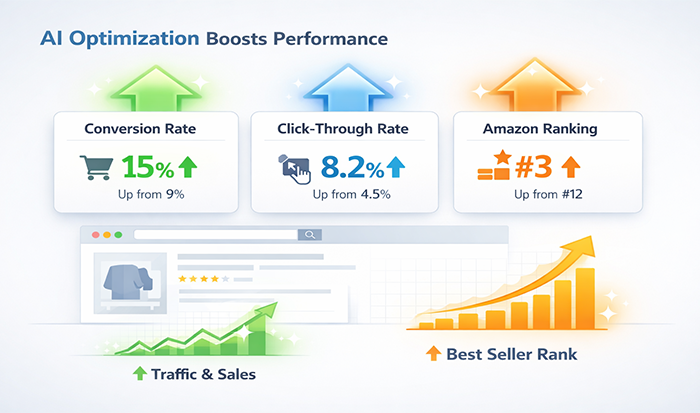
This Sellerite-style report looks at how AI is affecting Amazon Listing Performance, not in theory, but in practical terms. We are not talking about AI as a buzzword or a shiny add-on. We are talking about where it actually helps: faster listing creation, better keyword coverage, quicker testing cycles, stronger content consistency, and in some cases, measurable lifts in conversion and click-through performance.
The reason this matters now is simple. Amazon is more competitive than ever, and the difference between a listing that gets ignored and one that earns traffic often comes down to execution quality. Sellers are under pressure to move faster without letting quality slip. That is where the right AI Tool for Amazon Listing work starts becoming meaningful. The key question is no longer whether sellers are using AI. It is whether they are using it in a way that genuinely improves the listing instead of just producing more words.
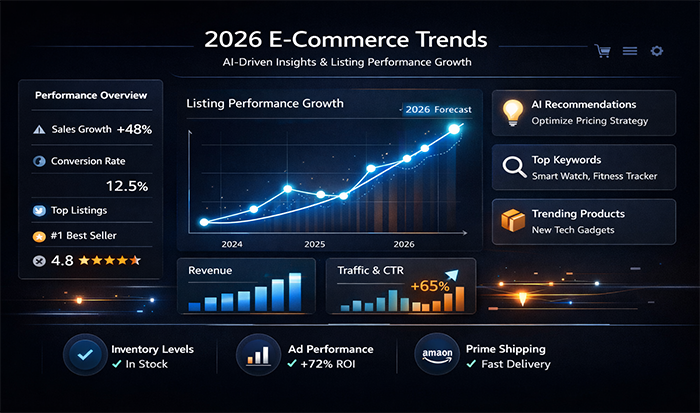
How We Define AI Impact On Amazon Listing Performance

What “impact” actually means here
For this report, the impact of AI on Amazon Listing Performance does not simply mean a seller used a tool to write a title or generate bullet points. It means the listing improved in ways that could affect real business results.
We are looking at practical performance signals such as:
- Faster listing creation and update speed
- Better keyword placement and coverage
- More consistent titles, bullets, and descriptions
- Improved click-through potential from clearer messaging
- Stronger conversion through better benefit framing
- Quicker testing and optimization cycles
This matters because AI does not improve listings just by existing. It improves them when it helps sellers make the page clearer, more relevant, and easier for shoppers to trust.
Why AI benchmarks matter in 2026
The 2026 environment is making listing quality more important, not less. Shoppers compare faster, competitors copy faster, and categories get crowded quickly. That means sellers do not just need decent content anymore. They need pages that are clear, useful, optimized, and easy to refine at speed.
That is where Amazon Listing AI Tools are becoming harder to ignore. For some teams, they reduce production time. For others, they improve consistency across large catalogs. And for more advanced operators, they create a faster loop between performance data and content updates.
So when we talk about AI impact here, we are really talking about whether these tools help sellers move from slower guesswork to more disciplined listing optimization.
What The 2026 Data Suggests About AI And Listing Performance
AI helps most with speed and structure first
One of the clearest patterns in 2026 is that AI tends to improve speed before it improves performance. In other words, the first win is usually operational. Sellers can create titles, bullet points, descriptions, and keyword drafts much faster than they could through manual writing alone.
That matters more than it sounds. A listing that takes three days to update will almost always improve more slowly than one that can be tested and refined in hours. In this sense, the biggest early value of an AI Tool for Amazon Listing is not genius-level copy. It is momentum.
This usually shows up in areas like:
- Faster first-draft creation
- Easier variation writing across multiple SKUs
- Quicker content refreshes after poor performance
- Better workflow support for agencies and catalog-heavy brands
The real advantage is that sellers can spend less time staring at a blank page and more time evaluating what actually works.
Performance improves when AI is paired with human judgment
This is the part many sellers miss. AI can generate content quickly, but speed alone does not guarantee stronger Amazon Listing Performance. The gains show up more consistently when sellers use AI as a drafting and optimization layer, then apply human review before publishing.
That combination matters because Amazon listings still need:
- Category awareness
- Buyer psychology
- Brand voice consistency
- Compliance judgment
- Real product understanding
Without that human layer, AI-generated copy can become generic, repetitive, or too broad to convert well. But when the tool is guided properly, the output often becomes more useful. Titles get clearer. Bullet points become more benefit-driven. Descriptions become easier to scan. That is where performance starts moving.
AI And Amazon Listing Performance At A Glance
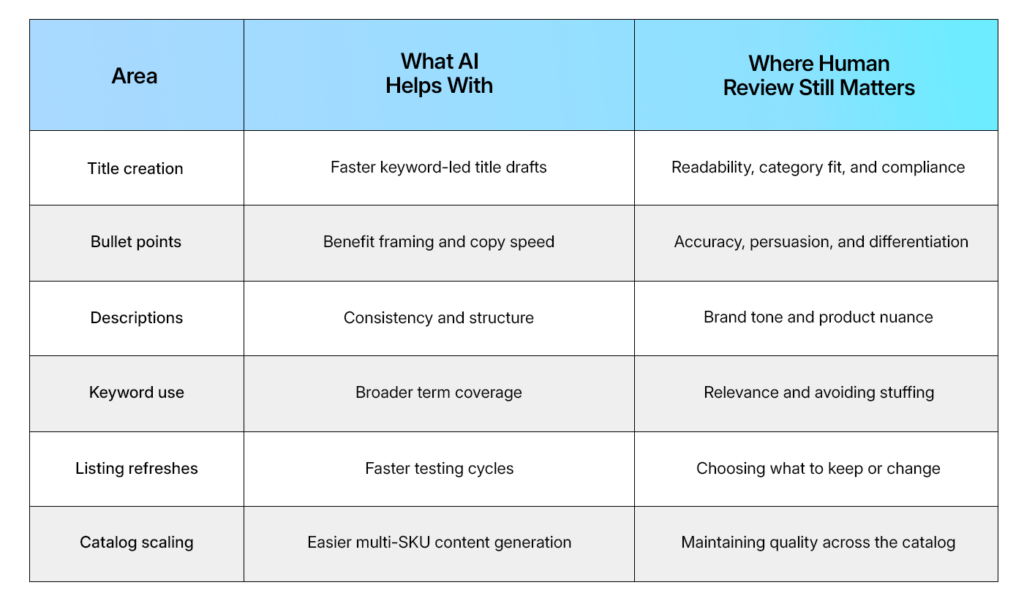
This table highlights something important: Amazon Listing AI Tools usually perform best when they support the workflow, not replace decision-making. The strongest results tend to come from sellers who use AI to speed up good strategy, not avoid strategy altogether.
What Usually Improves When Sellers Use AI Well
Listings become clearer faster
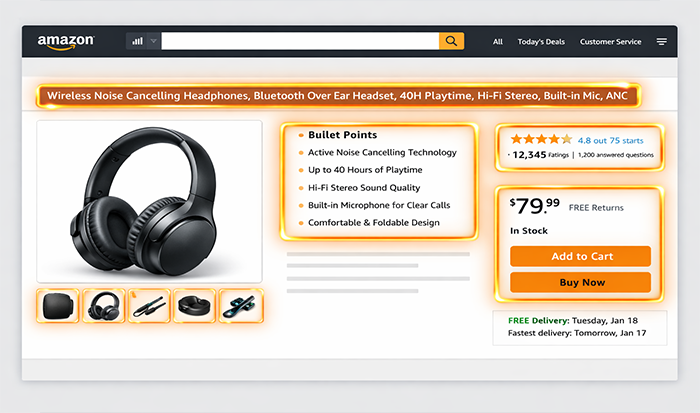
One of the most useful impacts of AI is that it helps remove slow, inconsistent listing work. Sellers often know their page needs improvement but delay changes because writing and rewriting every section takes time. AI reduces that friction.
Used properly, it can help sellers:
- Rewrite weak bullets faster
- Create cleaner, more readable product descriptions
- Expand keyword coverage without starting from scratch
- Generate fresh test angles for product benefits
That matters because a lot of listing weakness comes from delay, not ignorance. Sellers often know the page is underperforming. They just move too slowly to improve it.
Testing cycles become more practical
Another major gain is testing speed. When content creation becomes easier, sellers can test more variations without draining the whole team’s time. That means better chances of finding stronger wording, sharper messaging, or a more effective product angle.
This is where Amazon Listing Performance often improves in a very practical way. A slightly better title, a cleaner first bullet, or a more convincing feature explanation can improve click-through and conversion enough to matter. AI does not guarantee that result, but it makes the testing process much easier to sustain.
Where Sellers Overestimate AI
Just as important as the upside is the caution. AI is useful, but it is not magical. A weak product does not become strong because the bullet points sound polished. Poor images still hurt. Bad reviews still hurt. Wrong pricing still hurts.
Common mistakes include:
- Publishing AI copy without checking accuracy
- Repeating too many keywords and hurting readability
- Using generic claims that fail to differentiate the product
- Assuming content alone can fix weak offer positioning
- Letting the listing lose its human tone and credibility
This is why sellers should treat AI as an assistant, not an autopilot. The best listings still come from understanding the buyer, understanding the product, and using the tool to speed up execution not to replace thinking.
A Sellerite-Style Workflow For Better AI-Driven Listings
If you want AI to improve Amazon Listing Performance, the workflow matters more than the tool itself.
A practical approach looks like this:
- Start with real keyword research and customer language
- Use AI to build the first draft for title, bullets, and description
- Review every section for clarity, compliance, and tone
- Publish only what feels natural and product-specific
- Measure click-through, conversion, and keyword movement
- Refresh weak sections quickly instead of waiting months
This kind of system turns Amazon Listing AI Tools into something much more useful than a content shortcut. It makes them part of an optimization process.
What This Means For Your 2026 Listing Strategy
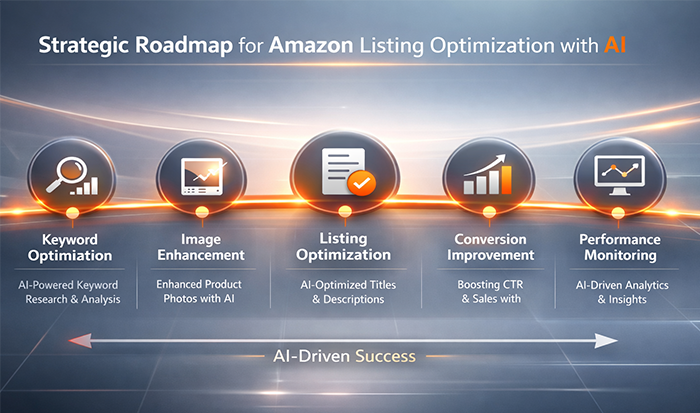
The main takeaway from this report is clear: AI is having a real impact on Amazon Listing Performance, but mostly when it is used as part of a smarter workflow. The strongest benefit is not that AI writes perfect listings. It is that it helps sellers move faster, test more, and improve pages with less friction.
For Sellerite users, that means the real opportunity is not just using an AI Tool for Amazon Listing once and moving on. It is building a process where AI helps generate, refine, and scale better listing content while human review protects accuracy, trust, and brand quality.
In 2026, better Amazon Listing performance is not coming from speed alone or creativity alone. It is coming from the combination of both. And that is exactly where AI, used properly, can become a meaningful advantage.
