

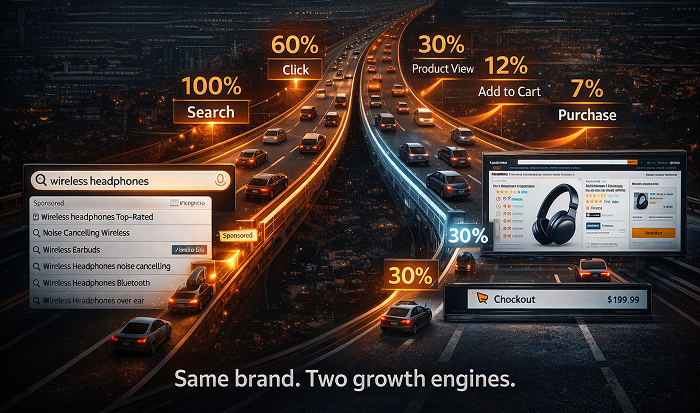
Introduction — Amazon Is Now the Starting Line, Not Just the Checkout
For most shoppers in 2025–26, the buying journey doesn’t start on Google anymore—it starts on Amazon’s search bar. Recent data shows that well over half of online shoppers begin product discovery directly on Amazon, with some studies putting that figure around 56–63% depending on the market.
That changes everything about how Amazon Product Search works in practice. Instead of being just a place to “price‑check,” Amazon has become the primary search engine for shopping intent.
This report breaks down the modern path from query to Amazon Product Purchase, tying together real Amazon Search Trends, how people move through results, and why some listings convert while others stall. The lens is practical: if you’re an Amazon seller, how do you align your strategy with real customer behavior instead of old assumptions?

Methodology — How the Search-to-Purchase Journey Was Mapped
This analysis combines three main inputs that reflect how shoppers move from Amazon Product Search to final purchase:
- Aggregated marketplace stats: marketplace‑first behavior (over 60% of shoppers starting on Amazon), shopper intent depth, and visit volume.
- Amazon Search Term Report and Brand Analytics patterns: which queries lead to views vs purchases, and how click share moves around.
- Path‑to‑purchase insights from Amazon Marketing Cloud and similar tools: the sequence of ad touches, organic views, and repeat visits before conversion.
From this, the journey was simplified into four repeating stages:
- Discovery via search (raw Amazon Search Trends and entry queries)
- Evaluation on result pages and PDPs (clicks, bounce, add to cart)
- Decision and purchase (single or multi‑session conversion)
- Post‑purchase feedback and future search behavior (reviews, branded searches)
At each stage, we looked at how Trending Searches on Amazon influence movement and where sellers most often lose buyers.
Stage 1 — Discovery: How Shoppers Actually Search on Amazon
From Generic Terms to Intent‑Rich Phrases
The top Amazon Search Trends in 2025 show a clear evolution: shoppers are typing longer, more specific phrases instead of one‑ or two‑word generics. What used to be “desk lamp” has turned into “dimmable desk lamp for home office,” and “protein powder” has become “low sugar protein powder for women.” These shifts reflect higher purchase intent and clearer expectations.
You can see this in Amazon Product Search Trends reports:
- Long‑tail, intent‑rich queries are growing faster than generic category terms.
- Question‑like searches (“best…for…”, “how to…”) and attribute‑driven queries (size, material, audience) steadily gain share.
For sellers, this means titles and bullets written around real problems and use‑cases have a structural advantage over listings stuffed with disconnected keywords.
Stage 2 — Consideration: What Happens Between Click and Cart

Search Result Click Patterns and Filtering
Once a shopper types a query, search results and filters start quietly shaping Amazon Product Purchase odds. Studies of Amazon Product Search click behavior show:
- The majority of clicks cluster in the top row or two of search results; CTR drops sharply after positions 10–12.
- Sponsored placements at the top capture a disproportionate share of first clicks, especially for high‑intent Trending Searches on Amazon.
- Many shoppers immediately apply filters (Prime, rating 4+ stars, price brackets) before even scanning individual listings.
In practice, that means two things: ranking and reviews control who gets considered, and ad placements often “introduce” products even when the sale later shows as organic.
PDP Behavior — Where Shoppers Drop or Move Forward
On the product page itself, Customer Buying Behavior follows a predictable pattern:
- Above‑the‑fold elements (main image, price, rating, key bullets) heavily influence whether shoppers scroll further.
- Time‑on‑page and scroll depth correlate with conversion: shallow engagement often matches “back to search” behavior; deeper scroll with image and review interaction predicts add‑to‑cart.
- Gaps between Amazon Product Search Trends (what people type) and listing messaging (what they see) drive a large share of bounces and low conversion.
In other words, if your listing doesn’t visually and verbally echo the query that got them there, the journey ends right here.
Stage 3 — Decision: Single-Session vs Multi-Session Purchases
Not Every Journey Is One and Done
Path‑to‑purchase analysis using Amazon Marketing Cloud shows that many Amazon Product Purchase events are preceded by multiple touches—not just a single search and click. Common patterns include:
- Ad → Organic → Purchase: shopper first sees a Sponsored Product, later returns via organic search and buys.
- Generic search → Brand search → Purchase: initial generic query turns into a branded query after exposure.
- Browse → Compare → Wishlist/Cart → Later purchase: especially common in higher‑ticket categories.
This multi‑touch reality explains why certain Trending Searches on Amazon generate more “assists” than last‑click sales. Sellers who only look at last‑click attribution underestimate the value of visibility early in the journey.
Key Decision Levers Right Before Purchase
Across categories, a few elements consistently influence the final decision:
- Recent reviews and Q&A activity: fresh social proof reduces risk, especially in crowded categories.
- Clear delivery promises: Prime, fast shipping, and transparent delivery windows.
- Simple pricing cues: visible promotions, strikethrough pricing, and unambiguous total cost.
Small improvements in these areas often move buyers from “thinking about it” to actual Amazon Product Purchase in that last session.
Stage 4 — Post-Purchase: How Purchases Feed Future Search
Reviews, Returns, and the Next Search
The journey doesn’t end at the thank‑you page. Post‑purchase behavior reshapes future Amazon Product Search Trends and sales potential:
- Positive experiences and reviews increase the chance that future journeys start with brand or product‑specific terms, rather than generic queries.
- Negative experiences (especially returns due to “not as described” or quality issues) erode both ranking and trust, reducing future click share for related searches.
- High satisfaction in repeat‑purchase categories (Pet, Grocery, Health) turns one‑time buyers into habitual searchers of specific SKUs or brands.
This feedback loop means that your performance today quietly influences tomorrow’s Amazon Search Trends around your brand and niche.
Trend Snapshot — How Amazon Search Behavior Is Evolving
Macro Search-to-Purchase Patterns
Data from multiple 2024–25 reports paints a clear macro picture of Amazon Search Trends:
- Between 56% and 66% of shoppers in key markets now start product discovery on Amazon, not external search engines.
- Marketplace‑first “search then buy” journeys are accelerating; shoppers arriving from Amazon search tend to be further down the purchase funnel than those from Google.
- Searches tied to content creation, home improvement, and niche hobbies are growing faster than broad, general‑interest terms.
For sellers, tracking Amazon Product Search Trends in their category is less about chasing fads and more about spotting where buyer intent is clustering.
Example Journey Metrics
A simplified view of journey metrics for a mid‑price consumer product might look like this:
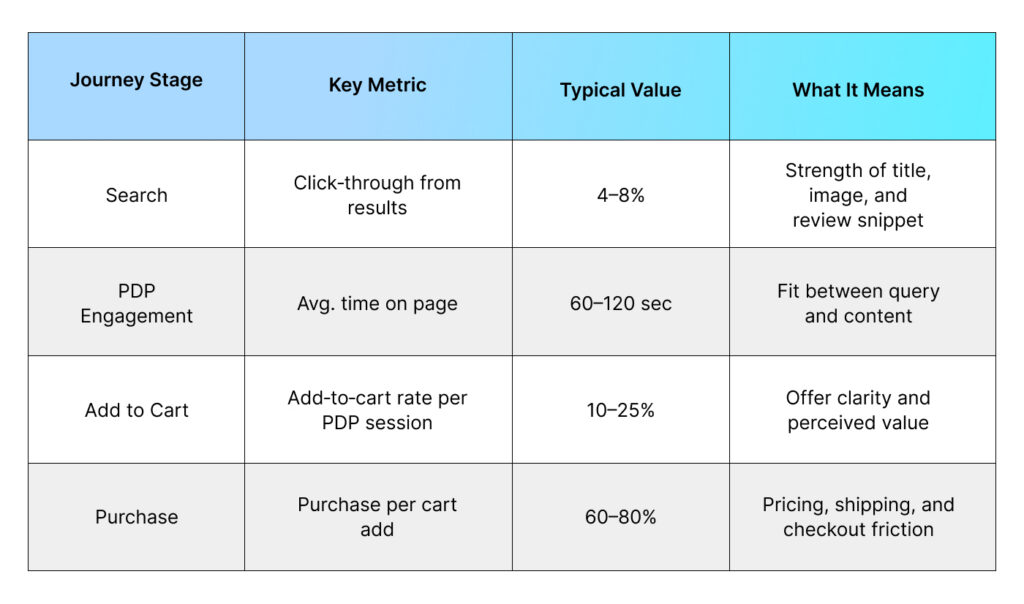
Watching these numbers together tells you where your own search‑to‑purchase journey leaks the most traffic.
Practical Framework — Optimizing for the Full Journey
Five Concrete Steps for Sellers
To align with real Amazon Product Search behavior, a seller‑friendly framework might look like this:
- Map your entry queries: Use Search Term Reports and Brand Analytics to see which Amazon Product Search Trends actually bring shoppers to your listings.
- Rewrite for intent, not just keywords: Make sure titles, bullets, and images clearly answer the main “job” behind your top searches.
- Tighten page‑one presence: Combine organic ranking work with Sponsored placements to secure repeated exposure for your highest‑value queries.
- Watch mid‑journey signals: Track click‑through, time on page, and add‑to‑cart rates together to see where people are losing confidence.
- Close the loop with post‑purchase: Actively manage reviews and returns, and use repeat behavior to refine targeting and messaging.
You’re not just optimizing for a ranking; you’re engineering a smoother path from search to purchase and back again.
Closing Insight — Own the Journey, Not Just the Keyword

The big shift in 2025–26 is that Amazon is no longer just where people finish a purchase—it’s where they start the journey. Amazon Search Trends and Trending Searches on Amazon show intent that’s much closer to purchase than traditional search engines. Sellers who treat search results, product pages, ads, and reviews as separate silos are missing the point.
The most resilient brands are the ones mapping and optimizing the full search‑to‑purchase journey: from the first typed phrase in Amazon Product Search, through the moments of doubt on the PDP, to the final Amazon Product Purchase and the review that shapes the next shopper’s story.
If you can see that whole arc clearly—and tune each step around how customers actually behave—you stop chasing traffic and start building momentum that compounds over time.
