


Introduction — When “Good Listings” Aren’t Enough Anymore
If you’ve sold on Amazon for a while, you’ve probably watched a solid listing slip from page one to page two without any obvious mistake on your side. That wobble usually isn’t random; it’s the Amazon Search Algorithm evolving under your feet.
The system is steadily moving away from simple keyword counting and toward a mix of intent, performance, and trust signals that decide who gets seen and who quietly sinks.
This research-style breakdown looks at how the modern Amazon Search Ranking Algorithm behaves, what’s changed from the classic Amazon A9 Search Algorithm, and how that shift plays out in your day‑to‑day visibility.
Think of it as a practical field guide rather than a technical breakdown—useful for deciding what to tweak on your listings and launch strategy right now.

Methodology — How This View of the Algorithm Was Framed
Rather than pretending to crack the code line by line, this analysis leans on patterns sellers see repeatedly when they change specific levers. When titles change, when pricing moves, when ads ramp—how does organic exposure respond over time under the current Amazon Product Search Algorithm?
To keep it simple, imagine three buckets of ranking inputs:
- Relevance: how well your content lines up with what shoppers actually type, and how clearly the Amazon Search Engine Algorithm can understand that.
- Performance: what buyers do after they see you—click‑through, conversion, revenue per view, returns, and so on.
- Trust: signals that you’re a safe bet—review quality, account health, fulfillment reliability.
Everything below is organized around those three buckets, because almost every visible shift in the Amazon Search Ranking Algorithm lately seems to lean harder into some blend of them.
Algorithm Impact Snapshot — What’s Gaining Weight, What’s Fading
Ranking Factor Heat Map
Here’s a simplified table that captures how different factors inside the modern Amazon Search Algorithm tend to behave compared to a few years ago. It’s not a secret formula—more like a dashboard telling you where to spend your energy.
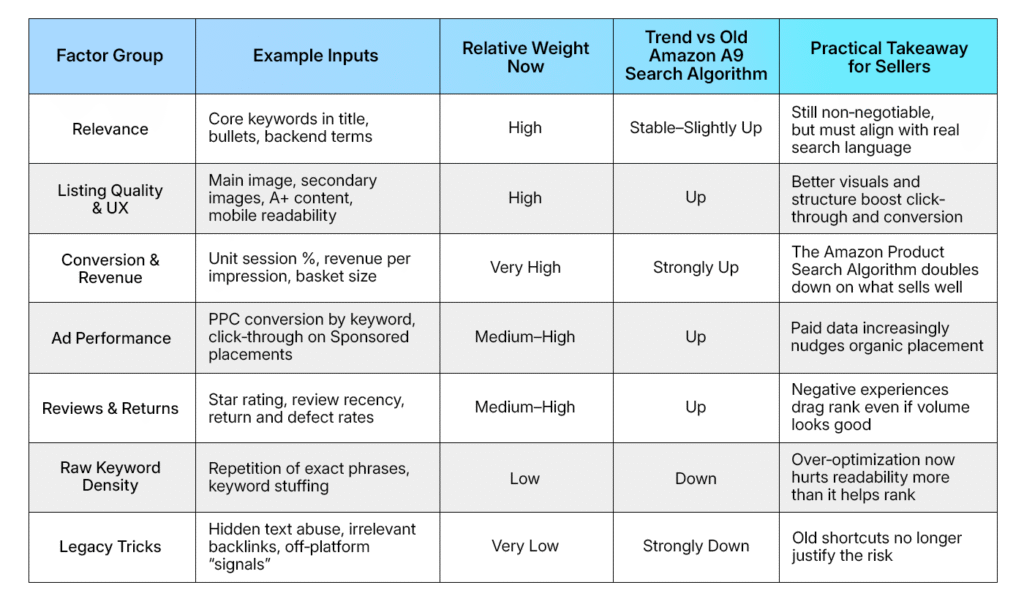
This kind of view is what you want in mind when you decide whether to squeeze another keyword into your title or invest that energy into better images or review flow.
Key Shift #1 — From Keyword Density to Intent Matching
Amazon Still Needs Keywords, Just Not Stuffed Ones
The older Amazon A9 Search Algorithm was much easier to influence with sheer keyword repetition; if your phrase coverage was wide enough and your price was sharp, you had a decent shot. Today’s Amazon Search Ranking Algorithm is more interested in whether your listing feels like the natural answer to what the shopper had in mind.
In practice, that shows up as:
- Clean, front‑loaded titles that mirror how buyers actually search (“wireless headphones for kids” vs. a long chain of disjointed phrases).
- Bullet points that focus on who the product is for and what problem it solves, not just feature dumping.
- Backend fields used to catch variations and misspellings, not crammed with every synonym you can think of.
You’re still feeding the Amazon Search Algorithm with clear signals—but in a way that doesn’t break the reading experience for the human on the other side.
Key Shift #2 — Performance Signals Are Now the Main Story
The Algorithm Watches What Shoppers Do, Not Just What You Write
The current Amazon Search Engine Algorithm behaves more like a continuous experiment than a static rulebook. When it shows your listing for a term, it pays close attention to the outcome: do people click, do they buy, do they return? That behavior feeds back into ranking decisions far more aggressively than before.
Patterns sellers keep noticing:
- Listings with slightly fewer keywords but noticeably better images and social proof often outrank “perfectly optimized” but low‑converting competitors.
- Conversion dips after a price increase or packaging change can echo across multiple keywords, not just one or two.
- A spike in returns for “not as described” or “poor quality” can quietly push a listing down, even if overall sales look okay in the short term.
In the modern Amazon Product Search Algorithm, conversion and satisfaction are what keep your visibility once you’ve earned it. Keywords mostly get you into that first round.
Key Shift #3 — Personalization and Context Are Changing Who Sees You
Same Query, Different Results, Different Chances
One subtle but important evolution of the Amazon Search Algorithm is personalization. Two shoppers can type the same phrase and see products in a slightly different order based on their budget, browsing history, and past purchases.
What that means for your day‑to‑day reality:
- If you clearly signal “premium,” you’ll show more prominently to shoppers who keep choosing higher‑priced options—and less to bargain hunters.
- Long, conversational searches (especially via mobile and voice) push the Amazon Search Ranking Algorithm to rely more on natural‑language phrases in your listing.
- Small differences in title wording and first image can change which micro‑segment of shoppers the algorithm thinks you’re best suited for.
So you’re not just trying to please a single, static Amazon Search Engine Algorithm; you’re positioning your product as the best match for specific types of buyers Amazon is learning to recognize.
Key Shift #4 — Ads and Organic Are Now Closely Intertwined

PPC Is Starting the Conversation, Organic Is Finishing It
On the surface, paid placements and organic results are separate lanes. Under the hood, the behavior data from your ads is incredibly valuable to the Amazon Search Ranking Algorithm because it reveals how relevant you are to certain queries and audiences.
Here’s how that often plays out:
- Well‑structured campaigns that target tight keyword clusters teach the Amazon Product Search Algorithm where your listing “belongs.”
- High ad conversion on a term can precede gradual organic gains for that same term—especially during launch phases.
- Killing ads entirely on a young listing can stop that learning process prematurely, leaving you with a flat or drifting organic curve.
Modern strategy treats PPC as an accelerator and signal generator, not just a separate traffic faucet sitting off to the side of SEO.
Practical Framework — Working With the Algorithm Instead of Fighting It
A Simple Playbook Sellers Can Actually Use
To translate all of this into something you can act on, here’s a streamlined framework for aligning with the current Amazon Search Algorithm without overcomplicating things.
- Anchor relevance clearly: choose 3–5 primary terms and 10–20 supporting ones, then write titles and bullets in normal, buyer‑friendly language that still hits those phrases.
- Engineer strong early performance: treat your first 60–90 days like a controlled test—optimize price, images, and review flow so the algorithm sees clean engagement from day one.
- Keep a feedback loop: watch click‑through, conversion, and returns for your main keywords, and adjust copy, visuals, or offer structure instead of only tweaking bids.
You’re essentially trying to make it easy for the Amazon Search Ranking Algorithm to conclude, “Shoppers who search this way seem happy when they buy this product.” That’s the core of durable visibility now.
Closing Insight — The Algorithm Is Moving Toward “Best Match,” Not “Most Optimized”

The big pattern emerging from all these changes is that the modern Amazon Search Algorithm behaves less like a rules engine you can game and more like a constantly‑learning recommendation system. It still cares about keyword clarity and technical hygiene, but it cares even more about what happens after a shopper sees you.
If you focus your energy on understanding intent, tightening your offer, and making each click more likely to turn into a satisfied customer, you’re moving in the same direction as the Amazon Product Search Algorithm itself.
Listings built that way might not jump overnight, but they tend to climb, hold, and recover better as the system keeps updating—no matter how many times the internal rulebook gets rewritten.
