




Table of Contents
Introduction

In the 2026 US marketplace, the “gold rush” has officially been replaced by a “war of systems.” If you’re still trying to scale an Amazon FBA business using 2022 tactics spamming PPC and hoping for organic “halo” effects you’re likely seeing your margins evaporate. Scaling today isn’t just about pushing more volume; it’s about tactical efficiency.
Most sellers hit a wall at the $50k/month mark because they try to “muscle” their way through growth. At Sellerite, we see that the real winners are those who stop acting like hobbyists and start building an Amazon growth strategy that prioritizes profit over vanity metrics.
What Scaling Really Means in 2026

Scaling and growing are not the same thing. Growth is additive (more sales = more problems), while scaling is exponential (more sales = higher efficiency). Many sellers plateau because they don’t have the “infrastructure” to handle the velocity.
To scale Amazon FBA business operations successfully, you have to solve for the “Plateau Paradox”: the moment where your overhead grows faster than your revenue. In 2026, this means moving away from manual keyword bidding and moving toward high-level brand orchestration.
The Foundation: Validated Products & Market Fit
You can’t scale a “me-too” product. In a saturated US market, Amazon FBA scaling strategies start with data-backed differentiation. We don’t just look at sales volume; we look at “Niche Elasticity.”
The Sellerite Method: Turning Complaints into Cash
We use AI to scrape competitor “negative” reviews, finding the exact pain points customers are willing to pay a premium to solve. If 40% of the 1-star reviews for the top seller in your niche mention that the “handle breaks after two weeks,” your scaling strategy isn’t just “better marketing” it’s “reinforced handles.” You aren’t just selling a product; you’re selling the solution to the market’s biggest frustration.
The Math: Why Your Sourcing is Sabotaging Your Scale
If your landing cost plus FBA fees leaves you with less than a 30% buffer, you don’t have a scaling problem; you have a sourcing problem.
In the 2026 US landscape, your Amazon growth strategy lives or dies by your Contribution Margin. Here is the brutal reality of the math:
- The “Rule of Threes”: Ideally, your price point should be split into thirds: 1/3 for COGS (Cost of Goods Sold + Shipping), 1/3 for Amazon Fees (FBA + Referral), and 1/3 for Marketing (PPC) and Profit.
- The Squeezed Margin Trap: When your “buffer” is thin (under 20–25%), you have zero “oxygen” for PPC. Since scaling requires aggressive bidding to capture high-intent + scalable keywords, a low-margin product will actually lose you more money the faster you grow.
- The Sourcing Fix: Scaling often requires moving beyond Alibaba middle-men. We focus on “Direct-to-Factory” negotiation and “Volume Tiering.” If you can’t reduce your unit cost by 15% when you triple your order volume, your supply chain isn’t scalable.
The Practitioner’s Rule: You can’t “optimize” your way out of a bad buy. If the math doesn’t work at 1,000 units, it will be a disaster at 10,000 units.
True scaling is built on a foundation of “healthy fat” in your margins that allows you to outspend your competitors on the road to Page 1.
Amazon Listing Optimization for Higher Conversions

In the 2026 US marketplace, traffic is a commodity you can simply buy, but conversion is the high-stakes art form that actually keeps you in business.
If your listing isn’t a psychological “Yes” within the first three seconds, you aren’t just losing a sale you’re effectively subsidizing your competitor’s PPC budget.
To increase Amazon sales, your listing must do more than just “show” the product; it has to eliminate every bit of friction in the buyer’s mind.
Visual Dominance: Why Static Photos are Dead Weight
If you’re still relying on a basic white-background image and a couple of lifestyle shots, you’re invisible. In 2026, high-performing listings are built on Visual Dominance.
- The 15-Second Hook: Your “Main Image” is just the entry fee. Your second or third “slot” needs a high-energy Lifestyle Video that shows the product in the context of the user’s life. It’s not a commercial; it’s a “Proof of Utility.”
- Comparison Charts (The Objection Killer): We use A+ Content to build “Comparison Charts” that don’t just list features they explicitly tackle objections.
If the biggest complaint in your niche is “too small” or “hard to clean,” your chart should visually show exactly why your product solves those specific headaches. You want the customer to feel stupid for even considering the cheaper, “standard” alternative.
Keyword Depth: Beyond Simple Indexing
Most “SEO experts” will tell you to just stuff your listing with high-volume keywords so you “index.” In 2026, indexing is the bare minimum.
We focus on “Intent Mapping.” There is a massive psychological difference between someone searching for “kitchen gadget” (browsing) and someone searching for “ergonomic stainless steel garlic press” (ready to buy). We align your backend keywords and Alt-Text with the specific, long-tail search queries that lead to a one-click purchase.
The “Search-to-Solution” Bridge: We don’t just rank for keywords; we rank for the problems those keywords represent. If your backend is tuned to the “intent” behind the search, Amazon’s A10 algorithm recognizes your listing as the most relevant answer, which drives your conversion rate (CR) through the roof.
Continuous Optimization: The Listing is Never "Done"
The US market is a moving target. We use Main-Image Split Testing and AI-driven heatmaps to see exactly where customers are dropping off. If people are clicking but not buying, the “Visual Story” is broken. If they aren’t clicking at all, the “Hook” is weak.
The Practitioner’s Rule: A listing that converts at 15% is a hobby; a listing that converts at 35% is a scalable asset. At Sellerite, we don’t just “optimize” once; we iterate until your listing is the undisputed “Category King.”
Product Launch Strategy That Actually Ranks
The “honeymoon period” is shorter than ever. A modern Amazon product launch strategy requires a synchronized strike across three fronts:
- Search-Find-Buy Momentum: Driving high-intent traffic that tells the A10 algorithm your product is the “Answer” to the search.
- External Blitz: Using influencers to create a spike in “Off-Amazon” traffic, which Amazon now rewards with a massive organic ranking boost.
- TOS-Compliance: No “gray hat” hacks. We focus on velocity and ranking signals that keep your account safe while you climb.
Amazon PPC - From Break-Even to Profit Machine

In the 2026 US marketplace, Amazon advertising isn’t a “set-and-forget” task it is a high-frequency trading game. If you’re still running a messy account with 50 random campaigns, you aren’t scaling; you’re just donating your hard-earned margins to Jeff Bezos.
To increase Amazon sales without bleeding out on ACOS, your PPC needs to shift from “experimental” to “surgical.”
The "Segmented" Campaign Structure
Most sellers fail because their data is “noisy.” They mix research keywords with high-performing exact matches in the same campaign. We move our partners to a Segmented Structure:
- Research Campaigns: Using Broad and Auto targeting to “mine” for new customer behavior.
- Performance (Exact) Campaigns: This is your “War Chest.” Once a keyword proves it converts, we move it here with its own dedicated budget.
- Brand Defense: Ensuring competitors don’t “poach” your customers on your own product detail pages.
Scaling Winning Keywords: The "Top of Search" War
Scaling isn’t just about “increasing the budget.” It’s about Placement Dominance. In 2026, the conversion rate for “Top of Search” is often 3x higher than “Rest of Search.” When we find a winning keyword, we don’t just throw money at it we use placement multipliers to ensure you own the #1 spot.
This aggressive stance builds the “Sales Velocity” that eventually forces your organic rank to the top, where the “free” sales live.
Aggressive Waste Reduction: The Negative Keyword Ritual
Scaling a business is as much about what you don’t spend as what you do. Most accounts we audit are wasting 20% to 30% of their spend on “junk” search terms that are too broad or completely irrelevant. We perform a Weekly Negative Harvest, cutting the dead weight so every dollar is pushed toward high-intent shoppers. If a keyword has 15 clicks and zero sales, it’s not “data” it’s a leak that needs to be plugged.
The Big Question: When to Scale vs. When to Optimize?
This is where most founders get stuck. The rule of thumb in 2026 is simple:
- Scale when your TACoS (Total Advertising Cost of Sale) is healthy and your organic rank is climbing. If you’re winning the category, press the advantage.
- Optimize when your conversion rate dips or your margins get squeezed. If you’re spending more but the “Organic Halo” isn’t following, you have a listing or pricing problem, not a traffic problem.
The Practitioner’s Edge: PPC is a treadmill the moment you stop running, you slide backward. That’s why we offer Full PPC Management. We handle the hourly bid adjustments and the keyword mining so you can focus on building the next “Hero” product in your lineup.
External Traffic - The Real Growth Multiplier
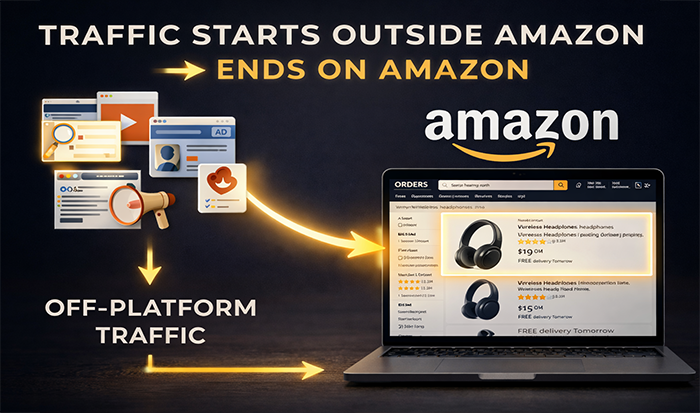
If Amazon is your only source of traffic, you don’t own a business; you own a high-risk asset. To truly grow Amazon store authority, you have to stop thinking like a “seller” and start acting like a media buyer. In 2026, the real scale happens off-platform.
The "Rented Land" Risk
Relying solely on Amazon’s internal search is building on a foundation of sand. If a competitor with a deeper pocket outbids you on your top 5 keywords, your revenue vanishes by lunch.
The most successful Amazon FBA scaling strategies we deploy at Sellerite treat the Amazon listing as a “checkout page” while using social platforms as the “top-of-funnel” discovery engine.
TikTok & Meta: The Organic Ranking "Cheat Code"
Driving traffic from TikTok Ads or Instagram Reels doesn’t just help your blended CAC (Customer Acquisition Cost) it forces the A10 algorithm to give you a massive organic “promotion.” Here’s why this moves the needle more than internal PPC:
- The A10 Priority Shift: Amazon is desperate for new users. If you bring a “fresh” customer from TikTok to their platform, Amazon rewards that behavior by spiking your organic ranking for your main keywords. It’s essentially a “thank you” from the algorithm for expanding their ecosystem.
- The 10% Kickback (Brand Referral Bonus): Amazon isn’t just giving you rank; they’re giving you cash. Through the Brand Referral Bonus, you get an average of 10% of the sale price credited back to your account. In the US market, where referral fees are high, this bonus often makes your external sales more profitable than your standard organic sales.
- The “Search Lift” Phenomenon: When a TikTok goes viral, people don’t always click the link they go to Amazon and search for your brand name. These “Branded Searches” are the holy grail of authority signals. They tell Amazon that you aren’t just a generic commodity; you are a destination brand.
The "No-Fluff" Execution Strategy
US consumers in 2026 are immune to polished, “stock-video” ads. To scale, you need high-velocity User-Generated Content (UGC).
The Reality Check: You can’t “SEO” your way to the top anymore. You have to “Traffic” your way there. The brands that win in 2026 are those that control their own audience rather than waiting for Amazon to hand them one.
AI & Automation for Smarter Scaling
Most sellers think scaling to seven figures requires hiring a 10-person team or a bloated agency. In 2026, that’s a legacy mindset that kills your margins. Real scaling now means building an “AI Stack” , a digital workforce that handles the repetitive, data-heavy grunt work while you focus on the high-level brand strategy.
If you aren’t using automation to buy back your time, you aren’t a business owner; you’re just a highly stressed data entry clerk.
Sentiment Mining: Turning Competitor Flaws into Your Features
Instead of spending forty hours reading 5,000 reviews across your category, we use AI to instantly map out exactly why customers are hitting the “Return” button on your competitor’s products. This is how you increase Amazon sales through precision, not just volume.
The “Big Box” brands are usually too slow and bureaucratic to update their manufacturing. By the time they realize their product has a faulty hinge, you’ve already used AI to identify that weakness, fixed it in your own production run, and updated your images to highlight your “Reinforced Durability.” You aren’t just selling; you’re out-engineering the competition.
Dynamic "Profit" Bidding: Protecting Your Rank and Your Cash
PPC in 2026 is too volatile for a “set-and-forget” approach. We use automation to bridge the gap between your advertising spend and your actual warehouse shelves. This is Dynamic “Profit” Bidding.
If your inventory levels drop below a certain threshold, the AI automatically throttles your aggressive bids. Why? Because a “Stockout” is a ranking death spiral that can take months to recover from.
Instead of burning cash to sell your last 100 units in a day, the AI slows down the velocity to keep you “alive” until your next shipment clears customs. It’s about protecting your organic position while maximizing the ROI on every single click.
Keyword Discovery: Beating the "Standard" Tools to the Punch
By the time a keyword shows up as “High Volume” in the standard industry tools, every other seller in the US market is already bidding on it. That’s how you end up in a $4.00 CPC bidding war.
Modern AI now spots “Emerging” search terms by analyzing social media trends and real-time Amazon “Suggested Search” shifts before the data aggregators even catch them. Catching a high-volume, high-intent keyword two weeks before the rest of the market is the difference between owning the “Top of Search” for $0.80 and struggling to break even at $3.50.
The Practitioner’s Edge: Automation isn’t about replacing your brain; it’s about giving your brain better data. The sellers who win in 2026 are the ones who let the bots handle the math so they can handle the vision.
Managing Reviews & Social Proof at Scale
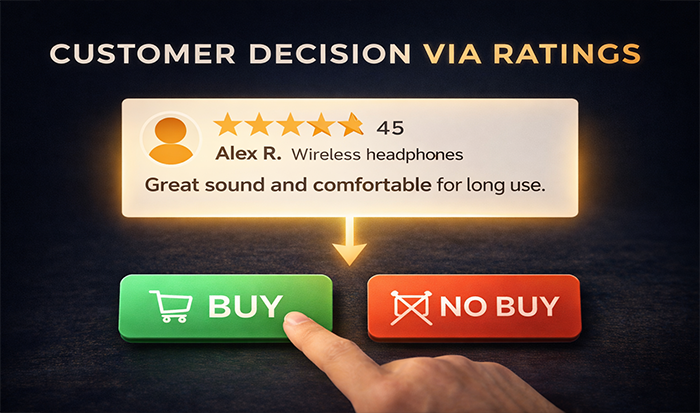
In the 2026 US market, a 4.2-star rating is essentially a death sentence. Customers have become hyper-cynical; they don’t just look at the number, they look at the recency and the substance. If your last review was from three months ago, you’re invisible.
To truly increase Amazon sales, your review strategy has to be a proactive engine, not a reactive “hope and pray” tactic. We aren’t just chasing stars; we are building a “Review Moat” that kills buyer hesitation before they even scroll to the bottom of the page.
The Conversion Engine: Why "Review Velocity" is the New Ranking King
A review isn’t just a static badge of honor; it’s a high-octane ranking signal. Amazon’s A10 algorithm has evolved to track Review Velocity the speed and consistency at which you acquire new feedback.
If your feedback starts to stall, your organic rank will begin to “drift” downward. Amazon assumes a product that isn’t getting fresh reviews is losing its market relevance. We focus on keeping that “drip” consistent so the algorithm sees your brand as a “trending” leader in your category.
The "Safe" Hustle: Forget the Account-Killers
In 2026, the “gray hat” tactics like those shady Facebook groups or “rebate” services are the fastest way to get your account permanently nuked. Amazon’s AI is now incredibly good at spotting “review manipulation” patterns.
At Sellerite, we stick to the “Safe Hustle”:
- The Vine Program: We maximize this early to get that initial “seed” of 30 reviews from trusted voices.
- TOS-Compliant Inserts: We design packaging inserts that focus on the customer’s experience, not a “bribe” for a rating. We ask for “honest feedback” and provide a QR code that leads directly to a customer support channel.
By catching a frustrated customer before they hit the review button, we turn a potential 1-star into a 5-star service recovery.
Leveraging the "Why": Turning Reviews into Ad Copy
This is where most sellers leave money on the table. We don’t just read your reviews; we mine them for gold. If three different customers mention that your product has an “incredible unboxing feel” or that the “magnetic clasp is surprisingly strong,” we take that exact language and weave it back into your listing’s bullet points.
When a customer sees their own internal thoughts reflected in your sales copy, the psychological “click” happens. You aren’t just selling a product; you’re echoing the market’s own voice.
This creates a feedback loop: better copy leads to better expectations, which leads to better reviews, which leads to higher organic ranking.
Operations & Inventory Management
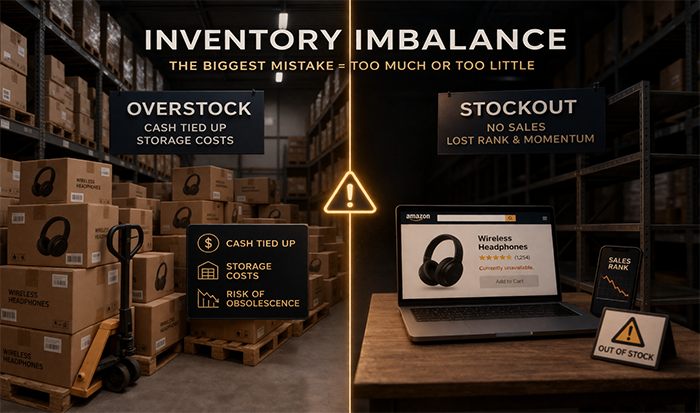
Scaling is exhilarating until you look at your “Out of Stock” notification. In the 2026 Amazon landscape, a stockout isn’t just a temporary pause in sales, it’s a catastrophic “ranking reset.” When your buy box disappears, your organic keywords start to bleed, and your carefully tuned PPC history begins to degrade.
You aren’t just losing today’s profit; you’re paying a “tax” to climb back up the mountain once you finally replenish.
Forecasting is Art + Math (and a bit of Paranoia)
In 2026, looking at last month’s sales data to predict next month’s needs is a rookie move. To grow Amazon store stability, your forecasting has to account for the “External Traffic” spikes we trigger through TikTok and Meta.
We build a strict 90-day lead time buffer into every purchase order. Why? Because US port congestion and “random” customs inspections are the new normal. If your lead time is 45 days, and you don’t have another 45 days of “safety stock” on the water or in the warehouse, you are one logistics hiccup away from a business-killing stockout. We don’t guess; we over-prepare.
The 3PL Safety Net: Don't Let Amazon Hold You Hostage
Relying 100% on FBA warehouses is a dangerous game. Between shifting restock limits and predatory long-term storage fees, Amazon’s warehouses should be your “distribution points,” not your “storage units.”
We implement a Hybrid 3PL Model. We keep the bulk of your “overflow” stock in a private Third-Party Logistics (3PL) facility in the US. This allows us to “drip-feed” inventory into FBA based on actual velocity. This strategy does two things:
- It keeps your IPI (Inventory Performance Index) score high.
- It dodges those massive Q4 storage surcharges that eat your margins alive.
Logistics as a Competitive Advantage
Most sellers treat shipping as a “fixed cost.” It’s not. If you can shave $0.50 off your landed cost per unit through smarter pallet optimization or negotiating better sea-freight contracts, that’s $5,000 in pure, bottom-line profit for every 10,000 units sold.
In a margin war, that $0.50 is your “war chest.” It’s the extra budget you can spend on a higher PPC bid to kick a competitor off the top spot, or the buffer that allows you to run a “Lightning Deal” without going into the red.
At Sellerite, we don’t just manage your ads; we look at your cartons and pallets, because that’s where the real scaling battles are won or lost.
Scaling Without Getting Suspended
Scaling is exhilarating until you wake up to a “Deactivated” banner in Seller Central. In the 2026 US market, growth itself is a risk signal. Amazon’s “Risk AI” is programmed to be paranoid if your sales suddenly jump from 10 units a day to 200, the system doesn’t congratulate you; it audits you.
It assumes you’re either manipulating reviews, selling counterfeits, or running a “pump and dump” scheme.
To scale safely, you have to grow at a pace that looks “natural” to a machine while staying aggressive enough to dominate your niche.
Managing the "Risk Signals": The Review-to-Sales Ratio
Amazon’s fraud sensors are obsessed with the Review-to-Sales ratio. If you’re aggressively driving external traffic from TikTok and your sales spike, but your review count doesn’t move or worse, it spikes too fast you’ll trigger a manual review.
Our Amazon FBA scaling strategies are designed to balance this growth “horizontally” and “vertically”:
- Vertical Growth: We push your “Hero” SKU, but we throttle the velocity if the review-to-sales conversion looks statistically impossible compared to the category average.
- Horizontal Growth: We launch complementary SKUs to spread the revenue risk across the account. This makes your overall account volume look stable and diversified, which the “Risk AI” loves to see.
The "Paper Trail" Defense: Stay Ready So You Don't Have to Get Ready
Most sellers wait for a “Performance Notification” to start digging through their emails for invoices. By then, it’s too late. The bots give you a 24-to-72-hour window, and if your documents aren’t perfect, your listing stays down.
We build your “Defense Folder” before we turn on the traffic. This includes:
- Verifiable Invoices: Pro-forma invoices don’t cut it. We ensure your factory provides finalized, stamped invoices that match your ship dates and quantities perfectly.
- Letters of Authorization (LOA): Even if you own the brand, having a formal LOA from your manufacturing entity to your selling entity prevents “Inauthentic” claims from sticking.
- Active Trademark Monitoring: We don’t just register your brand; we monitor for “copycat” filings that could lead to a “Brand Registry” conflict.
Staying in Amazon’s "Good Graces"
Compliance isn’t a one-time setup; it’s a daily discipline. We monitor your Account Health Rating (AHR) like a hawk. If a single “Policy Violation” drops your score by even a few points, we address it immediately.
We don’t let “minor” issues stack up, because Amazon doesn’t just suspend for big mistakes they suspend for a pattern of small ones.
The Reality: You can’t outrun the bots, but you can outsmart them by being the most documented, most organized seller in your category.
Common Scaling Mistakes That Kill Growth
Most sellers get blinded by the “Seven-Figure” screenshots. They chase top-line revenue like it’s the only metric that matters, while their bottom line is bleeding out in the background.
In the 2026 US market, “revenue” is a vanity metric; “cash flow” is the only reality. If you don’t respect math, scaling won’t make you rich, it will just make you fail faster.
The "Premature Scale" Trap
Don’t try to pour gasoline on a fire that hasn’t even started. If your product hasn’t found its Price-to-Value sweet spot, no amount of traffic will save it.
We see sellers trying to scale a product that has a “3.8-star” sentiment because they think “more volume” will drown out the bad reviews. It won’t. It just amplifies the flaws. You need to dial in your conversion and customer satisfaction before you hit the accelerator.
The PPC Addiction (Ad Arbitrage vs. Brand)
If you can’t get at least 40% of your sales organically, you don’t own a brand; you own an “Ad Arbitrage” play. You are essentially paying Amazon for the privilege of selling your own product.
In 2026, PPC costs are only going one way: Up. If your business model relies entirely on buying every single customer, a slight dip in your conversion rate or a spike in CPC (Cost Per Click) will wipe out your entire month’s profit. Real scaling is about using PPC to buy the organic rank that eventually pays for the ads.
Ignoring the "Return Rate" Landmines
Driving 10,000 visitors to a mediocre listing is like pouring water into a leaky bucket. If your listing quality, your images, your sizing charts, your descriptions doesn’t perfectly match the reality of the product, your Return Rate will spike.
On Amazon, a high return rate is a “silent killer.” It doesn’t just eat your profit through shipping and disposal fees; it triggers a “Product Quality” flag. Too many returns in a 30-day window, and Amazon will suspend your listing “for your own protection.” You cannot scale a product that people keep sending back.
Cash Flow Blindness: The "Rainy Day" Reality
Scaling is a capital-hungry monster. Every time you double your sales, you have to double your next inventory order and you usually have to pay for that inventory months before you see a dime of profit from it.
We see sellers spend every last cent of profit on “more stock” without keeping a Rainy Day fund. What happens if your shipment is delayed by 3 weeks at the Port of Long Beach? Or if a competitor launches a “Price War” that forces you to lower your margins for a month?
Without a cash cushion, one bad logistics month can bankrupt a “million-dollar” business. The Practitioner’s Rule: Scale with your head, not just your heart. If the unit economics don’t work at 100 units, they won’t magically work at 10,000.
Building a Scalable Amazon System
If you’re still looking for “loopholes” or “ranking hacks” in 2026, you’re playing a losing game. Amazon’s algorithm is smarter than you, and it’s definitely faster than you. A “hack” might give you a bestseller badge for a weekend, but a system builds a brand that stays on Page 1 for a decade.
To truly grow Amazon store value especially if you ever want to sell your business to an aggregator you have to stop being the “Founder” who does everything and start being the “Architect” who builds the machine.
Systems vs. Hacks: The Predictability Factor
A “hack” is finding a temporary keyword loophole or a “gray hat” ranking trick. The problem? As soon as Amazon patches that gap, your sales tank and you’re back to square one.
A system, on the other hand, is a repeatable process. It’s having a “Standard Operating Procedure” (SOP) for:
- Keyword Harvesting: Not just guessing, but a weekly ritual of mining search term reports and competitor shifts.
- PPC Optimization: Having a clear logic for when to kill a bleeding keyword and when to double down on a winner. When you have a system, your growth isn’t a “fluke” it’s a predictable result of your inputs.
Delegation & Automation: Buying Back Your Time
Scaling is physically impossible if you are the one answering every customer message, checking inventory levels daily, and manually adjusting every bid. You will burn out before you hit seven figures.
In 2026, we use a “Hybrid Automation” approach:
- Automate the “Robotic” Tasks: Use AI for the repetitive heavy lifting generating initial customer service drafts, setting up automated “Low Stock” alerts, and using “Dayparting” scripts for your PPC so you aren’t bidding high at 3 AM when nobody is buying.
- Delegate the “Tactical” Work: Hire specialized help (or a partner like Sellerite) to handle the daily account management.
- Own the “Big Picture”: Your job as the Architect is High-Level Strategy. You should be spending your energy on new product R&D, brand expansion into new marketplaces, and high-level marketing pivots.
Building for the Exit
Aggregators in the US market don’t buy “hustle” they buy “systems.” If your business requires you to be at the laptop 12 hours a day for it to function, it’s not an asset; it’s a high-stress job.
By building a scalable system, you’re creating something that can run without you. That is where the real wealth is created.
How Sellerite Helps You Scale Faster & Safer
We don’t call ourselves an “agency” because, in the Amazon world, that usually means a group of people who just manage your bids and send you a PDF report once a month. At Sellerite, we operate as your Scale Partners.
We’ve been in the trenches through every major “Algorithm Update” and “TOS Change” since the early days. We know exactly which “hacks” get people banned and which “systems” actually build seven-figure exits.
We don’t just give advice; we take ownership of the engine room so you can focus on the steering wheel.
The Product Blitz: High-Velocity Launch and Ranking
A launch in 2026 isn’t about “post and pray.” It’s a synchronized strike. We handle the heavy lifting of building initial velocity through a combination of high-intent keyword targeting and search-find-buy signals that the A10 algorithm craves.
We don’t just aim for Page 1; we aim for the top-of-search spots that carry the highest conversion weight. Our goal is to hit the “Honeymoon Period” hard enough that your organic ranking becomes a self-sustaining asset within the first 14 days.
The Traffic Multiplier: Managing the "External Bonus"
The US market is won or lost on TikTok and Meta. We manage the creative and the media buying that pulls high-intent shoppers off social media and directly onto your Amazon listing.
This does more than just drive sales; it triggers the Brand Referral Bonus, putting a 10% kickback from Amazon directly back into your pocket. By bringing “new” customers to the platform, we force Amazon to prioritize your listing over competitors who are only fighting for internal traffic.
The AI Advantage: Plugging the Profit Leaks
Your competitors are likely bleeding money in places they aren’t even looking. We use our proprietary AI tools to perform a “Deep Audit” of your account every 24 hours. We don’t just look at ACoS; we look at:
- FBA Fee Discrepancies: Catching mismeasured dimensions that are overcharging you on every unit.
- Sentiment Mining: Using AI to scrape thousands of competitor reviews to find the exact “Feature Gaps” we can exploit in your next production run.
- Dynamic Bidding: Adjusting your PPC spend in real-time based on your current inventory levels and conversion shifts.
Full Stewardship: Guarding Your Account Like Our Own
Account health isn’t a “check-the-box” task; it is the lifeblood of your business. In the US, one malicious IP complaint or a sudden spike in “Defective Rate” can wipe out a year of growth in an afternoon.
- Proactive Monitoring: We don’t wait for a performance notification. We monitor your “Voice of the Customer” dashboard daily to catch quality trends before they trigger a “Listing Deactivation.”
- TOS Vigilance: We stay ahead of Amazon’s legal shifts. If a new policy drops regarding “Sustainability Claims” or “Review Guidelines,” we’ve already audited your listings before the bots even start their crawl.
- Crisis Management: If a “Red Flag” pops up, you aren’t calling a generic help desk. You have a partner who knows exactly which “Plan of Action” (POA) will get your listing back online in hours, not weeks. We treat your Account Health Rating like it’s our own reputation on the line because it is.
Conclusion

Scaling in 2026 isn’t a “tactic” it’s a commitment to a better system. You can keep hitting the same revenue ceiling, or you can build a brand that Amazon actually wants to see on Page 1.
The US market moves fast. The only question is: Is your brand ready to move with it?
Stop guessing and start dominating. [Book your 2026 Growth Strategy Call with Sellerite Today]

 Back to top
Thought Leadership, Tips, and Tricks
Never miss insights into the Amazon selling space by signing up for our email list!
