



Table of Contents
Why Most New Sellers Get Amazon Ads Wrong (And How You Can Avoid It)
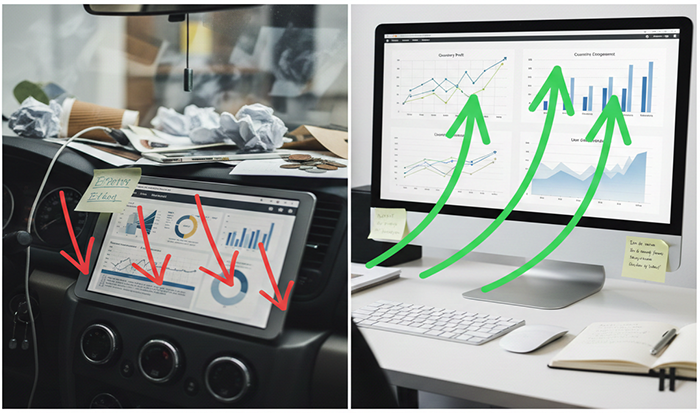
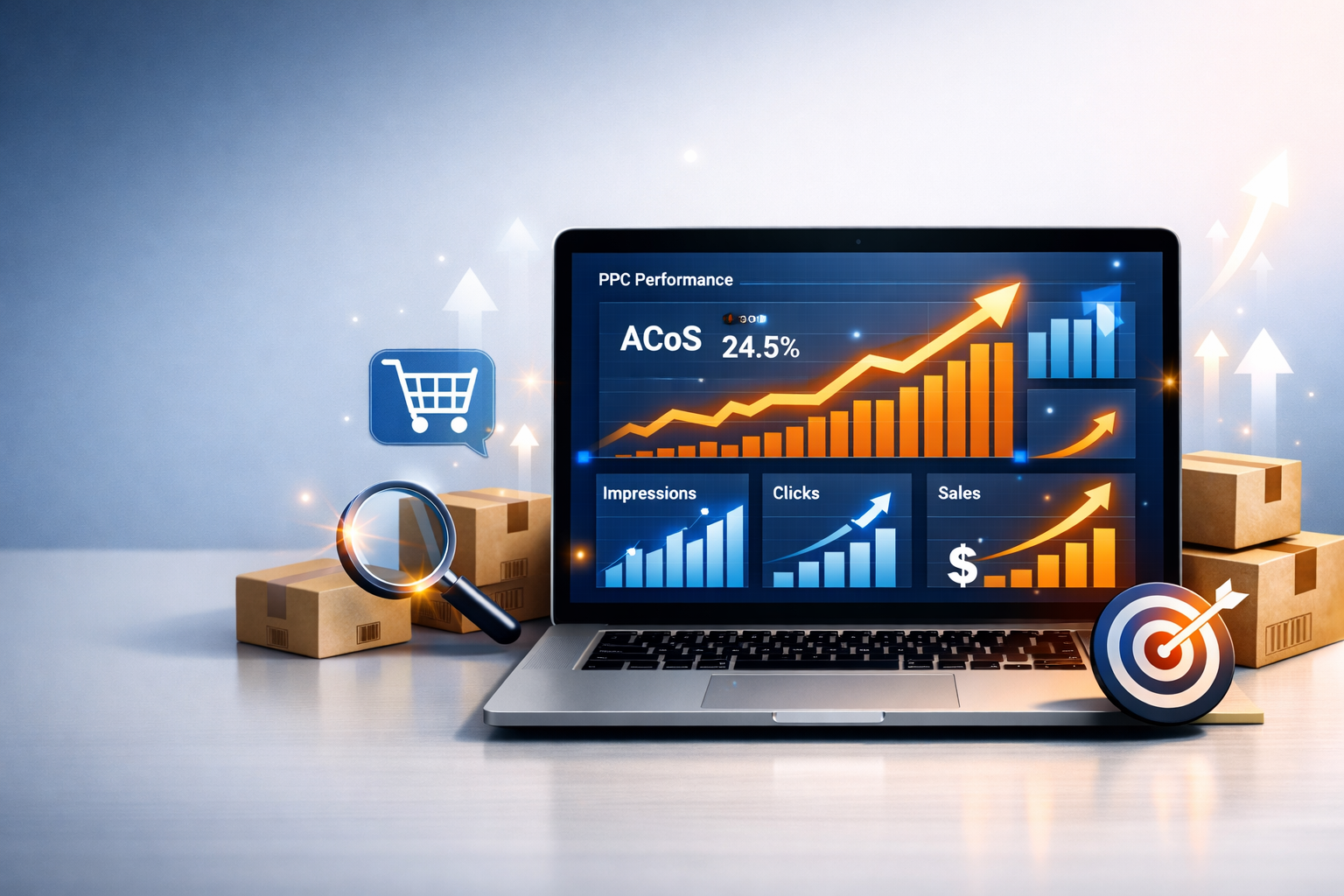
Let’s cut to the chase—if you’re launching your first product on Amazon in 2026, advertising isn’t optional anymore. It’s the engine that gets your listing seen, clicked, and bought.
But here’s the problem: most new sellers treat Amazon Advertising Strategy like a slot machine. They throw money in, hope for sales, and wonder why they’re bleeding cash by week three.
The reality? Amazon Advertising for sellers is a system. It has rules, rhythms, and a learning curve that can either launch you to page one or burn through your budget before you get a single review.
This Sellerite guide is built for new sellers who want to start smart, not just start fast. We’ll walk you through a step‑by‑step Amazon Advertising campaign Strategy that actually works in 2026, with real benchmarks, timelines, and the exact moves to make in your first 90 days.
No fluff, no theory—just a practical playbook you can follow even if you’ve never run an ad before.
The difference between sellers who thrive and those who quit usually comes down to one thing: patience with data. You can’t rush the algorithm. You can’t buy your way to relevance. But you can build a foundation that compounds over time. That’s what this guide is about.
The Foundation: What You Must Have Before Spending A Dollar
Your listing is your ad’s landing page—make it convert
Here’s the pre‑launch checklist that every successful Amazon Advertising Agency insists on:
- Main image: Must be on pure white background, but add a small infographic overlay if it clarifies the product (e.g., “BPA‑Free” badge, “Pack of 3” callout). The human eye scans for context in milliseconds. Give it that context.
- Title: Lead with benefit, not just keywords. “Stainless Steel Water Bottle” is forgettable. “Keeps Ice Frozen for 24 Hours – 32oz Stainless Steel Water Bottle” sells. The algorithm reads keywords, but humans read promises. Make your promise clear.
- Bullets: Answer the top 5 questions from your competitor’s Q&A section. Seriously—go read them. Copy the language. These are the exact phrases buyers use when they’re on the fence.
- Reviews: Launch with at least 15–20 reviews. Use Amazon’s Early Reviewer Program or Vine. Without this, your Amazon Advertising Strategy is dead on arrival. No one buys a product with 3 reviews unless it’s $5. And even then, they hesitate.
If your listing doesn’t check these boxes, pause. Fix it. Then come back to ads. Spending money on ads before your listing is ready is like pouring water into a leaky bucket. You’ll just get frustrated and blame the platform when the real issue is your foundation.
Week 1–2: The Launch Phase—Your First Amazon Advertising campaign Strategy
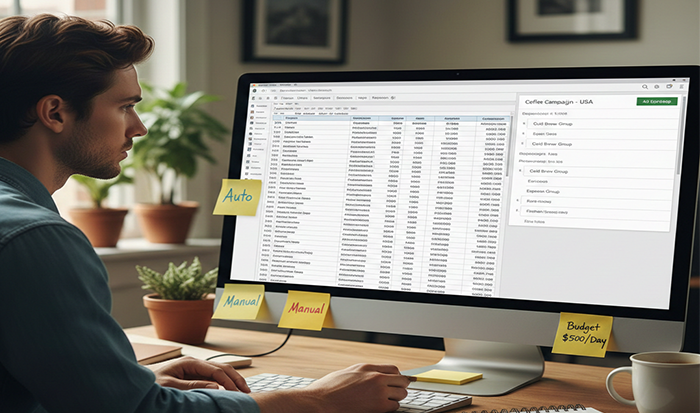
Start with Sponsored Products only
That’s it. No auto campaigns. No Sponsored Brands. No Display. Just one campaign, tightly controlled.
Why exact match? Because broad match will show your ad for “wireless earbuds” when you sell “wired headphones,” and you’ll pay for clicks that never convert. Exact match forces discipline. It teaches you which words actually make you money.
Step‑by‑step setup:
- Keyword research: Use Amazon’s search bar autocomplete. Type your main product and write down the 10 phrases that appear. These are your starting keywords. They’re not perfect, but they’re real buyer language. That matters more than volume at this stage.
- Bid low: Start at $0.50–$0.75 per click. You’re not trying to win page one on day one. You’re trying to collect data without going broke. Think of it as buying information, not just sales.
- Daily budget: $20–$30. This gives you 25–40 clicks per day. Enough to learn, not enough to panic. If you spend $100 on day one and get zero sales, you’ll quit. If you spend $25 and get one sale, you’ll learn.
- Run for 7 days: Don’t touch it. Let Amazon’s algorithm learn who clicks and who buys. Resist the urge to tweak bids every hour. The algorithm needs time to find patterns.
After 7 days, check your Amazon Advertising Conversion Rate. If it’s above 5%, you’re on track. If it’s below 3%, your listing or keywords are off. Don’t scale. Diagnose.
Add one Sponsored Brands campaign (if you have brand registry)
Amazon Advertising Strategies that skip brand defense often see their organic sales poached by better‑funded competitors. Don’t let that be you. A simple defensive campaign costs pennies but protects dollars.
Week 3–4: The Optimization Phase—Cut Waste, Double Down
Kill what doesn’t convert
- Any keyword with >20 clicks and 0 sales? Pause it. It’s not a “maybe later” keyword. It’s a dud.
- Any keyword with ACoS > 100%? Lower bid by 30%. Give it one more chance at a cheaper cost.
- Any keywords with ACoS < 30%? Increase bid by 20% to capture more volume. This is your winner—feed it.
This is the heart of a smart Amazon Advertising campaign Strategy: constant pruning. New sellers often fail because they’re afraid to turn keywords off. They think, “Maybe it just needs more time.” No. It needs to be paused. Every dollar you save from a dud keyword is a dollar you can spend on a winner.
Introduce phrase match (carefully)
Now that your exact match campaign is profitable, clone it and change the match type to phrase. This captures “long tail” variations without the chaos of broad match.
Example: If your exact keyword is “stainless steel water bottle,” phrase match will show your ad for “insulated stainless steel water bottle” or “stainless steel water bottle for kids.” These are relevant, high‑intent variations.
Set bids 20% lower than exact match. Monitor daily. If you see irrelevant clicks, add negative keywords immediately. Phrase match is a bridge between control and scale. Walk it carefully.
Month 2: The Scaling Phase—Grow Without Blowing Up

Increase budget on winners
Scaling rule: Increase daily budget by 20% every 3 days as long as ACoS stays under 40%. The moment ACoS spikes above 50%, pause scaling for a week and optimize. This measured approach prevents the classic new seller mistake: going from $30/day to $300/day overnight and watching Amazon Advertising ROI implode.
Slow scaling gives the algorithm time to adjust. It also gives you time to spot problems before they become disasters.
Launch Sponsored Display for retargeting
Set up a campaign targeting “views of your product in the last 7 days.” Bid $0.30–$0.40. These shoppers are warm. They convert at 2–3x the rate of cold traffic.
Amazon Advertising Strategies that ignore retargeting leave 30–40% of potential sales on the table. Don’t be that seller. Retargeting is the easiest way to boost Amazon Advertising ROI without increasing your overall ad spend.
Month 3: The Expansion Phase—Add Complexity Only When Ready
Test Sponsored Brands video
Keep it simple: 15 seconds, show the product in use, end with a clear benefit. Video can boost Amazon Advertising Conversion Rate by 20–30% if done right. But if your listing is weak, video just amplifies the problem. Fix the foundation first, then add video as a conversion multiplier.
Build a defensive campaign
Create a Sponsored Products campaign targeting your own ASINs. Bid $0.25–$0.35. This blocks competitors from showing ads on your product page and keeps your brand front‑and‑center.
Amazon Advertising for sellers who don’t defend their turf lose 5–10% of sales to conquesting ads. It’s death by a thousand cuts. A defensive campaign is cheap insurance.
Common New Seller Mistakes That Kill Amazon Advertising ROI

Mistake #1: Bidding on broad match day one
Mistake #2: Ignoring ACoS until it’s too late
Mistake #3: No negative keywords
Mistake #4: Setting budget too high, too fast
When To Hire An Amazon Advertising Agency
The 90‑day rule
Agencies bring:
- Systematic A/B testing (creatives, bids, placements)
- Advanced segmentation (audience, dayparting, placement modifiers)
- Experience scaling from $50/day to $5,000/day without breaking ACoS
But don’t hire an agency on day one. You need to understand your own metrics first. Otherwise, you won’t know if the agency is actually helping or just spending your money.
Advanced Amazon Advertising Strategies For Month 4 And Beyond

Portfolio bidding strategy
Audience targeting (for brand registered sellers)
Amazon DSP (Demand‑Side Platform)
Key Metrics Every New Seller Must Track
The three numbers that matter
- ACoS (Advertising Cost of Sale): Should be <40% for profitability. If it’s higher, you’re either overpaying for clicks or your listing isn’t converting.
- ROAS (Return on Ad Spend): Should be >3x for sustainability. Below that, you’re growing revenue but not profit.
- TACoS (Total ACoS): Ad spend ÷ total revenue (organic + ad). Should be <15% long‑term. If TACoS is rising while ACoS is flat, your organic sales are dropping. That’s a ranking problem, not an ad problem.
Track these three numbers every single day. They’re your vital signs.
Budget Allocation Framework For New Sellers
The 70‑20‑10 rule
- 70% of ad budget → Sponsored Products (proven, direct ROI)
- 20% → Sponsored Brands (brand building, defense)
- 10% → Sponsored Display (retargeting, awareness)
Within Sponsored Products, allocate:
- 50% to exact match (your core keywords)
- 30% to phrase match (long‑tail expansion)
- 20% to auto campaigns (keyword discovery)
This structure balances control with discovery, ensuring you don’t miss opportunities while staying profitable. It’s a proven framework used by every serious Amazon Advertising Agency.
The First 90 Days: A Timeline Summary

Final Word: Amazon Advertising Strategy Is A Skill, Not A Hack

Start small. Stay disciplined. Track every dollar. And when you find what works, scale it slowly. The tortoise wins this race.
If you do that, you won’t just survive your first 90 days—you’ll build a foundation that funds your next 10 products. And that’s how you turn a side hustle into a real brand.
FAQs
1.Do new Amazon sellers really need to run ads in 2026?
2.How much should a new seller spend on Amazon ads at the start?
3.Which Amazon ad type is best for beginners?
4. When should I start scaling my Amazon ad budget?
5. Are Sponsored Display ads worth it for new sellers?



 Back to top
Thought Leadership, Tips, and Tricks
Never miss insights into the Amazon selling space by signing up for our email list!
Read more



Expert
strategies
delivered
to your
inbox
top industry minds to fuel
your brand’s growth.

Send request to Sellerite
Once you submit the consultation form, we’ll dive into the details and email you a tailored report within 24-48 hours.
"*" indicates required fields
*By submitting your Email Address, you are agreeing to all conditions of our Privacy Policy.
