




Table of Contents
Introduction - Why Account Health Is Everything
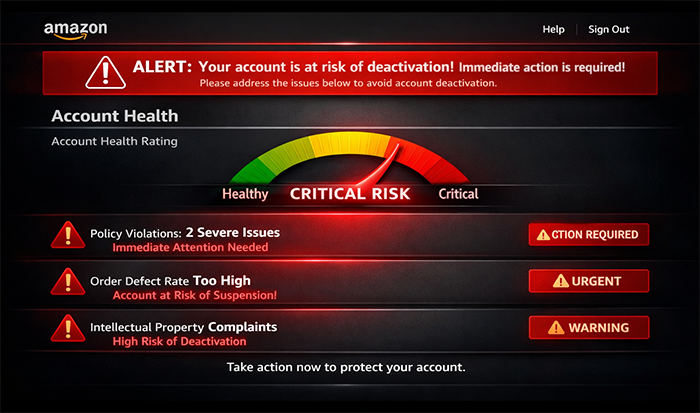
We have all seen the screenshots, the skyrocketing revenue bars and the “Amazon Choice” badges. It’s easy to get caught up in the thrill of how to grow an Amazon store fast. But if you’ve been in the trenches for long, you know that scaling isn’t just about the numbers going up; it’s about making sure the foundation doesn’t crack under the pressure.
Most sellers treat their Amazon growth strategy like a race to the finish line, pouring every cent into ads and inventory. But here’s the truth: growing without a safety net isn’t just riskyit’s a gamble with your livelihood.
The Growing Pains Nobody Talks About
When you push for volume aggressively driving external traffic Amazon or dumping budget into Amazon PPC scaling you aren’t just increasing sales. You’re increasing your surface area for things to go wrong.
More orders mean more room for:
- Misunderstandings in the review section.
- The logistical headache of returns.
- The dreaded “policy violation” notification that arrives when you’re least prepared.
Why Compliance is Your Secret Weapon
Most people only care about “Account Health” when their dashboard turns yellow or red. By then, the damage lost revenue, vanished listings, and frozen cash flow is already done.
If you want to increase Amazon sales and actually keep them, you have to stop seeing compliance as a chore and start seeing it as your most important Amazon FBA scaling strategies.
You aren’t just selling products; you’re building a legacy that needs to survive the algorithm’s next mood swing.
Growth + Protection = Longevity
Whether you are refining your Amazon product launch strategy or looking into Amazon automation tools to free up your time, remember that sustainable growth is the only kind that counts. You shouldn’t have to choose between a boost in sales and a good night’s sleep.
To improve Amazon conversion rate and dominate your niche, you need a partner who watches your back while you look ahead. That’s how you truly master how to scale Amazon FBA business.
Understanding Amazon Account Health Metrics

When you are deep in the process of how to scale an Amazon FBA business, it’s easy to get blinded by the “Total Sales” dashboard. But Amazon doesn’t care about your revenue as much as they care about your reliability.
If your metrics slip, your Amazon growth strategy won’t just stall it will collapse. Think of these four pillars as the vital signs of your business. If one drops, the whole system goes on life support.
The AHR (Account Health Rating)
Your AHR is basically your credit score with Amazon.
- Healthy (Green): You have the green light to go aggressive.
- At Risk (Yellow): This is your final warning to slow down and audit your processes.
- Critical (Red): You’re one mistake away from a total shutdown.
If you want to grow Amazon stores sustainably, you need to keep this in the green. A high AHR isn’t just a badge; it’s your license to stay in business.
Order Defect Rate (ODR) – The 1% Rule
Amazon has zero chill when it comes to customer experience. Between negative feedback and A-to-z claims, you have a razor-thin margin. If you cross that 1% threshold, your ability to increase Amazon sales will vanish as Amazon throttles your visibility. You can’t out-spend a bad ODR with Amazon PPC scaling.
Late Shipment & Cancellation Rates
These are the “silent killers” of Amazon FBA scaling strategies.
- Late Shipments: Keep it under 4%.
- Cancellations: Keep it under 2.5%.
Amazon views a cancellation as a broken promise. If you’re constantly canceling orders because your inventory management is messy, no amount of external traffic Amazon or fancy Amazon automation tools will save your ranking.
The Long Game
Refining your Amazon product launch strategy is exciting, and trying to improve Amazon conversion rate is where the money is made. But none of that matters if you’re locked out of your own account. Protect your metrics like your business depends on it because it does.
The Most Common Reasons for Amazon Suspensions
Everyone wants to know how to scale Amazon FBA business, but nobody wants to talk about the graveyard of suspended accounts that tried to grow too quickly without looking at the fine print.
Amazon doesn’t just “randomly” ban people; they wait until you’re big enough to notice, and then they pull the rug. If your Amazon growth strategy involves cutting corners, you aren’t building a business, you’re building a house of cards.
The Paperwork Trap (Authenticity & IP)
You might find a “great deal” from a local distributor and think you’re ready to increase Amazon sales overnight. But the moment a competitor or a grumpy customer flags your product as “inauthentic,” Amazon will demand invoices.
If those invoices don’t meet their hyper-specific criteria, your inventory stays locked in a warehouse and your cash flow dies. Proving authenticity isn’t a “later” problem; it’s a “Day 1” requirement.
The Paperwork Trap (Authenticity & IP)
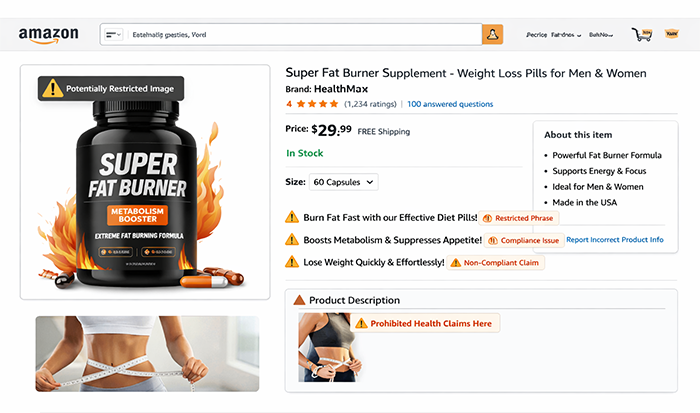
We’ve all seen it: a supplement brand claiming a “100% cure” or a gadget making impossible promises to improve Amazon conversion rate. It works for a week, and then the algorithm catches the restricted keywords.
Your listing doesn’t just get suppressed, it gets nuked. Being “TOS-compliant” means your marketing has to be as honest as your product.
The Review Illusion
It’s tempting to “nudge” your ratings to help your Amazon product launch strategy. But incentivized feedback is the fastest way to get a lifetime ban. Amazon’s bots are better at spotting fake patterns than you are at hiding them.
The "Small Tricks" That End Careers
There are so many “grey areas” that gurus talk about:
- Sneaking competitor brand names into your backend keywords.
- Making indirect medical claims.
- Messing with variations to “hijack” reviews from old products.
These might give you a temporary spike in Amazon PPC scaling, but they are account-killers in the long run.
Logistics: The Unsexy Side of Scaling
Whether you’re driving external traffic to Amazon or using Amazon automation tools, if your packaging is wrong or your supplier is late, the complaints will pile up. Amazon values the customer’s “opening experience” more than your profit margin.
If you can’t ship it right and ship it on time, you aren’t ready for Amazon FBA scaling strategies.
True compliance isn’t about following rules because you’re told to it’s about protecting the asset you’ve worked so hard to build. If you want to know how to grow an Amazon store the right way, you have to realize that “safe” is the only way to stay “successful.”
Amazon Policy Compliance - What Sellers MUST Know
The word “Compliance” sounds like something for a lawyer’s office, but in the world of how to scale Amazon FBA business, it’s actually your most aggressive offensive play. Most sellers think being “TOS-compliant” just means you aren’t selling counterfeit goods.
But in reality, Amazon’s Terms of Service is a living, breathing document that changes its mind more often than the UK weather. If your Amazon growth strategy is based on what worked six months ago, you’re already standing on a trapdoor.
Being truly compliant in practice means having a paper trail for every single unit before it even touches a shipping container. It’s not just about “honest listings”; it’s about having the specific, brand-authorized invoices that Amazon’s bots will eventually demand.
If you’re driving external traffic to Amazon or ramping up your Amazon PPC scaling, you are essentially putting a massive bullseye on your account.
The more you increase Amazon sales, the more likely a competitor or a bot is going to flag you. If you don’t have the “boring” stuff the letters of authorization and the VAT-compliant records, your Amazon product launch strategy is just a high-speed chase toward a dead end.
Then there are the “grey areas” that the gurus love to whisper about. Things like “keyword stuffing” your backend with competitor brand names or using Amazon automation tools to “nudge” your review count. These aren’t “hacks” ; they’re account-level landmines.
You might see a temporary spike and think you’ve mastered how to grow an Amazon store faster than the rest, but Amazon plays the long game.
They’ll let you sell for months, and then, right when your inventory is at its peak and your cash is tied up, they’ll pull the rug for “Inauthentic Activity” or “Variation Abuse.”
This is exactly why we built the compliance arm of Sellerite. We don’t just “explain” policies; we act as a firewall. We audit the messy corners of your account to find the “tripwires” before the bots do.
Whether it’s vetting your suppliers or ensuring your Amazon FBA scaling strategies aren’t accidentally violating the latest “Fair Pricing” or “Review Manipulation” updates, we handle the technical grit so you can focus on the vision.
You shouldn’t have to choose between a boost in sales and a good night’s sleep. We make sure that as you improve Amazon conversion rate, you’re doing it on a foundation that won’t crack under the pressure.
How to Avoid Amazon Suspension (Proactive Strategy)

The Fortress Strategy: Protecting Your Amazon Empire Before the Storm
In the world of e-commerce, everyone talks about the “gold rush” of how to scale Amazon FBA business, but nobody talks about the wall you have to build around your gold.
Prevention isn’t just a boring chore; it’s the only way to ensure your Amazon growth strategy actually reaches the finish line. If you aren’t watching the back door, someone or some algorithm is going to walk right in and take everything you’ve built.
The "Daily Pulse" Check
You wouldn’t drive a car without looking at the dashboard, so don’t run a store that way. To grow an Amazon store, you need to live in your Account Health Rating (AHR) dashboard.
The Routine: Every single morning, check your customer feedback and performance metrics. These aren’t just numbers; they are the early warning signs of a heart attack for your business.
The Goal: Catch a spark before it becomes a wildfire. If you see a dip, adjust your Amazon PPC scaling or pause a campaign before the bots do it for you.
The Paper Trail (Your Get-Out-of-Jail-Free Cards)
When Amazon asks for proof, they don’t want excuses; they want receipts. If you want to increase Amazon sales safely, your documentation needs to be airtight.
Invoices & Letters: Keep your supplier invoices, purchase records, and brand authorization letters in a folder that’s updated weekly.
Supplier Vetting: Stop chasing the cheapest price from unverified sources. One bad batch of inventory can ruin your Amazon FBA scaling strategies forever. Work only with partners who understand that their “authenticity” is your “safety.”
The "Listing Law" (Look Before You Leap)
Before you hit “publish” on your next big Amazon product launch strategy, run a final compliance audit.
- No “Miracle” Claims: If it sounds too good to be true, the algorithm will flag it.
- Category Accuracy: Don’t try to “hack” the system by listing in the wrong category to get a badge.
- The Visuals: Make sure your images don’t just improve Amazon conversion rate, but actually reflect what’s in the box.
Automate the Boring Stuff
You can’t be everywhere at once. This is where Amazon automation tools come in not to replace your brain, but to act as your 24/7 security guard.
Use them to track shipments and monitor external traffic Amazon sources, so you can focus on the creative vision of your brand while the systems keep the lights on. Growth is exciting, but longevity is the real flex. Build it right the first time.
Listing-Level Risks Most Sellers Miss
When you’re obsessed with how to scale Amazon FBA business, it’s easy to get tunnel vision. You’re looking at the big numbers the PPC spends, the inventory shipments, the global expansion.
But in the world of Amazon, it’s rarely the big moves that kill you; it’s the tiny, overlooked details in your listings that act like a slow-release poison for your Amazon growth strategy.
If you want to know how to grow an Amazon store without waking up to a “Listing Deactivated” notification, you have to treat your product pages like legal documents, not just sales pitches.
The Keyword Trap: Traffic vs. Trouble
We have all been tempted to sneak a high-volume, semi-irrelevant keyword into the backend to “hack” the system. You think it’ll help you increase Amazon sales, and maybe it does for a day or two.
But here’s the reality: irrelevant keywords confuse the algorithm.
Not only do they fail to improve Amazon conversion rate (because you’re showing your product to the wrong people), but they also act as a massive red flag for Amazon’s “misleading content” bots.
If your Amazon PPC scaling is based on keywords that don’t 100% match your product, you aren’t scaling you’re just paying to get caught.
The Danger of "The Miracle Claim"
In the rush to make an Amazon product launch strategy stand out, it’s tempting to use words like “Guaranteed,” “Clinically Proven,” or “Permanent Cure.”
Unless you have a legal team and a mountain of FDA-approved paperwork sitting behind those words, don’t use them. Amazon’s compliance bots are trained to hunt for these specific phrases.
One “Guaranteed Results” claim can get your entire account flagged for medical or restricted product violations. It’s not worth the 5% bump in sales if it costs you the entire store.
Visuals: The "Honesty" Filter
We live in an era of Amazon automation tools and AI-generated lifestyle images, but if your photos promise a world that the physical product can’t deliver, you’re dead in the water.
- The “Before/After” Ban: Amazon hates these. They view them as inherently manipulative.
- Unauthorized Badges: Adding your own “Number 1 Best Seller” or “Eco-Friendly” seal to an image is a fast track to a policy violation.
Your images should be your strongest tool for Amazon FBA scaling strategies, but they must be as honest as a mirror.
Variation Abuse: The Guru's "Secret" That Backfires
A common “black hat” trick is grouping unrelated products together to “borrow” reviews from an older, successful listing. This isn’t just a mistake; it’s a “red flag” violation. Amazon views variation manipulation as a direct attempt to cheat the customer.
When you’re driving external traffic Amazon to a page, you need every click to be a high-trust interaction. If a customer lands on a page for “Blue Pens” and sees 5,000 reviews for “Coffee Mugs,” they report it and Amazon listens.
True growth is boring before it’s exciting. It’s built on clean data, honest claims, and airtight compliance. Don’t let a “small” shortcut destroy your long-term vision.
What To Do If Your Amazon Account Gets Suspended

The 48-Hour War Room: What to Do When the "Suspended" Email Hits
There is no heart-sink quite like opening your inbox to see those dreaded words from Amazon. In an instant, your Amazon growth strategy isn’t about revenue anymore it’s about survival. Every hour your “Buy Box” is gone, your rankings bleed out, and your competitors start eating your lunch.
But here’s the most important thing: Do not panic-reply. A rushed, emotional appeal is the fastest way to get a permanent ban. If you want to know how to grow an Amazon store for the long haul, you have to handle this like a professional investigator, not a victim.
The Critical "Golden" Window (First 24–48 Hours)
The instinct is to scream at the screen or fire off an “I didn’t do it!” email. Stop.
- Audit the Damage: Don’t just read the email; look for the subtext. Is it a “related account” issue? An authenticity complaint? A rogue keyword? You have to identify the exact “tripwire” before you say a word.
- Stop the Bleeding: Immediately pause your Amazon PPC scaling and any external traffic Amazon campaigns. There’s no point in paying for clicks to a dead page.
- The Paper Trail: Start pulling every invoice, authorization letter, and shipping log. If you’ve been using Amazon automation tools to manage your back-end, pull those reports too.
Talking to the "Bot" (How to Write an Appeal That Works)
When you finally write back, remember that the person or algorithm reading your appeal has zero emotion. They don’t care about your mortgage or your hard work. They only care about “Plan of Action” (POA).
- Factual over Emotional: “I am so sorry, I worked so hard” gets ignored. “The root cause was an incorrectly labeled SKU in our third-party warehouse” gets read.
- The Root Cause: Amazon doesn’t just want you to fix the mistake; they want to know why it happened and how it will never happen again. This is where your Amazon FBA scaling strategies must include a section on safety and redundancy.
- Be Clear, Be Concise: Use bullet points. Make it easy for a stressed investigator to say “Yes.”
The "Never" List (How to Avoid a Lifetime Ban)
- Don’t Blame the Algorithm: Even if it is a mistake on Amazon’s end, pointing fingers only slows you down. Own the “oversight” and move on.
- Don’t Guess: If you aren’t sure why you were suspended, don’t submit a “random” appeal. Every rejected appeal makes the next one harder to get approved.
- Don’t Ignore It: Hoping it will go away is how you lose your business. Address it head-on, with data.
Scaling Through the Storm
A suspension is a brutal lesson, but the sellers who survive it come back stronger. They realize that to increase Amazon sales sustainably, they need a foundation that is as strong as their Amazon product launch strategy.
You don’t just want to know how to scale an Amazon FBA business, you want to know how to build an Amazon business that is “un-killable.”
How the Amazon Appeal Process Works

The truth is, Amazon doesn’t care about your “why” they only care about your “how.” When you get hit with a suspension, it feels personal, like someone just padlocked your office door while you were inside.
But to the person reading your appeal, you’re just a data point that flashed red. If you want to know how to scale Amazon FBA business without losing your mind, you have to stop writing like a victim and start writing like a fixer.
The “Root Cause” isn’t an apology. It’s a forensic audit. If your Amazon growth strategy hit a wall because you bought inventory from a supplier who couldn’t provide a proper VAT invoice, say exactly that.
Don’t hide behind “staff errors.” Tell them the process failed because the vetting wasn’t tight enough. That’s the only way they’ll believe you’re ready to increase Amazon sales again.
You have got to show them the blood, sweat, and tears of what you’ve already fixed. If a listing was flagged, don’t just say you’ll edit it delete the whole thing and show them the “Delete” confirmation.
If you were driving external traffic Amazon to a page that had a compliance red flag, show them the paused campaign dashboard. They want to see that the fire is out, not just that you’ve bought a fire extinguisher.
The real “secret” to Amazon FBA scaling strategies that actually last? It’s the “Never Again” section. This is where you prove you’ve matured as a seller.
Maybe you’re bringing in new Amazon automation tools to catch shipping delays before they hit the 4% danger zone, or you’re overhauling your Amazon product launch strategy to include a mandatory 48-hour compliance “cool-down” period before anything goes live.
Scaling is a high-wire act. You’re trying to improve Amazon conversion rate and push for Amazon PPC scaling all at once, but if the wire snaps, you need a net. That Plan of Action is your net.
It’s the difference between a temporary setback and a permanent “Game Over.” If you want to know how to grow the Amazon store into a legacy, you have to respect the rules of the game as much as you respect the hustle.
Scaling Safely - Growth Without Risk

The harsh reality of the UK marketplace is that Amazon isn’t just a platform; it’s a minefield of regulation and high-velocity competition. Most sellers think that knowing how to scale Amazon FBA business is as simple as doubling your ad spend and hoping the algorithm rewards the hustle.
But if you’ve been in the game long enough, you know that scaling without a safety net is just a faster way to hit a wall. In the UK, where consumer protection and VAT compliance are non-negotiable, one “clever” shortcut can get your entire operation shuttered overnight.
I’ve seen too many brands get seduced by the “Growth at all costs” mentality. They start chasing those black-hat tactics manipulating variations or buying “grey-market” reviews thinking they’ve found a loophole in the Amazon growth strategy. It’s a rush, sure. Your sales spike, and for a week, you feel like you’ve cracked the code.
Then, the hammer drops. Amazon’s bots are far more sophisticated than the gurus let on. One day you’re at the top of the search results, and the next, you’re looking at a deactivated account and a warehouse full of dead stock in a Midlands fulfillment centre. That’s not a business; that’s a gamble.
If your goal is to truly grow the Amazon store into a legacy brand, you have to embrace the “Slow is Smooth, Smooth is Fast” philosophy. A professional Amazon product launch strategy isn’t an overnight explosion; it’s a controlled burn.
You start with Amazon PPC scaling that is built on actual conversion data, not just burning your margin to see what sticks. You grow your inventory in stages, ensuring every supplier is vetted and every invoice is HMRC-ready before you even think about driving external traffic Amazon to your listings.
The real win is finding that balance where ranking meets absolute compliance. You want to increase Amazon sales, but you want them to be “bulletproof” sales. This means crafting copy that doesn’t just improve Amazon conversion rate through hype, but through clear, honest value that doesn’t trigger a “misleading claims” flag.
It means using Amazon automation tools to stay on top of your metrics 24/7, so you’re never surprised by a late shipment or a negative feedback spike.
These Amazon FBA scaling strategies aren’t just about making more money they’re about keeping it. You build the fortress, you verify the supply chain, and only then do you expand the empire. That’s how you win in the UK.
Scaling Safely - Growth Without Risk
The reality of the UK market is that everyone wants to show you how to scale Amazon FBA business, but almost nobody wants to stand in the gap when the algorithm starts throwing punches. That’s the gap Sellerite fills.
We aren’t here to just watch your sales go up; we’re here to make sure they don’t come crashing down because of a “clever” mistake you didn’t even know you were making. Scaling without a safety net isn’t an Amazon growth strategy, it’s a countdown to a shutdown.
Most sellers wait until they get a “Policy Violation” email to care about compliance. By then, you’re already losing money every second your listings are dark. Sellerite’s compliance audits aren’t about checking boxes; they’re about hunting for the landmines before you step on them.
We dig into the “grey areas” that Amazon automation tools often miss, ensuring your Amazon product launch strategy is built on a foundation of verified invoices and airtight documentation.
When we look at your listings, we aren’t just looking for high-volume keywords to improve Amazon conversion rate. We’re looking for the “tripwires” , the exaggerated claims or the restricted phrases that trigger a bot at 3 AM and wipe out your best-seller.
We balance the need to increase Amazon sales with the absolute necessity of staying in Amazon’s good graces. It’s about building a brand that can handle aggressive Amazon PPC scaling or a massive influx of external traffic from Amazon without buckling under the weight of customer complaints or performance metrics.
And if the worst happens if a competitor flags you or a bot makes a mistake we don’t send you a template. We build a war-room style Plan of Action (POA) that speaks the only language Amazon investigators respect: cold, hard facts and systematic fixes.
Our Amazon FBA scaling strategies are designed to reduce your downtime to the absolute minimum, because we know that in this business, time isn’t just money, it’s your ranking, your reputation, and your peace of mind.
If you’re ready to grow an Amazon store with a partner who actually understands the stakes, you stop looking for shortcuts and start building a fortress. That’s what Sellerite does. We handle the “boring” compliance so you can focus on the vision.
Conclusion

At the end of the day, the difference between a “one-hit wonder” and a legacy brand on Amazon comes down to one thing: the foundation. You can chase every “black-hat” shortcut and “hack” the gurus are selling this week, but those aren’t Amazon FBA scaling strategies, they’re just countdowns to a deactivation notice.
If your Amazon growth strategy is built on a house of cards, the wind will eventually blow it down. It’s not a matter of if, it’s a matter of when.
True, sustainable success isn’t about finding a magic button to increase Amazon sales overnight. It’s about the disciplined, expert-led process of how to scale Amazon FBA business without tripping the alarms.
It’s about realizing that every time you push for Amazon PPC scaling or start driving external traffic to Amazon, you’re putting a spotlight on your account. If that spotlight reveals a messy back-end, missing invoices, or “grey-area” keywords, you’re done.
If you’re serious about how to grow an Amazon store into something that you actually own, something that provides real security, you have to stop treating compliance like a chore and start treating it like your most powerful competitive advantage.
While your competitors are getting suspended for “miracle” claims or shady Amazon product launch strategy tricks, you’ll be the one left standing, capturing their market share. You don’t just want to improve
Amazon conversion rate for a weekend; you want a listing that converts for a decade.
Scaling with raw power is easy, but scaling with strategy is where the real money is made.
It’s about using Amazon automation tools to stay ahead of the bots and having a partner like Sellerite who knows exactly where the landmines are buried. You handle the vision, we handle the fortress.
Stop wondering if your account is a ticking time bomb. It’s time to move from “hope” to “certainty.” Let’s get a real-world account audit on the books and find the risks before Amazon does. That’s how you actually win the long game.
FAQs:
1. What is Amazon DSP in simple terms?
2. How is it different from regular Amazon PPC?
3. Can I use it if I don’t sell on Amazon?
4. What does "programmatic" actually mean here?
5. Is Amazon DSP management difficult?


 Back to top
Thought Leadership, Tips, and Tricks
Never miss insights into the Amazon selling space by signing up for our email list!
