


Why This Pricing Data Matters In 2026
If you sell on Amazon long enough, you learn this fast: discounts can make sales go up, and profits go down at the same time. That is the tension at the heart of every Amazon Discounting Strategy. A price cut can lift click-through rate, improve conversion, and create a short-term sales spike, but if the discount is too deep or too frequent, the margin damage can quietly outweigh the upside.
That is exactly why this Sellerite report matters in 2026. Amazon sellers are under pressure from ad costs, fee increases, and more aggressive promotional behavior across crowded categories. In that environment, discounting is no longer just a growth tactic. It is a margin decision, a ranking decision, and in many cases a brand-positioning decision too.
The real issue is not whether discounts work. They often do. The issue is whether your Amazon Discount Strategy is increasing profitable demand or just training shoppers to wait for the next deal.

How We Define Amazon’s Discounting Strategy For This Report
What “discounting” really includes
When we talk about Amazon’s discounting strategy, we are looking beyond simple coupon clipping. On Amazon, discounting can take several forms:
- Percentage-off promotions and coupons.
- Time-bound event discounts during Prime Day or holiday periods.
- Subscribe & Save incentives.
- Bundle-style or cross-sell offers that raise perceived value.
- Tactical markdowns to support velocity or move excess stock.
The key point is that not all discounting behaves the same way. A short, controlled promotion to support a launch is very different from permanent price erosion on a hero SKU.
What “margin impact” means here
For this report, margin impact means more than just a lower selling price. A discount affects profit through several layers at once:
- Lower per-unit revenue.
- Possible higher sales volume.
- Continued ad spend, often on thinner unit economics.
- Potential FBA fee relief if turnover improves and storage pressure drops.
- Long-term effects on brand perception and repeat purchase behavior.
This is why Profit Margins can improve or deteriorate under a discounting program, depending on how the offer is structured. Discounting is not automatically good or bad. It is highly sensitive to timing, depth, category behavior, and whether the product already has demand momentum.
What The 2026 Data Says About Discount Strategy

Shallow discounts often outperform deep cuts
One of the clearest patterns in recent Amazon pricing analysis is that shallow, time-bound discounts tend to protect contribution margin better than deep cuts while still driving urgency. One 2026 strategy breakdown recommends 15% to 18% discounts around major shopping peaks, while keeping hero SKUs in the 0% to 5% range and secondaries in the 10% to 15% range.
That matters because deep discounting feels exciting but often wrecks economics. One example cited by Marketplace Valet shows a product priced at $50 with a 25% margin, or $12.50 profit per unit. A 15% discount cuts that unit margin to just $5 before ad spend and fees are considered. In other words, the discount did not just trim profit. It crushed the cushion that made the sale worth having in the first place.
The smarter Discount Strategy is usually not “how low can we go?” It is “how little do we need to give up to move the customer?”
Volume can offset margin loss, but only under the right conditions
There is one important counterpoint. Discounts do not always hurt total profit. In some cases, lower per-unit margin can still increase overall profit if sales volume rises enough. One 2025 promotions analysis gives a simple example: a 20% discount that doubles sales could produce roughly a 60% increase in total profit, particularly on products that begin with healthy margins or need faster inventory turnover.
That said, this only works when the economics are real. If ad costs rise along with the promotion, or if the product already had weak unit margins, the “volume saves us” logic can fall apart quickly. This is why a good Amazon Discount Strategy starts with contribution margin math, not just conversion optimism.
Amazon Discounting Strategy At A Glance
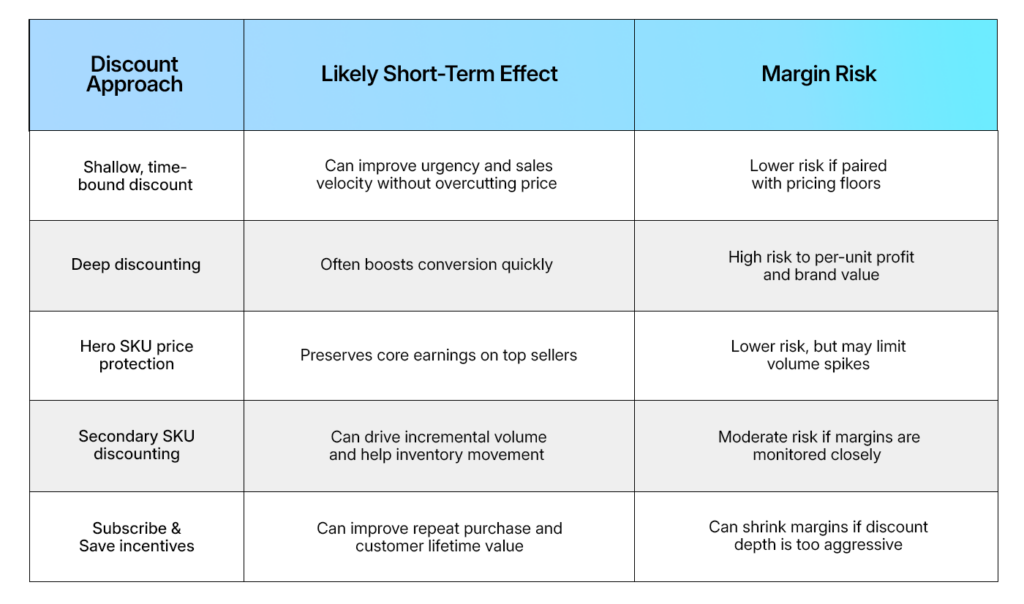
This is the practical takeaway: the best Amazon Discounting Strategy is usually selective, not blanket. Sellers who protect hero SKUs and use more tactical discounting on slower or more flexible items often preserve Profit Margins better over time.
Where Discounting Helps and Where It Hurts
The upside sellers are chasing
There are good reasons sellers keep using discounts. In the right context, discounts can:
- Lift conversion rate during promotional windows.
- Increase sales velocity and support temporary ranking movement.
- Help clear overstock and reduce storage-related pressure.
- Attract first-time buyers who may reorder later.
- Support new product launches when traction matters more than short-term efficiency.
This is why the right Discount Strategy can still be a powerful lever. Sellers are not wrong to use promotions. They are only wrong when they use them without knowing what they are costing underneath.
The hidden downside
The downside is usually slower and less obvious. Recent analyses warn that over-discounting can create several long-term problems:
- Lower contribution margin per order.
- Price wars that trigger more cuts across competitors.
- Weaker brand perception if buyers stop seeing the product as worth full price.
- Customers are trained to delay purchases until the next offer appears.
- Sales drop after the promotion ends, which can weaken ranking signals.
This last issue matters more than sellers think. One 2025 discounting analysis notes that Amazon’s algorithm rewards steady sales behavior. A temporary surge followed by a sharp post-discount drop can create the opposite of the stable momentum sellers are trying to build.
What Strong Margin Protection Looks Like In 2026

The strongest 2026 pricing guidance points toward a few recurring themes.
First, sellers are increasingly using price floors and tiered discount rules rather than one-size-fits-all markdowns. One 2026 strategy guide recommends protecting hero products with floors around 15% above landed cost while using steeper but still controlled discounts on secondary products.
Second, brands are leaning more into targeted promotions instead of sitewide discounting. Amazon’s Brand Tailored Promotions tools are being positioned as a more precise way to reach recent buyers, cart abandoners, and loyalists without cannibalizing all full-price demand.
Third, more experienced sellers are testing smaller pricing adjustments over time instead of jumping straight to large markdowns. That approach helps identify better conversion-price balance without permanently weakening margin structure.
Together, these shifts suggest something important: modern Amazon Discount Strategy is becoming more segmented, more data-driven, and less emotionally reactive.
A Sellerite-Style Workflow For Smarter Discounting
If you want discounting to help the business instead of quietly draining it, the workflow has to be disciplined.
A practical process looks like this:
- Calculate true contribution margin before every promotion, not just gross margin.
- Separate hero SKUs from secondary SKUs before deciding discount depth.
- Use shallow, time-bound offers first and watch elasticity before going deeper.
- Layer promotions with stronger listing content and PPC support instead of depending on price alone.
- Measure post-discount performance, not just in-promotion sales spikes.
- Use targeted loyalty or remarketing-style promotions where possible to protect full-price demand.
This kind of system turns discounts into a deliberate lever instead of a panic button.
What This Means For Your 2026 Strategy

The headline from the data is clear: discounting can drive growth, but careless discounting destroys margin faster than most sellers expect. A strong Amazon Discounting Strategy is not about being permanently cheap. It is about knowing where promotions create profitable momentum and where they simply create noise.
For Sellerite users and data-driven brands, the smarter move is to treat discounting like a precision tool. Protect your core SKUs, test discounts in narrow windows, monitor the after-effects, and make sure every promotion earns its place in the P&L.
That is really the difference between a weak Amazon Discount Strategy and a strong one. One chases volume at any cost. The other understands that long-term Profit Margins are not the enemy of growth. They are what make growth worth having in the first place.
