



Table of Contents
What Are Profit Margins on Amazon?

Think of margin as the truth behind each sale. It’s the percentage of your selling price that’s left after every cost is paid—product, shipping, duties, Amazon fees, storage, ads, returns, and a fair share of overhead. When you understand this number, pricing and ad decisions stop feeling like a gamble.
If you’re trying to build a business that can survive fee changes, seasonal swings, and rising CPCs, this number becomes your north star. The math is simple—what matters is using honest inputs and revisiting them as things change.
Simple definition and formula: Profit Margin = (NetProfit÷Revenue)×100
Quick example:
- Price: $30, Total costs: $22, Net profit: $8 → Margin =
- (8÷30)×100
- (8÷30)×100 = 26.7%
Gross Profit Margin vs. Net Profit Margin
Here’s where a lot of sellers get tripped up. Gross margin looks clean: just price minus COGS. But on Amazon, that’s only chapter one.
Net margin includes everything that actually hits your bank account: referral fees, FBA, storage, ads, returns, and overhead. In other words, net is the “can I sleep at night?” number.
Use gross margin for early sanity checks—does this product even make sense before fees and ads? Use net margin for the real decisions—can I scale this SKU and still have money left over at the end of the month?
Key distinction:
- Gross looks at price minus COGS—good for initial viability.
- Net includes all costs—good for day-to-day, cash-backed decisions.
Why net margin matters more on Amazon:
- Fees and ad costs can move quickly and squeeze profit without warning.
- A product that looks great on gross margin can be barely break-even once ads ramp.
Why Profit Margins Matter More Than Sales
High sales with weak margins feel like running on a treadmill—lots of motion, not much progress. Strong margins give you optionality: you can restock earlier, invest in better creative, and avoid panic discounting. That calm, controlled growth is what builds a durable brand.
One simple comparison says it all. Many sellers have lived both sides of this table.
Sales vs. profit in practice:
- Seller A: $100,000 revenue at 8% net = $8,000 profit
- Seller B: $60,000 revenue at 22% net = $13,200 profit
- Winner: The seller with stronger margin—and fewer headaches.
How to Calculate Profit Margins on Amazon
You don’t need a complicated model. You need a clean process and realistic numbers. Start with your price, list every per-unit cost, subtract to find net profit, then convert it to a percentage. Do this for each SKU and revisit monthly so your decisions stay grounded in reality.
If something feels “off” with a product, this process usually reveals where the leak is—size tier, CPC creep, higher returns, or freight that quietly edged up.
Four clear steps:
- Determine your selling price
- Identify all associated costs
- Calculate net profit
- Compute profit margin
Step 1 – Determine Your Selling Price
Your price is a reflection of your positioning. If your listing tells a clear story—great images, benefits, proof—customers accept a fair premium. If it blends into the crowd, you’ll end up fighting on price. Start by looking at your niche honestly, then set a price your unit economics can support.
Before you lock it in, pressure test it: assume ad costs at current levels and returns at realistic rates. If your margin collapses unless ACoS is unrealistically low, rethink the offer or the packaging.
Practical checkpoint:
- Compare top competitors’ pricing, bundles, and coupons; decide where you fit.
- Make sure your visuals and A+ Content justify your price, not just your features.
- Do a quick margin calculation with current fees and blended ad spend.
Step 2 – Identify All Associated Costs (COGS, Amazon fees, advertising, etc.)
This is where “mystery margin loss” usually lives. Fees change, CPCs drift up, storage sneaks in, and returns creep. Map each cost per unit so you see the full picture. Then, if profit dips, you’ll know exactly which lever to pull—packaging, ads, or inventory.
Use averages from the last 60–90 days for ads and returns. Launch periods can look different, so treat those with caution and conservative assumptions.
Cost checklist per unit:
- COGS: product, packaging, inserts
- Freight and duties: ocean/air, customs, insurance, drayage
- Amazon referral fee: category percentage
- FBA fulfillment fee: based on size and weight
- Storage fees: monthly and long-term (watch Q4)
- Advertising: PPC/DSP blended cost per unit
- Returns/refunds: expected rate and handling hit
- Overhead allocation: software, payroll, creatives, samples, QA
Step 3 – Calculate Net Profit
Subtract total cost per unit from your selling price. This is your oxygen. Track it weekly alongside TACoS and contribution margin. If you see a slide, investigate quickly—look at CPCs, size-tier changes, or a spike in return reasons.
As your conversion improves, ad efficiency usually follows—so net profit can rise even if your price stays steady.
A simple habit:
- Net Profit per unit = Selling Price − Total Cost per unit
- Review weekly; adjust bids, coupons, or packaging if trends slip.
Step 4 – Find the Profit Margin
Turn net profit into a percentage so you can compare across SKUs and pricing tests. Also track ROI on landed COGS to see how efficiently your cash is working—handy when choosing which SKUs to prioritize for restock.
A lightweight dashboard with these metrics keeps your decisions sharp without drowning you in data.
Two formulas to keep handy:
- Profit Margin = NetProfit÷SellingPrice×100
- ROI on Landed COGS = NetProfit÷LandedCOGS×100
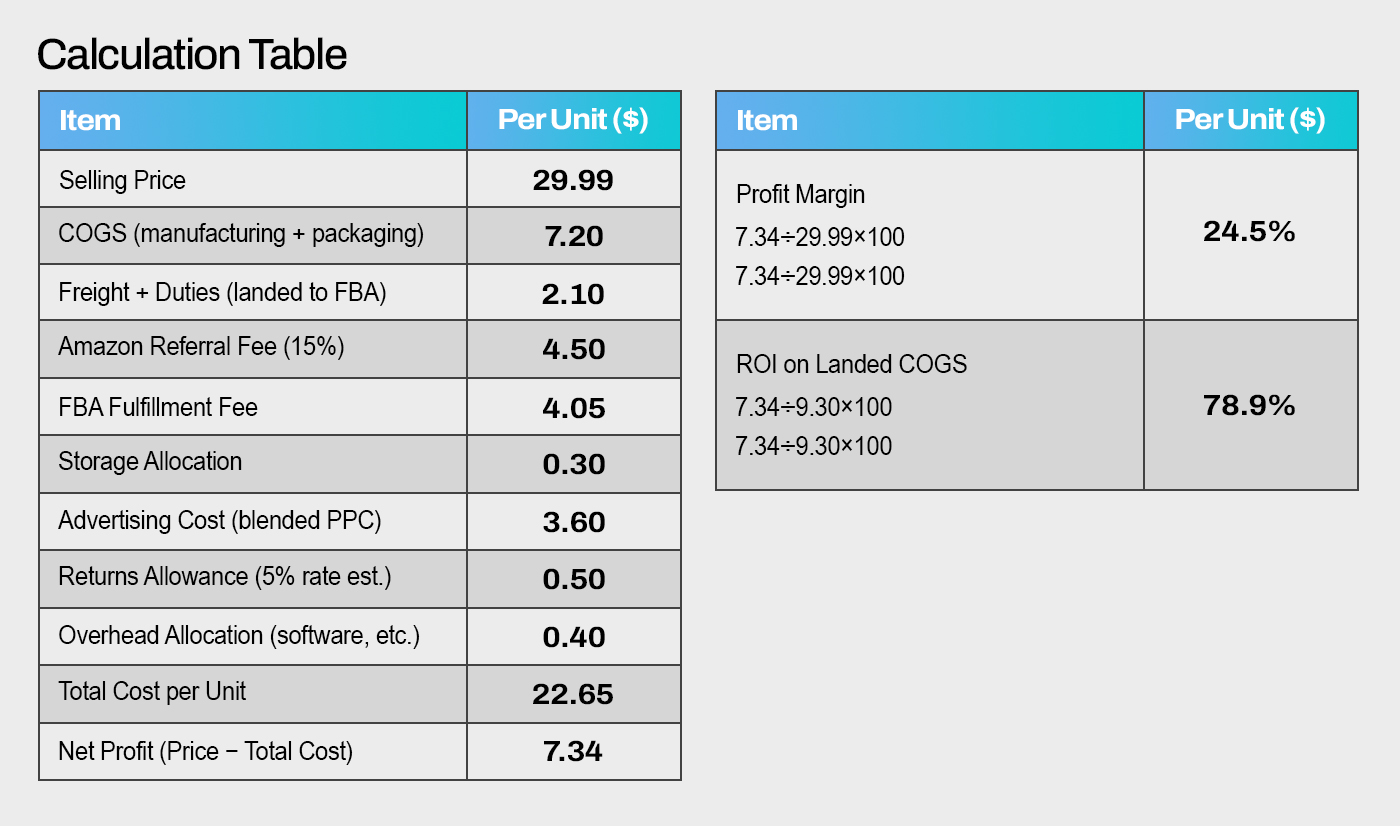
Example Calculation Table
Here’s a straightforward example for a $29.99 private-label product. What jumps out is how small changes add up dropping a size tier, improving conversion, or tightening ad targeting can move your margin by several points. Use this as a template and plug in your actual numbers.
If your output looks tighter than expected, don’t panic. Three focused fixes often turn the dial: better creative, leaner packaging, and stricter ad pruning.
Using an Amazon Profit Margin Calculator
An Amazon profit margin calculator won’t run your business for you, but it will save time and reduce guesswork. Tools from Helium 10, Jungle Scout, or SellerApp help estimate fees by size/weight and let you test scenarios like price tweaks, couponing, or changes in ad spend without rebuilding a spreadsheet every time.
Use calculators for speed; use your settlement reports for truth. The combination keeps your forecasts sharp and your plans realistic.
Why they’re useful:
- Faster what-if planning for price, coupons, and ad changes
- Built-in fee tables across categories and size tiers
- A clear view of how ACoS/TACoS shifts affect margin
What’s a Good Profit Margin on Amazon?

“Good” depends on your model and category. Private-label brands with decent positioning often land in the mid-teens to low-20s and push toward 30% net if they manage ads and returns carefully. Wholesale and resellers typically operate leaner due to pricing pressure and Buy Box dynamics.
Benchmarks are a compass, not a grade. The real test is whether your margin holds when you scale inventory and ad budgets.
Directional ranges many sellers see:
- Private Label: 15–30% net margin when ads and returns are under control
- Wholesale/Reseller: 8–15% net margin with tight buy-box strategy
- Handmade/Custom: 20–35% if production is efficient and branding is strong
- High-ticket: Lower percentage but strong dollar profit per unit
- Consumables: Thinner at first; better with repeat buyers and LTV
Factors That Affect Profit Margins on Amazon

Margins don’t live in a vacuum. Fees shift, CPCs rise, a competitor undercuts, or returns climb after Q4. You can’t control everything, but you can control how quickly you notice and how decisively you respond. The five factors below drive most of the swings—and each has a practical response.
Keep a monthly rhythm: quick review, one fix, measure impact, repeat.
1. Amazon Fees (referral, FBA, storage)
Amazon fees are predictable but sensitive to size, weight, and inventory age. One packaging change can move you into a lower tier; one slow season can push inventory into long-term storage territory. Designing for fees is one of the cleanest margin wins.
Treat packaging and inventory age as profit levers, not afterthoughts.
Practical moves:
- Redesign packaging to reduce dimensional weight and drop a tier.
- Clear aged inventory before long-term storage fees kick in.
- Check fee previews before launching variants or changing dimensions.
2. Advertising Costs (PPC and DSP)
CPCs have a way of creeping up. If conversion doesn’t keep pace, your margin shrinks silently. Structure campaigns by intent, promote proven search terms to exact match, and manage placements and dayparting so spend aligns with when buyers convert.
Look beyond ACoS—watch TACoS so you see the whole picture, not just last-click.
Practical moves:
- Bid to contribution margin; keep exact-match campaigns tight and clean.
- Use placement multipliers only where conversion justifies it; daypart low-intent hours.
- In DSP, cap frequency and prioritize high-intent retargeting with New-to-Brand insights.
3. Product Sourcing and Manufacturing Costs
A 20–40 cent reduction in COGS can transform a tight SKU. You’ll find savings in terms, freight consolidation, and packaging efficiency—not just unit price. Quality control reduces returns, which quietly protects margin as much as “cheaper” components do.
Make negotiation and QC routine. Stability here pays off everywhere else.
Practical moves:
- Get multiple supplier and forwarder quotes; negotiate EXW/FOB and consolidate where possible.
- Add in-factory QC to catch defects before they become returns.
- Rework packaging to reduce materials and size without lowering perceived value.
4. Returns and Refunds
Returns don’t just cost money—they stall momentum and dent reviews. Most return spikes point back to unclear expectations, sizing issues, or preventable quality problems. Fixing the top two reasons usually delivers a quick win.
Approach returns like a content-and-design problem first, not just a support task.
Practical moves:
- Clarify sizing, materials, and use-cases with images and bullets.
- Include quick-start guides and QR links to short setup/care videos.
- Track reasons monthly; fix the top drivers and check again in 30 days.
5. Competitive Pricing Pressure
Price wars look like action but end in thinner margins. If your listing feels interchangeable, the market forces your price down. The antidote is differentiation—bundles, better content, warranties, or a brand story customers can believe in.
Protect your floor with real value, not just defensive pricing.
Practical moves:
- Use value stacking (bundles, premium variants, extended warranties).
- Enforce MAP with distributors to keep channels aligned.
- Use dynamic pricing with margin floors rather than auto-matching the Buy Box.
Proven Strategies to Improve Profit Margins
Improving margin is rarely about one silver bullet. It’s a series of small, steady improvements that stack over time. Pick two or three levers below, implement them cleanly, and measure weekly. Over a quarter, the gains become obvious.
Your goal: calm, repeatable improvements you can scale across SKUs.
1. Reduce Operational Costs
Most brands carry quiet overhead: tools nobody uses, overlapping subscriptions, and inefficient freight. A short audit cuts the noise. Keep what moves the needle, and renegotiate the rest. You’re not cost-cutting for sport—you’re eliminating friction.
A lean operation gives you more freedom to invest in creative and inventory when it counts.
A few focused actions:
- Audit software quarterly; cancel overlaps and negotiate annual discounts.
- Compare 3PL and freight rates; consolidate shipments for better per-unit cost.
- Repack to hit lower FBA size tiers and reduce breakage.
2. Optimize Amazon Advertising (PPC/DSP)
Well-structured ads are quiet profit protectors. Split by intent, move winners to exact, and trim waste weekly. In DSP, target intentionally and cap frequency. Let the contribution margin—not hope—set your bids.
Done right, ads stop feeling like a cost center and start behaving like a growth engine.
A few focused actions:
- Promote converting search terms to exact with bids tied to contribution margin.
- Negative-match waste weekly; test Sponsored Brands video and product targeting.
- In DSP, prioritize high-intent retargeting and cap frequency to prevent overspend.
3. Increase Average Order Value (AOV)
A higher AOV stretches your ad dollars. Often, it’s easier to encourage a second item than to win a new shopper. Bundles, value packs, and smart comparison charts quietly nudge bigger carts.
Design your Storefront and A+ to guide natural add-ons—not just showcase features.
A few focused actions:
- Build complementary bundles and value packs; feature them in A+ and Storefront.
- Use modest coupons to encourage add-ons without training customers to wait for deals.
- Cross-link related ASINs in comparison charts to guide multi-item purchases.
4. Improve Listing Conversion Rate
Conversion rate is a core margin lever. Clear visuals, benefit-driven bullets, and short, helpful videos reduce friction—and your cost per sale. Treat your listing like a landing page you refine monthly.
If a shopper can’t tell why you’re the best choice in seven seconds, you’re leaving money on the table.
A few focused actions:
- Upgrade main image; add lifestyle shots and benefit-focused infographics.
- Tighten bullets around outcomes and proof; cut filler.
- Add video showing unboxing, sizing, and use-cases to preempt returns.
5. Negotiate Better Supplier Deals
Every cent off COGS compounds over time. Good negotiation blends price, terms, and quality—all three protect margin. Share your demand plan and performance to earn better deals.
This isn’t a one-off conversation; it’s a relationship you manage.
A few focused actions:
- Ask for tiered pricing tied to quarterly volume; offer partial prepayments for discounts.
- Lock raw-material prices during volatility with time-bound agreements.
- Co-develop packaging/components that reduce defects and fulfillment fees.
6. Reduce Product Returns
Returns hit your P&L and your ranking. Clear expectations and easy setup go a long way. The fastest fix is often content: the right image or line in a bullet can save dozens of returns.
The aim is fewer surprises after delivery.
A few focused actions:
- Align claims with real-world performance; avoid overpromising.
- Include a quick-start guide and QR code to a 60–90 second help video.
- Add protective packaging where damage-in-transit appears in return.
7. Optimize Inventory Management
Inventory is where cash meets fees. Overstock drives storage costs; stockouts tank rank and raise CPCs. A steady forecasting rhythm and a simple set of triggers protect both profit and momentum.
Make inventory planning a weekly habit, not a quarterly scramble.
A few focused actions:
- Use rolling 90-day forecasts with seasonality and promo overlays.
- Maintain safety stock by lead time and velocity; split shipments when it helps.
- Remove or liquidate slow movers ahead of long-term storage fee thresholds.
8. Use Amazon Brand Registry
Brand Registry unlocks tools that directly lift conversion and protect pricing. It also gives you data you can actually use—like search terms and market share signals—to focus efforts where they pay off.
If you’re private label, this is foundational.
A few focused actions:
- Build A+ Content and Brand Story to justify price and increase conversion.
- Use Brand Analytics to find high-intent keywords and category gaps.
- Run Sponsored Brands and Stores to shape journeys and boost AOV.
Scaling Profit Margins on Amazon
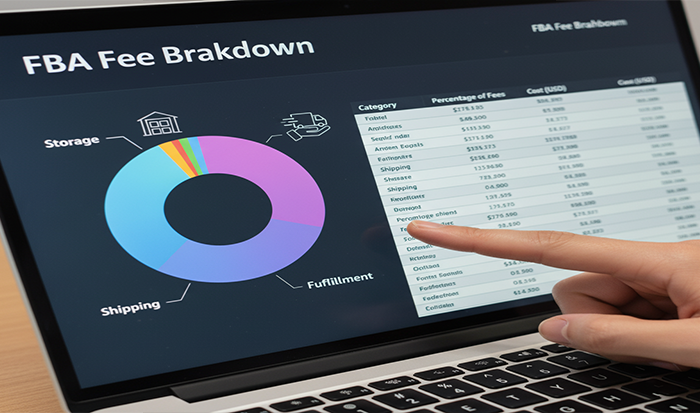
Scaling profitably is about discipline. Keep your unit economics healthy, expand where you have proof, automate the repetitive, and build a brand people remember. Growth without margin discipline just scales problems.
If you move thoughtfully, your business gets calmer as it gets bigger.
1. Expand Product Range Wisely
New SKUs should deepen your brand’s promise, not scatter it. Look for products that share suppliers, components, or audiences. Validate with data, test small, and scale what performs.
The goal is a family of products that sell each other.
A few focused actions:
- Validate with keyword demand, review gaps, and price elasticity tests.
- Start with small MOQs; scale after TACoS and conversion hit targets.
- Build product families to encourage cross-sells and higher AOV.
2. Automate Repetitive Operations
Automation protects margin at scale. Use rules, alerts, and SOPs to keep quality consistent while you focus on higher-value work—creative, product, and partnerships.
Think fewer fire drills, more predictable days.
A few focused actions:
- Automate bids and dayparting with rules tied to contribution margin and CVR.
- Set alerts for low inventory, suppressed listings, and Buy Box loss.
- Create SOPs for launches, review generation, claims, and returns.
3. Build a Strong Brand Identity
Brand strength is margin defense. When customers feel they know you—and trust you—they accept your price and come back. Your Storefront, A+ Content, and packaging should tell one clear, consistent story.
Make your value obvious and memorable.
A few focused actions:
- Clarify your value proposition and keep visuals consistent across touchpoints.
- Encourage compliant UGC; capture branded searches with Sponsored Brands.
- Use Subscribe & Save and post-purchase education to increase LTV.
4. Reinvest Profits for Sustainable Growth
Strong margins let you reinvest with confidence. Fund what’s proven before chasing the next shiny object: inventory for bestsellers, better creative, and product tweaks that reduce returns or justify higher pricing.
This is how steady growth compounds.
A few focused actions:
- Restock top performers first; expand SKUs only after core demand is covered.
- Invest in creative (video, 3D renders, comparison charts) that lifts conversion.
- Fund product improvements that reduce returns and support premium pricing.
Common Mistakes That Shrink Profit Margins
Most margin leaks are avoidable if you look for them. Build a monthly check-in with your team: find one leak, fix it, and verify the result over the next few weeks. That rhythm alone can change the trajectory of your P&L.
Here are the usual suspects—and how to stay ahead.
Frequent pitfalls and fixes:
- Ignoring net profit
- Fix: Track net margin, TACoS, and contribution margin weekly; react early.
- Underestimating ad spend
- Fix: Segment by intent; bid based on margin and CVR; prune waste weekly.
- Weak inventory planning
- Fix: Forecast by lead time and seasonality; keep safety stock; plan removals early.
- Average listing quality
- Fix: Upgrade visuals and bullets; add a helpful video; include comparison charts.
- Joining price wars
- Fix: Differentiate with bundles and brand value; use MAP where applicable.
- Not monitoring returns
- Fix: Review reason codes monthly; address top drivers via content, QC, packaging.
- Missing fee or size-tier changes
- Fix: Recalculate quarterly; simulate fees before changing packaging or variants.
- Single-supplier dependence
- Fix: Qualify backups; split volume; negotiate terms with performance clauses.
Final Thoughts

If you build your business around healthy profit margins on Amazon, decisions get clearer, cash flow gets calmer, and growth feels controlled rather than chaotic.
Do the math, fix the small leaks, and protect your price by delivering real, visible value. That’s how brands endure in competitive categories.
Pick one lever from this guide—ads, packaging, conversion—and improve it this week. Small, steady wins compound.
FAQs
1. What’s a good profit margin for Amazon sellers?
For private labels, 15–30% net margin is a healthy target once ads and returns are in control. Wholesale/reseller models often sit in the 8–15% range. The best margin is the one you can sustain as you scale.
2. Do FBA fees reduce profit margins?
Yes—especially for bulky or heavy items. Reduce packaging dimensions to drop size tiers, keep sell-through strong to avoid storage penalties, and check fee previews before launching variants.
3. How to calculate profit margin easily?
Use: Margin = (Price−AllCosts)÷Price×100
Speed the process with a reliable Amazon profit margin calculator, then validate assumptions against settlement reports.
4. How to improve profit margin without raising prices?
Trim ad waste, lift conversion with stronger creative, reduce returns with better instructions and QC, negotiate COGS and freight, and redesign packaging to lower fulfillment fees.
5. Are high-margin products always better?
Not necessarily. A high-margin slow mover ties up cash. Balance margin with sell-through, repeat purchase potential, and operational complexity.



 Back to top
Thought Leadership, Tips, and Tricks
Never miss insights into the Amazon selling space by signing up for our email list!
YOUR WINNING SOLUTIONS
Read more

Expert
strategies
delivered
to your
inbox
top industry minds to fuel
your brand’s growth.

Send request to Sellerite
Once you submit the consultation form, we’ll dive into the details and email you a tailored report within 24-48 hours.
"*" indicates required fields
*By submitting your Email Address, you are agreeing to all conditions of our Privacy Policy.
