


Why This Debate Actually Matters For Your Ad Spend
When sellers talk about Amazon PPC, one of the first questions that comes up is, “Should I let Amazon automate this, or should I run everything manually?” On the surface, it sounds like a feature choice. In reality, it’s a strategy choice that directly affects how efficiently every advertising dollar is used.
Both Amazon PPC Automatic Campaign setups and Amazon Manual PPC builds can perform well—or badly. The difference usually isn’t the toggle you click, but how you use each mode in your overall Amazon PPC Campaign Strategy.
This Sellerite report looks at where automated vs manual Amazon PPC Campaigns tend to shine, where they fall short, and how data‑driven sellers blend both rather than picking a side.

How Automatic And Manual Amazon PPC Actually Work
What automated Amazon PPC is doing behind the scenes
When you launch an Amazon PPC Automatic Campaign, you’re essentially telling Amazon: “Use my listing and your shopper data to decide which searches and placements to show my ads on.” The system:
- Scans your title, bullets, description, and backend to infer relevant terms.
- Matches your ads to customer search queries, related products, and categories.
- Uses internal signals (clicks, conversions, relevance) to adjust where and how often you appear over time.
This is what people refer to as Amazon PPC Automation: the platform deciding targeting on your behalf, within the budget and bids you set. It’s powerful for discovery, but easy to waste money with if you don’t monitor search terms and refine.
What manual campaigns give you that automation doesn’t
With Amazon Manual PPC, you control:
- The exact keywords you want to bid on (exact, phrase, broad).
- The match types and negative keywords.
- Bids at the keyword level rather than only at the campaign or ad group level.
A strong Amazon PPC Strategy usually treats manual campaigns as the “precision layer” where proven, high‑intent terms live. You pay for control with time and attention—but that control is exactly what lets you squeeze more efficient Amazon PPC performance from your budget.
Performance Patterns: Automated Amazon PPC vs Manual Campaigns
Where automatic campaigns typically perform well
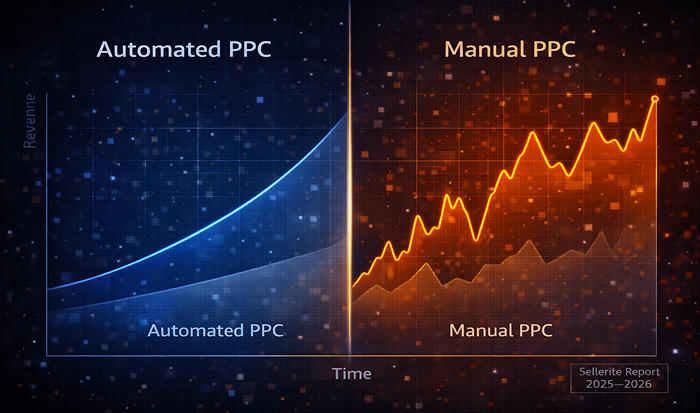
In practice, automated Amazon PPC Campaigns tend to do well in three situations:
- Early discovery – When you don’t yet know which search terms convert, automatic campaigns can surface keyword ideas and related ASINs you wouldn’t think of on your own.
- Broad catalog coverage – For large catalogs, automatic setups can ensure all SKUs have some traffic without manually building hundreds of ad groups.
- Continuous mining – Even mature accounts often run a small Amazon PPC Automatic Campaign just to keep discovering new long‑tail terms.
The trade‑off: you’ll almost always see some wasted spend on irrelevant or low‑intent queries if you rely on automation alone and don’t mine search term reports.
Where manual campaigns almost always win
Manual Amazon PPC Campaigns generally outperform automatic ones when:
- You already know your core money keywords.
- You want clear, granular control over bids and placement.
- You’re targeting specific brands, competitor ASINs, or tightly defined themes.
Well‑built manual campaigns usually deliver:
- Lower ACoS and higher ROAS on key terms over time.
- Cleaner data (it’s obvious which keyword drove which results).
- Easier strategic adjustments in your Amazon PPC Campaign Strategy—e.g., pausing only competitor terms or scaling only branded keywords.
The cost: manual campaigns require ongoing maintenance—bid changes, adding negatives, testing match types—making them more effort‑heavy than a “set and hope” automatic campaign.
At A Glance: Automated Amazon PPC vs Manual PPC
High‑level comparison
Here’s a simple way to think about Amazon PPC Automatic Vs Manual within a Sellerite‑style framework:
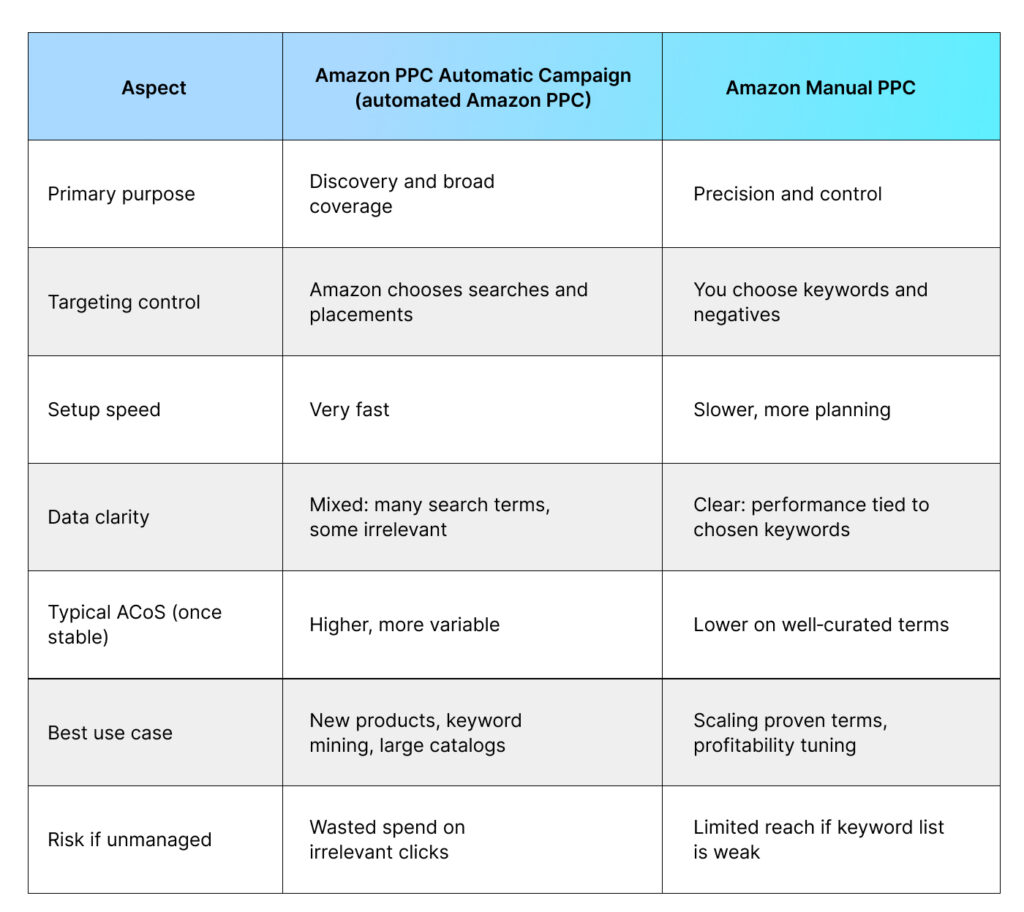
A mature Amazon PPC Strategy doesn’t treat these as either/or. It uses automatic for continuous research and manual for focused performance.
Building A Hybrid Amazon PPC Campaign Strategy
Step 1: Use automatic campaigns as your keyword radar
Start with a structured Amazon PPC Automatic Campaign for each key product or group of closely related products:
- Set a modest daily budget.
- Use a conservative base bid.
- Let it run long enough to gather meaningful search term data.
Then, treat the search term report as a research dataset:
- Pull out terms with multiple clicks and actual conversions.
- Flag irrelevant or poor‑performing queries as negatives.
- Identify unexpected high‑intent phrases you didn’t plan for.
This is how automated Amazon PPC feeds your manual build with real buyer language, not just tool‑generated keywords.
Step 2: Promote winners into manual campaigns
Next, build Amazon Manual PPC campaigns around the strongest terms discovered:
- Create separate campaigns or ad groups for branded, generic, and competitor keywords.
- Use exact match for your highest‑intent, best‑converting phrases.
- Use phrase (and carefully controlled broad) for exploration around promising themes.
In this phase, the goal of your Amazon PPC Strategy is to:
- Lower ACoS on proven terms by fine‑tuning bids.
- Protect high‑performing keywords from being diluted inside broad automatic campaigns.
- Make it easy to scale spend on what works and cut spend on what doesn’t.
Step 3: Let automation and manual play different roles long‑term
Once you’re past the initial build:
- Keep Amazon PPC Automatic Campaigns running at reduced budget as an evergreen keyword miner.
- Rely on Amazon Manual PPC for the majority of your spend and performance tuning.
- Periodically move new winners from automatic to manual, and add new negatives to automatic.
Over time, this hybrid structure turns Amazon PPC Automation into a controlled discovery engine rather than a black‑box budget sink.
Common Mistakes When Comparing Amazon PPC Automatic Vs Manual
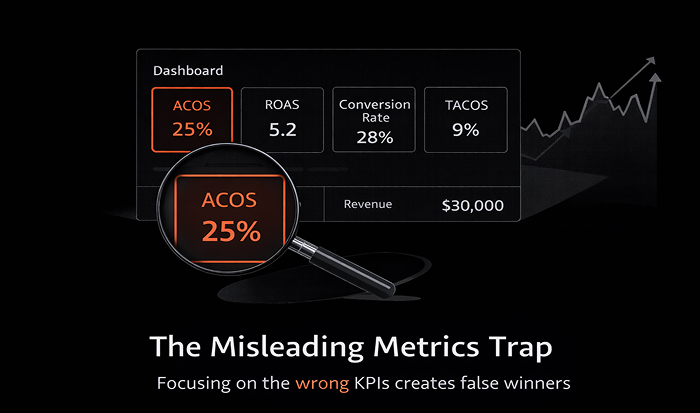
Treating automatic campaigns as “fire and forget”
One of the biggest problems in real accounts: automatic Amazon PPC Campaigns launched and then ignored for months. No search term mining, no negatives, no bid adjustments.
Result:
- Rising ACoS.
- A bloated list of irrelevant terms.
- The false conclusion that automation “doesn’t work.”
In reality, automatic campaigns need stewardship. They’re powerful at matching buyer language to your listing, but they need human guidance to stay on‑target.
Over‑segmenting manual campaigns before having data
On the other side, some sellers jump into Amazon Manual PPC with 20 ultra‑niche campaigns before they know which terms even generate impressions.
Result:
- Thin data spread across too many campaigns.
- Difficulty making confident bid decisions.
- Unclear picture of what’s genuinely moving the needle.
Early on, it’s usually better to build a few well‑structured manual campaigns informed by automatic data than to attempt a hyper‑granular structure based purely on guesswork.
