

Introduction — 2025–26 is a “stress test” era for Amazon sellers
Inflation pressure and supply chain volatility didn’t disappear in 2025–26—they just changed shape, forcing sellers to operate with tighter margins, faster repricing, and more resilient inventory planning.
At the same time, the macro backdrop is still supportive for e-commerce overall: global e-commerce sales were forecast at $6.42T in 2025 and $6.88T in 2026, with 2026 projected to grow 7.2% year over year.
This report connects those realities to Amazon Marketplace Trends, showing how Amazon’s logistics redesign, advertising growth, and seller-service economics shape the Amazon Seller Market Outlook and the broader Global E-commerce Amazon Impact.

Methodology — How this analysis was built (and what “performance” means here)
Because inflation and supply chain shifts impact different categories in different ways, performance here is analyzed through a “seller reality” lens: demand stability, fulfillment speed, cost-to-serve, and conversion drivers.
The report uses publicly available indicators from Amazon’s logistics/operations commentary and global e-commerce forecast benchmarks to anchor trend direction.
Data inputs used
- Amazon’s explanation of “regionalization” (restructuring the U.S. fulfillment network into eight regions) as a supply chain efficiency lever.
- Global e-commerce forecast data (2025–2028) to frame the Amazon E-commerce Forecast in context.
- Third-party seller services sales trend, including 2025 Q3 $42.49B (+12% YoY) and 2024 $156.15B (+11% vs 2023) as a proxy for marketplace vitality.
- Amazon advertising services revenue, including reporting that ad sales reached $17.7B in Q3 2025 (+24% YoY), as a proxy for competition intensity and paid visibility reliance.
Inflation reality check — why it hits Amazon sellers differently

Inflation is not just “higher costs”; it changes shopper behavior, basket composition, and the threshold where customers stop seeing a product as a good deal. In Amazon and other marketplaces, inflation pressure often manifests as increased price sensitivity, more coupon-driven decision-making, and rising expectations that delivery and returns remain frictionless even when costs go up.
These teams, building more meaningful relationships with their clients, would not have been possible without the support of such amazingly talented people.
This creates a double-edged result: sellers with solid cost control and supply reliability tend to gain share, while sellers with brittle sourcing or slow replenishment lose ranking and momentum.
What shoppers do during inflation (seller-facing signals)
- They compare more listings before purchase, which increases the value of strong review ratings and clear value props.
- They lean into deals and visible promos (coupon badges, strikethrough pricing), which compresses margins for undifferentiated products.
- They reward reliability (in-stock + fast shipping), which turns supply chain execution into a conversion lever.
Amazon Supply Chain Trends — regionalization changes the game
One of the most important Amazon Supply Chain Trends in this era is regionalization: Amazon describes restructuring its U.S. fulfillment network into eight largely self-sufficient regional networks while retaining national coverage.
Amazon reports that after the switch, the share of customer orders fulfilled entirely within their region rose from 62% to 76%, improving efficiency and delivery speed as more items travel shorter distances.
This matters for sellers because inbound placement, inventory positioning, and in-stock depth can directly influence delivery promises—and delivery promises can influence conversion.
Why regionalization matters during supply shocks
- Shorter travel distances reduce fulfillment cost-to-serve and increase speed, helping Amazon defend customer experience even when carrier networks are stressed.
- More local inventory fulfillment can reduce late deliveries, which protects seller metrics in volatile periods.
- Inventory availability closer to the customer can become a competitive edge, especially for replenishable products where shoppers expect quick turnaround.
Marketplace monetization — ads grow fastest when competition tightens

When costs rise and organic ranking becomes harder to defend (stockouts, price changes, review velocity), sellers often spend more on ads to stabilize sales.
That pattern shows up in Amazon’s ad business: advertising revenue was reported at $17.7B in Q3 2025, up 24% year over year.
This doesn’t mean ads “replace” organic performance, but it does mean the marketplace is increasingly pay-to-compete in high-intent keywords—especially during uncertain macro cycles.
What rising ad revenue signals for sellers
- CPC pressure tends to rise in crowded categories as more brands buy their way back to page one.
- Conversion rate becomes the real ad efficiency lever (better PDP = lower wasted spend).
- Budget planning must account for volatility: ads are often a shock absorber when supply chain disruptions break organic momentum.
Amazon Seller Market Outlook — the marketplace is still expanding
Despite inflation and supply constraints, third-party seller services remain a large and growing engine inside Amazon’s business model.
Marketplace Pulse reports third-party seller services sales of $42.49B in 2025 Q3 (+12% YoY), and growth from $140.05B in 2023 to $156.15B in 2024 (+11%), indicating sustained marketplace activity.
For sellers, that’s an important point: even in turbulent macro conditions, Amazon’s marketplace model continues to scale because consumers keep shopping online and brands keep competing for attention.
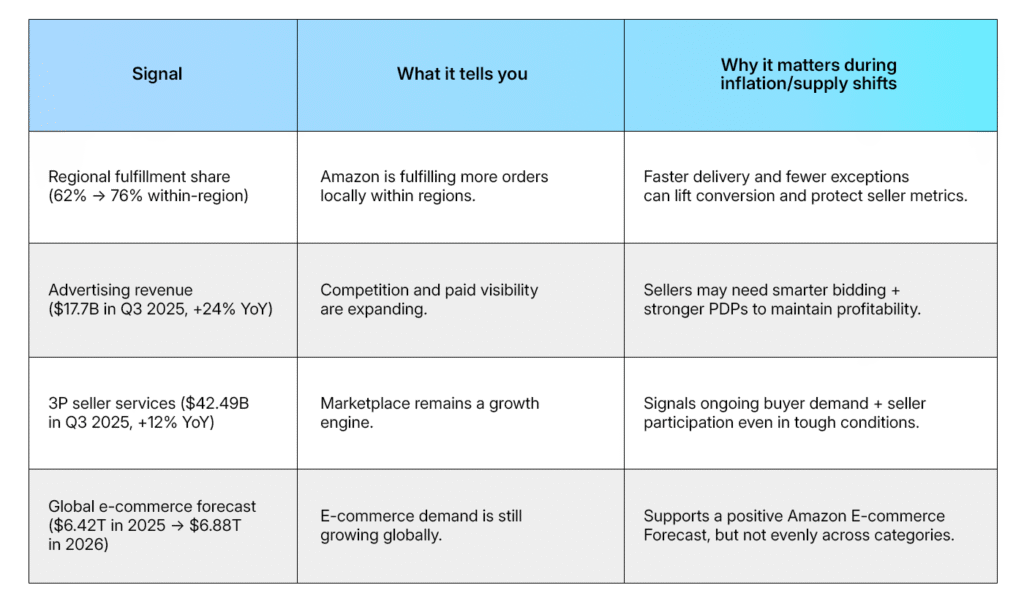
Key signals to watch (inflation + supply chain edition)
These metrics connect Amazon Marketplace Trends to day-to-day seller decisions, especially when inflation and supply shifts create volatility.
Global E-commerce Amazon Impact — what the macro forecast implies for Amazon
Global e-commerce is expected to grow from $6.42T in 2025 to $6.88T in 2026, and Shopify cites an EMARKETER forecast that extends to $7.89T by 2028.
Even with inflation slowing discretionary spending in some markets, the forecast suggests shoppers continue to shift purchases online, which typically benefits platforms that win on convenience, delivery speed, and selection—Amazon’s core strengths.
The implication is clear for sellers: the pie is still growing, but competition for profitable share becomes sharper because ads, fulfillment performance, and price discipline matter more.
What sellers should do next — practical moves that match 2025–26 conditions
The most consistent winners during inflation and supply chain shifts are sellers who treat operations and marketing as one system.
Below are seller-friendly actions that align with the trends above, without assuming perfect conditions.
Bullet playbook — resilient seller actions
- Build inventory buffers for hero SKUs (not everything), because stockouts can cascade into lost rank and higher ad costs.
- Price with “margin ranges,” not one fixed margin, so promos don’t accidentally turn into losses when costs fluctuate.
- Tighten PDP conversion (images, clarity, proof) so rising CPC doesn’t destroy unit economics.
- Treat delivery speed as part of the product: Amazon’s regionalization push rewards inventory that can be fulfilled locally and quickly.
- Monitor your category’s ad share-of-voice, because Amazon’s ad business growth signals a more competitive auction environment.
Closing insight — Amazon is built for turbulence, but sellers must adapt
Amazon’s logistics redesign (regionalization into eight networks) and improving within-region fulfillment share (62% to 76%) show how strongly Amazon is optimizing for speed and cost control—exactly what matters when supply chains wobble.
With the ad business growing to $17.7B in Q3 2025, up 24% year over year,” the increase of the ad business indicates “that the sellers are relying even more upon paid visibility, and as such, the efficiency of conversion and differentiation is no longer negotiable.
Amazon E-commerce Forecast: There is a positive outlook for the total Amazon E-commerce Forecast given that global e-commerce is forecast to grow from $6.42T (2025) to $6.88T (2026), although it is ultimately the sellers that adapt to resilience—not normalization—through inventory discipline, fulfillment readiness, and ad economics that will succeed.
