


Introduction — why pricing feels harder on Amazon than anywhere else
If pricing on Amazon feels like a moving target, that’s because it is. One competitor changes price, a repricer reacts, the Buy Box rotates, and suddenly what looked “competitive” yesterday is overpriced today.
This is exactly why an Amazon Competitive Pricing Analysis isn’t a one-time spreadsheet exercise—it’s an always-on system that helps sellers understand where they’re winning, where they’re bleeding margin, and where Amazon Marketplace Competition is quietly intensifying.
In 2025–26, pricing pressure is also more category-specific than most sellers realize. Electronics behaves like a stock market (fast volatility), apparel behaves like a seasonal calendar (peaks and dips), and Home & Kitchen often rewards smart bundles more than raw discounting.
This report breaks down competitor-driven pricing dynamics by major category, how Amazon Price Wars typically start, and what sellers can do to track and respond without racing to the bottom.

Methodology — how this pricing analysis was structured
This research-style report uses a practical seller lens rather than a purely academic one. Instead of trying to “guess” Amazon’s internal pricing rules, it focuses on observable marketplace behaviors: Buy Box competition patterns, landed price positioning, and repricer-driven shifts that influence visibility and conversion.
Primary inputs used:
- Category-level pricing observations and volatility patterns (electronics vs apparel vs home) from Amazon-focused pricing research.
- Buy Box competitiveness metrics emphasizing “landed price” (item + shipping) as a core comparison point.
- Repricing strategy frameworks that explain how sellers use automation for competitor price tracking Amazon and rapid adjustments.
From these inputs, the analysis is organized into three layers:
- Category pricing behavior (how prices move and why).
- Competitive triggers (what starts price wars).
- Seller response systems (how to track, test, and protect margin).
The pricing mechanics that drive competition on Amazon
Before looking at categories, it helps to understand the basic “rules of engagement” behind Amazon Competitor Analysis. Most price battles are not driven by the lowest product cost; they’re driven by Buy Box logic and speed of reaction.
Landed price is the real battlefield
Multiple Buy Box resources emphasize that Amazon evaluates “landed price”—the total the customer pays including shipping (and sometimes VAT)—not only the item price.
That’s why two sellers with the same product price can compete very differently if one charges shipping or has slower delivery. In practice, sellers who ignore landed price often think they’re competitive while the algorithm (and the customer) disagrees.
Re-pricers compress reaction time
Repricing tools and strategies are widely positioned as necessary in competitive listings because price changes happen continuously and sellers need real-time reactions.
But automation also accelerates Amazon Price Wars because many sellers run similar “match/beat competitor” rules. When several repricers are chasing each other, the downward spiral can happen quickly—especially in commoditized listings.
Category-by-category competitive pricing behavior
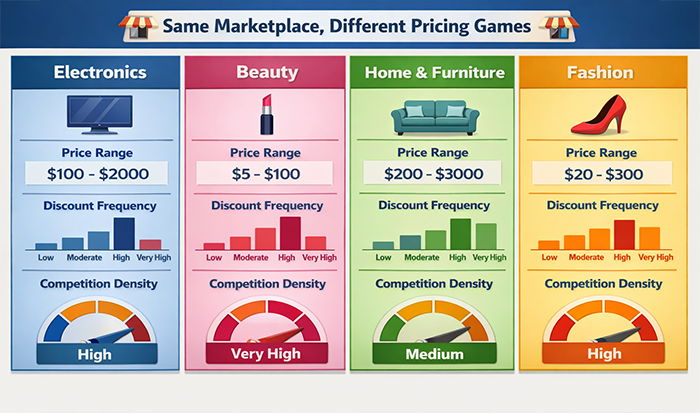
Amazon Marketplace Competition is not uniform. Each category has its own “pricing physics,” and understanding those patterns is what separates strategic pricing from emotional discounting.
Electronics — rapid volatility and constant undercutting
Electronics is often described as one of the most dynamic pricing categories on Amazon, where real-time adjustments are essential.
One cited analysis notes electronics and appliances have seen average product price drops as high as 50% over the past two years, which shows how fast value erodes when models age and competitors pile in.
In this category, sellers frequently use repricers to protect Buy Box share, and the same source claims automated repricing can lift Buy Box win rate versus manual pricing.
Seller reality check for electronics:
- Shoppers are comparison-heavy, and substitutes are everywhere.
- Old inventory gets punished quickly (model refresh cycles).
- The lowest price doesn’t always win, but being overpriced almost always loses.
Clothing, Shoes & Jewelry — seasonal cycles, not constant declines
Pricing in apparel behaves differently: rather than always trending downward, it tends to fluctuate around seasons, trends, and promotional windows.
That means aggressive discounting too early can destroy peak-season profit, while holding price too long can leave you with leftover inventory after demand cools.
Seller reality check for apparel:
- Timing matters as much as the number.
- Variation (sizes/colors) creates uneven competition within one ASIN family.
- Returns and fit expectations often force sellers to bake extra margin buffer.
Home & Kitchen — bundles, perception, and “value stacking”
Home & Kitchen often rewards sellers who avoid direct 1:1 price comparisons by using bundles, kits, or multi-packs. One analysis claims bundled products can achieve 25–35% higher profit margins compared to selling single items, even when offering an overall discount.
This category also responds well to psychological pricing; the same source references charm-pricing effects (like pricing at 19.99) influencing conversion.
Seller reality check for Home & Kitchen:
- Bundles reduce direct comparability (fewer identical offers).
- Branding and images can carry more weight than tiny price differences.
- Operational reliability (in-stock, Prime-ready) often beats “cheapest.”
Health & Personal Care — compliance limits the price war (sometimes)
Health and personal care listings can be competitive, but they’re often constrained by brand gating, compliance, and customer trust signals. This doesn’t eliminate price competition; it changes what drives conversion: reviews, authenticity, and perceived safety can justify a slightly higher price.
Seller reality check for Health & Personal Care:
- Trust is a pricing lever.
- Substitutes exist, but “safe + reliable” wins repeat purchases.
- Compliance issues can remove competitors, changing the price floor overnight.
Competitive pricing patterns by category (2025–26 seller lens)
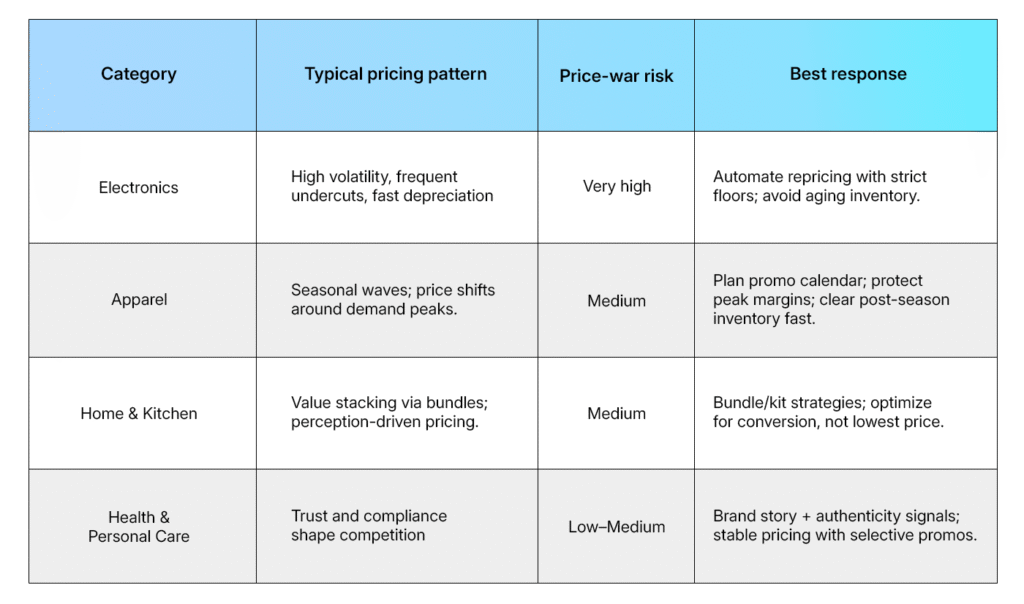
This table summarizes what an Amazon Competitive Pricing Analysis typically reveals when broken down by category, and what a smart response looks like.
Where Amazon Price Wars actually start (and how they spread)
Price wars usually begin with one of three triggers: a new competitor enters with aggressive goals, a repricer rule is too simplistic, or inventory pressure forces sellers to liquidate.
The three common triggers
- “Beat lowest by $0.01” repricing with no floor, which invites a spiral.
- Overstock or cash-flow panic, where sellers discount to exit inventory quickly.
- Buy Box obsession, where sellers overpay (in margin) to win visibility.
Once triggered, wars spread fast because repricers mirror each other. Tools that track competitors and automate responses make the marketplace more efficient—but also more unforgiving.
Competitor Price Tracking Amazon — what to track weekly (not daily panic)
A seller-friendly competitor price tracking Amazon system should focus on signals that predict profit, not just rank.
Bullet list — the pricing metrics that matter
- Landed price gap vs Buy Box winner (how far above/below you are).
- Buy Box share trend (how often you own it, not just if you ever win).
- Price change frequency on the listing (proxy for repricer density).
- Stock status of top 3 competitors (out-of-stock moments are margin opportunities).
- Promotion pressure (coupons/discount badges) and how often they appear.
Practical framework — a safer Buy Box price strategy without margin collapse
A good Buy Box Price Strategy acknowledges a hard truth: you can’t control competitor behavior, but you can control your rules, your differentiation, and your willingness to walk away.
Five steps sellers can apply immediately
- Set a real price floor based on full costs (fees, shipping, returns buffer).
- Reprice to a target range, not always to the lowest price.
- Use bundles/multipacks where possible to reduce direct comparability.
- Segment strategy by SKU type: commodity SKUs protect share; unique SKUs protect margin.
- Review repricer rules weekly; “set and forget” is how price wars drain you.
Closing insight — competitive pricing is a system, not a mood
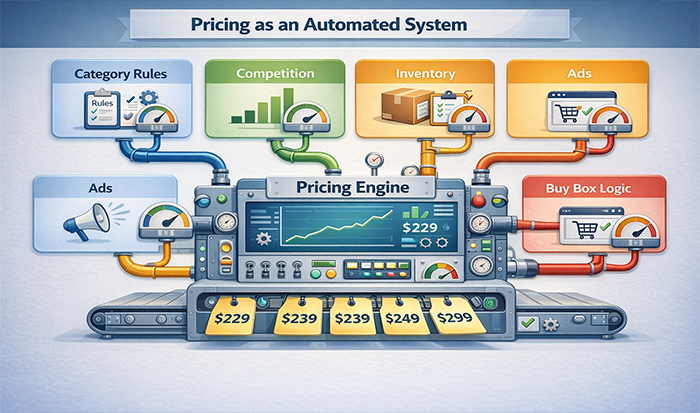
The biggest shift in 2025–26 is that Amazon Competitor Analysis and Amazon Competitive Pricing Analysis have become operational disciplines, not occasional tasks. Electronics may demand real-time repricing because volatility is built into the category, while Home & Kitchen often rewards smarter packaging and value stacking over raw discounting.
And across all categories, landed price competitiveness remains the foundation—because Amazon compares what the customer actually pays, not what you wish they would notice.
If you build a simple tracking dashboard, set non-negotiable price floors, and choose differentiation where price wars are inevitable, you stop reacting to Amazon Marketplace Competition—and start using it to your advantage.
